Identifying martyrs’ remains requires whole political system’s efforts: Deputy PM

Deputy Prime Minister Pham Thi Thanh Tra inspected the practical implementation of DNA identification technology at the Centre for DNA Identification under the Institute of Biology of the Vietnam Academy of Science and Technology, and the Military Institute of Forensic Medicine under the Military Medical Department of the Ministry of National Defence on September 14.

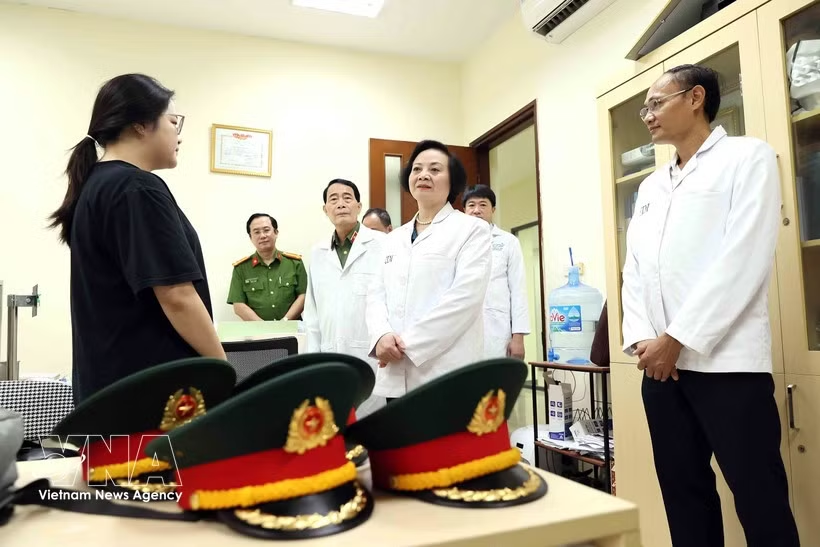
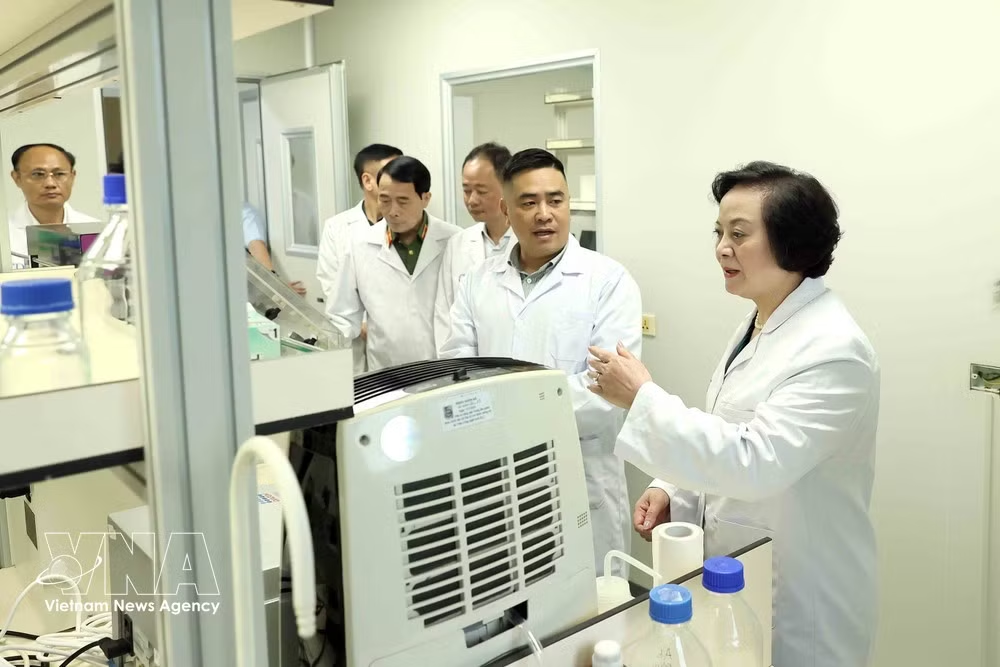
Deputy Prime Minister Pham Thi Thanh Tra encourages the staff of the Centre for DNA Identification. (Photo: VNA)

Hanoi (VNA) – Identifying the remains of Vietnam's war martyrs is an incredibly challenging task that demands perseverance, resources, and the united efforts of the entire political system, according to Secretary of the Party Central Committee and Deputy Prime Minister Pham Thi Thanh Tra.

Tra, who is head of the National Steering Committee for the Search, Collection and Identification of Martyrs’ Remains (Steering Committee 515), inspected the practical implementation of DNA identification technology at the Centre for DNA Identification under the Institute of Biology of the Vietnam Academy of Science and Technology, and the Military Institute of Forensic Medicine under the Military Medical Department of the Ministry of National Defence on September 14.

The inspection focused on the deployment of DNA testing technology to improve the effectiveness of identifying remains.

Mastering new technologies, expanding DNA testing capacity

At the Centre for DNA Identification, Tra acknowledged the efforts of officials and scientists at the Institute of Biology in mastering new technologies, while asking the units to continue addressing challenges related to human resources, data and implementation arrangements to meet growing demands.
tra-1879.jpg
Deputy Prime Minister Pham Thi Thanh Tra visits the Centre for DNA Identification. (Photo: VNA)

According to a report by the Institute of Biology, the DNA Testing Centre has mastered two groups of technologies: conventional mitochondrial DNA testing and next-generation sequencing combined with single nucleotide polymorphism analysis (NGS-SNP).

To date, the centre has received and stored 37,610 samples of martyrs’ remains from eight provinces and cities under assignments by Steering Committee 515. These include localities with particularly large numbers of samples, such as Tay Ninh with 15,674, Ho Chi Minh City with 7,113, Dong Nai with 4,618, Hue with 3,918 and Dong Thap with 3,216.

Since April, 10 sets of remains of fallen soldiers have been identified through DNA testing and returned to their families, in coordination with the Ministry of Public Security. This is a notable achievement, as the units have been testing new technologies while simultaneously applying them in practice.

Alongside the initial results, the Deputy PM highlighted three issues requiring focused attention: human resources, technology and data.

The official asked the Institute of Biology to urgently prepare for new technology and organise training for personnel who will operate it as soon as possible.

Reporting to the Deputy PM, President of the Vietnam Academy of Science and Technology Prof. Dr Tran Hong Thai said the Centre for DNA Identification currently has a core team of specialised personnel, while the academy has more than 200 biological science staff who can be mobilised when necessary. To meet the requirements of large-scale implementation, the top priority is to build an interconnected and synchronised DNA database to ensure rapid and accurate comparisons.

Removing bottlenecks in human resources, data to improve matching efficiency

According to a report by the Military Medical Department, during 2013-2025, the Military Institute of Forensic Medicine received nearly 5,000 samples of martyrs’ remains and tested nearly 2,000 of them, along with more than 1,800 samples from relatives, identifying 558 martyrs.

By September 11, 2026, during the 500-day campaign, the institute had collected 35,776 samples of martyrs’ remains from 16 out of 17 provinces and cities.

Regarding DNA testing, from March 15 to September 11, the institute extracted DNA from 243 samples of martyrs’ remains, obtaining 48 mitochondrial DNA sequences.

Its facilities have also been renovated and upgraded, with additional equipment installed and testing procedures optimised, raising the capacity of its DNA testing line from 400 to 800 samples per year.

Improvements have also been seen in human resources training, preservation and storage capacity.

Tra commended efforts by the department and the institute in identifying the remains of martyrs.

She called for continued reviews of practical experience and further standardisation of the procedures to develop common regulations, ensuring consistent, rigorous and professional implementation.

According to the Deputy PM, identifying the remains of war martyrs is not merely the fulfilment of a political task but also work carried out with a deep sense of responsibility and from the heart.

Alongside the achievements, however, she said the identification still faces several bottlenecks that need to be addressed. The first is human resources for DNA identification, which she described as one of the biggest challenges facing DNA-based identification of martyrs’ remains.

The second bottleneck is the data system. The Deputy PM called for a synchronised system capable of matching and comparing data with existing sources, avoiding a situation in which individual units develop separate systems that cannot be connected, synchronised or jointly exploited.

She also asked relevant agencies to study and finalise regulations, technical standards and cost norms for the collection, preservation, storage and identification of martyrs’ remains./.
VNA

See more

Doan Duc Hao, Director of the Department of Youth Affairs and Gender Equality under the Ministry of Home Affairs, speaks at a working session with a 16-member delegation of young Korean civil servants in Hanoi on September 14, 2026. (Photo: VNA)

Vietnam, RoK promote cooperation, youth’s role

Le Thi Viet Lam, Deputy Director of the Department of International Cooperation under the Ministry of Science and Technology, said Vietnam wishes to continue building an ecosystem that connects the State, research institutes, universities and businesses, enabling them to share resources and create value. This is also an area in which Vietnam is interested in learning from Korean experience.

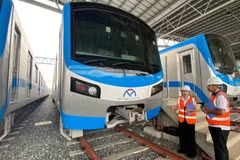
To operate Metro Line No. 1 (Ben Thanh–Suoi Tien), Ho Chi Minh City Urban Railway Company No. 1 (HURC1) currently employs 700 people to keep nearly 200 train trips running each day. (Photo: nhandan.vn)

Ho Chi Minh City addresses manpower shortage for urban railway development

Under the human resources training scheme serving the development of the urban railway network approved by the municipal People’s Committee, the city will need around 70,000 workers by 2030 to support investment in and development of its metro system, including project management personnel, operations and maintenance staff, engineers, technical workers, consultants and designers.

VBUK Vice Chairman Trinh Ngoc Cuong speaks at the ceremony to launch a publication marking VBUK's 20th anniversary,(Photo: VNA)

Resolution No.23: Vietnamese community in UK looks toward homeland

Politburo Resolution No. 23 calls for stronger links among overseas Vietnamese through sustainable networks connecting experts, intellectuals, entrepreneurs and young people. Each entrepreneur and professional can thus become a bridge, ensuring that despite being half a world away, the Vietnamese community remains closely connected to the homeland.

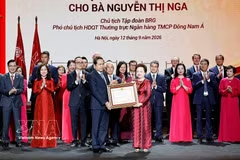
NA President Tran Thanh Man presents the Labour Hero title to BRG Group Chairwoman and Standing Vice Chairwoman of SeABank’s Board of Directors Nguyen Thi Nga (Photo: VNA)

NA President attends ceremony honouring BRG Group, SeABank

As Vietnam enters a new development phase, with a target of double-digit growth and strategic milestones in 2030 and 2045, National Assembly President Tran Thanh Man called on BRG Group and SeABank to build on their established foundations and effectively implement major Party, National Assembly and Government policies on socio-economic development.

Martyrs’ remains are found in Quang Tri province. (Photo: VNA)

Search area expanded to recover more martyrs’ remains in Quang Tri

The continued recovery of martyrs’ remains provides valuable information and further evidence of those who fought and sacrificed their lives for national independence and freedom. It also encourages search teams to persist in locating fallen soldiers still lying on former battlefields, contributing to the effective implementation of the 500-day campaign and reflecting Vietnam’s long-standing tradition of gratitude.

General Secretary of the Communist Party of Vietnam Central Committee and President To Lam (first, left) and French President Emmanuel Macron (first, right) witness the exchange of bilateral cooperation documents and agreements on September 10, 2026 during the former's official visit to France. (Illustrative photo: VNA)

Intellectual cooperation deepens Vietnam–France relations: expert

Dr Frederic Roustan highlighted the importance of scientific and intellectual cooperation, saying that despite ups and downs in bilateral diplomatic, political and economic relations over the decades, connections between French and Vietnamese scientists and intellectuals have been maintained, contributing to exchanges between the two countries.

Illustrative Image (Photo: VNA)

Ministry proposes seven-day 2027 Lunar New Year holiday

Under the Ministry of Home Affairs' proposal, civil servants and public employees in Vietnam would receive five statutory days off, including two days before and three days after the Lunar New Year. As two of those days fall on the weekend, they would receive two additional compensatory days off, bringing the total holiday to seven consecutive days.

The September 11 launch of the national programme for 2026–2030 on strengthening child protection and preventing and minimising illegal child labour (Photo: VNA)

National programme aims to strengthen child protection, reduce illegal child labour

The programme aims to ensure all children live in safe and healthy environments, minimise child abuse nationwide, and create opportunities for children suffering violence, sexual abuse or illegal child labour, those at risk of violence, exploitation or neglect, as well as the ones with other special circumstances, to integrate into society and develop comprehensively.

Harnessing overseas Vietnamese resources in new era

Harnessing overseas Vietnamese resources in new era

After more than two decades of implementing Politburo Resolution No. 36-NQ/TW, dated March 26, 2004, on overseas Vietnamese affairs, the Politburo adopted Resolution No. 23-NQ/TW on the same matter on August 2, 2026. The resolution ushers in a new phase with a more comprehensive approach, focusing on creating mechanisms to unlock and make effective use of the vast potential of the Vietnamese community abroad.

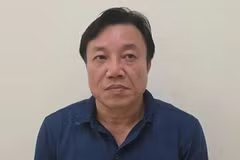
Nguyen Huy Ngoc, Vice Chairman of the Phu Tho provincial People’s Committee, former Director of the provincial Department of Health and the provincial General Hospital (Photo: the Ministry of Public Security)

Phu Tho province's official prosecuted for bribery

According to the Ministry of Public Security, its Police Investigation Agency for Corruption, Economic and Smuggling Crimes (C03) is investigating a case involving violations of accounting regulations causing serious consequences, smuggling and receiving bribes at Viet My Medical Investment JSC and related agencies and localities.