Going global: The competition challenge for "Made in Vietnam" cars

The growing number of exporters shows that Vietnam’s automobile industry is entering a new stage of development. However, international markets also present major challenges related to localisation, supporting industries, technological capabilities, human resources and country-specific technical standards.

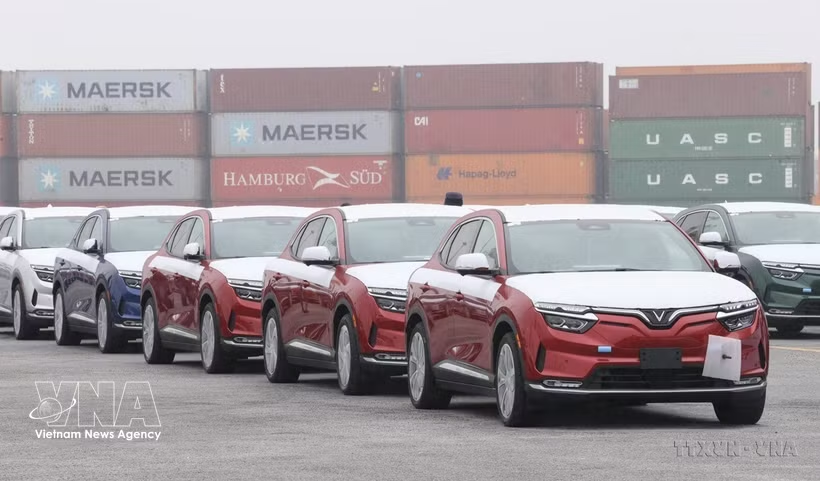
VinFast electric cars are gathered at Hai Phong Port, ready to be loaded onto a ship for export. (Photo: VNA)

Hanoi (VNA) – From mainly producing and assembling vehicles for the domestic market, a growing number of Vietnamese automobile manufacturers are stepping up exports, expanding into overseas markets and gradually strengthening their position in global value chains.

Testing made-in-Vietnam cars

For many years, Vietnam’s automobile industry largely developed around production and assembly to meet domestic demand. A limited market size, underdeveloped supporting industries and low localisation rates meant that exports of completely built-up (CBU) vehicles had yet to become a major growth driver for the sector.

However, the picture has changed markedly in recent years. Major brands such as THACO, Hyundai Thanh Cong, VinFast and KIM LONG MOTOR are increasingly exporting CBU vehicles and components to international markets.

The move not only addresses market expansion but also serves as a rigorous test of technological capacity, product quality and the ability to participate in global supply chains.

Most recently, on August 14, 2026, Hyundai Thanh Cong exported Hyundai vehicles manufactured in Ninh Binh to Mexico and Australia. The move marked a notable expansion, as vehicles made in Vietnam entered markets in North America and Oceania for the first time, alongside Asian markets previously reached by the company.

Under its plan, Hyundai Thanh Cong expects to export 15,280 units in 2026, including 10,160 finished vehicles and 5,120 component kits. Over the next five years, the company aims to expand into the Middle East, Africa, Central America, South America and Russia, with total exports projected at 187,000 units. From 2030, it aims to become a global export hub with annual output exceeding 60,000 vehicles.

Le Ngoc Duc, Vice Chairman of Thanh Cong Group and General Director of Hyundai Thanh Cong Vietnam, said the process began with building a solid manufacturing foundation, mastering technology and quality standards before gradually expanding into international markets. Meeting the stringent requirements of leading markets, he added, demonstrates the reputation, manufacturing capacity, technology and quality of Vietnam’s automobile production centres in the international market.

For THACO, exports are built on a relatively comprehensive manufacturing ecosystem in Chu Lai. The company exports not only buses, trucks and other automotive products but also components, spare parts and mechanical products. In 2026, it targets revenue of more than 65.5 trillion VND (2.52 billion USD), including over 30.5 million USD from exports. It also plans to step up export sales, develop products tailored to individual markets and expand its THACO-branded vehicle lines.

In electric vehicles, besides leading domestic EV sales, VinFast exported its 38th shipment in July, with more than 5,000 vehicles to European and other markets, less than four years after its first overseas batch of 999 vehicles.

In the commercial vehicle segment, KIM LONG MOTOR made its mark by shipping its first batch of 10 diesel and all-electric buses to Thailand in March 2026, under a contract for 300 vehicles scheduled for delivery during the year. Notably, some exported models have achieved localisation rates of more than 80%, reflecting the sector’s growing capacity to generate domestic added value.
Exporting CBU vehicles is just the beginning


The growing number of exporters shows that Vietnam’s automobile industry is entering a new stage of development. However, international markets also present major challenges related to localisation, supporting industries, technological capabilities, human resources and country-specific technical standards.

Exporting vehicles to demanding markets is not simply a question of output. It is a measure of a company’s ability to control quality, manage supply chains and meet stringent environmental and safety standards.

A representative of Hyundai Thanh Cong said its international expansion has been carried out in stages, beginning with trial markets such as the Republic of Korea, Peru, the Philippines, Thailand, Malaysia, Myanmar and Kazakhstan before moving into markets with higher regulatory standards such as Mexico and Australia. This process has helped the company strengthen its organisational capabilities and optimise products to meet diverse requirements.

Recognising this, leading companies such as THACO, Hyundai Thanh Cong, VinFast and KIM LONG MOTOR share a strategy of expanding beyond vehicle production into R&D, core technologies and supply chains.

According to industry experts, Vietnam’s automobile sector is shifting strongly from a mindset of “producing for the domestic market” to “producing to compete globally”. If the question in the past was whether Vietnam could assemble automobiles, the challenge has now moved to a new level: Can made-in-Vietnam cars compete in global markets, and how much value can be retained domestically? The answer will determine Vietnam’s position on the regional and global automobile manufacturing and export map./.
VNA

See more

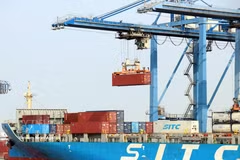
Ports in Ho Chi Minh City are always bustling with ships loading and unloading cargo (Photo: VNA)

Ho Chi Minh City helps businesses effectively leverage FTAs

Ho Chi Minh City will implement a range of tasks and solutions to enhance business competitiveness, promote sustainable exports, expand markets, and enable local businesses to engage more deeply in global value and supply chains. The move is also expected to contribute to the development of Ho Chi Minh City as a regional hub for trade, logistics and international economic integration.

Illustrative image (Photo: VNA)

Livestreaming helps Vietnamese goods break past local markets

Once a product goes digital, it can transcend geography entirely. Consumers no longer need to visit a store or craft village in person to learn where a product comes from, how it's made, or whether it's worth buying. They can do all of that, and decide to buy, from a screen.

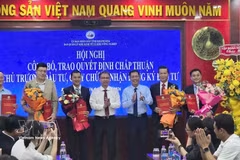
The south-central province of Khanh Hoa on September 16 announces investment approval decisions and investment registration certificates for five projects worth nearly 10.82 trillion VND (415.96 million USD). (Photo: VNA)

Khanh Hoa approves industrial projects with investment of 10.8 trillion VND

The south-central province of Khanh Hoa on September 16 announced investment approval decisions and investment registration certificates for five projects worth nearly 10.82 trillion VND (415.96 million USD), including three industrial park infrastructure projects and two foreign-invested ones.

A view of a ceremony to kick off the Northern Industry and Trade Fair - Bac Ninh 2026 on September 16, 2026 (Photo: VNA)

Northern industry-trade fair 2026 opens in Bac Ninh

The Northern Industry and Trade Fair - Bac Ninh 2026 features more than 222 booths with over 200 participating organisations and businesses, showcasing and introducing industrial and trade products from provinces and cities in the region, One Commune One Product (OCOP) items, typical rural industrial products, traditional craft village products, signature products of businesses, as well as regional trade, tourism and food products.

Delegates share information during the livestream programme. (Photo: VNA)

Bac Ninh promotes agricultural products through livestream

More than 300 products from Bac Ninh, Hanoi, Hung Yen, Son La, Thai Nguyen and Phu Tho were showcased during a livestream session held by the Bac Ninh Farmers' Union, ranging from traditional foods, agricultural products and medicinal herbs to natural products, OCOP goods, handicrafts and craft village products.

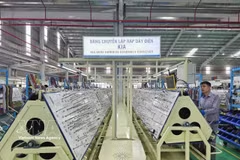
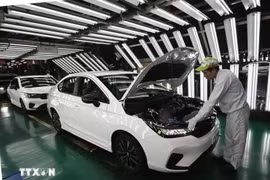
An automobile assembly line of THACO Truong Hai Group. (Photo: VNA)

Flexible fiscal policy helps drive economic growth

According to the Ministry of Finance, State budget revenue in the first eight months of 2026 was estimated at 2.02 quadrillion VND (77.7 billion USD), equivalent to 80% of the annual estimate and up 16% year-on-year. Domestic revenue reached 1.75 quadrillion VND, accounting for 86.6% of total revenue and rising 16.6%.

Visitors explore Vietnamese products at WorldFood Moscow 2026. (Photo: VNA)

Vietnamese goods step up market expansion in Russia

The Vietnamese participants are showcasing a wide range of products, including beverages, fresh and dried fruit, processed foods, instant foods and dipping sauces, while seeking distribution partners, expanding their market presence and increasing brand recognition in the country.

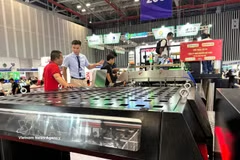
A Vietnamese manufacturer showcases a modern production line at VietnamPrintPack 2026. (Photo: VNA)

VietnamPrintPack 2026 kicks off in Ho Chi Minh City

VietnamPrintPack 2026 serves as a hub connecting the supply chain, showcasing breakthrough solutions in automation, digital printing, radio-frequency identification (RFID)-integrated smart packaging, and eco-friendly materials across Vietnam's industrial landscape.

Gemalink International Port in Ho Chi Minh City is one of the strategic seaports for industry, trade and global integration. (Photo: VNA)

Vietnam deepens global supply-chain integration

Deputy Minister of Industry and Trade Phan Thi Thang said Vietnam remains a top priority for international corporations and buyers seeking new sources of supply, thanks to its 17 FTAs, stable investment environment, improving production capacity and strategic location in Southeast Asia.

Illustrative image (Photo: VNA)

Vietravel Airlines resumes Hanoi – Da Lat route

Resuming the route is part of the carrier's year-end operating plan. It's a concrete step toward optimising the airline's domestic network, and a sign of its commitment to helping Lam Dong province revitalise tourism following the airport upgrades, its representative said.

Prof. Tan Jian Ping, Director of the Centre of Excellence for Sustainable Technologies for Agricultural Advancement and a Zero-Waste Economy (STARGAZE) at Xiamen University Malaysia (Photo published by VNA)

Vietnam, Malaysia see potential for smart agriculture cooperation

Prof. Tan Jian Ping, Director of the Centre of Excellence for Sustainable Technologies for Agricultural Advancement and a Zero-Waste Economy (STARGAZE) at Xiamen University Malaysia (XMUM), said NAP 2.0 focuses on applying Industry 4.0 technologies, including the Internet of Things (IoT), unmanned aerial vehicles, artificial intelligence (AI), automation and biotechnology.

The 30th Export Day draws representatives from various organisations and businesses in Argentina. (Photo: VNA)

Vietnam, Argentina eye broader Mercosur access amid free trade push

During the 30th Export Day, organised on September 15 in Buenos Aires by the Chamber of Exporters of the Argentine Republic (CERA) under the theme "New Export Frontier: The Transformation Underway," Vietnamese Ambassador to Argentina Ngo Minh Nguyet highlighted that Vietnam considers Argentina and Mercosur important partners in South America and sees broad potential to deepen trade and investment ties.