Malaysia-Vietnam cooperation potential under NAP 2.0: expert

By leveraging their complementary strengths under the NAP 2.0 framework, Malaysia and Vietnam have considerable potential to deepen cooperation to build a more technology-driven, sustainable, and resilient agricultural sector in Southeast Asia.

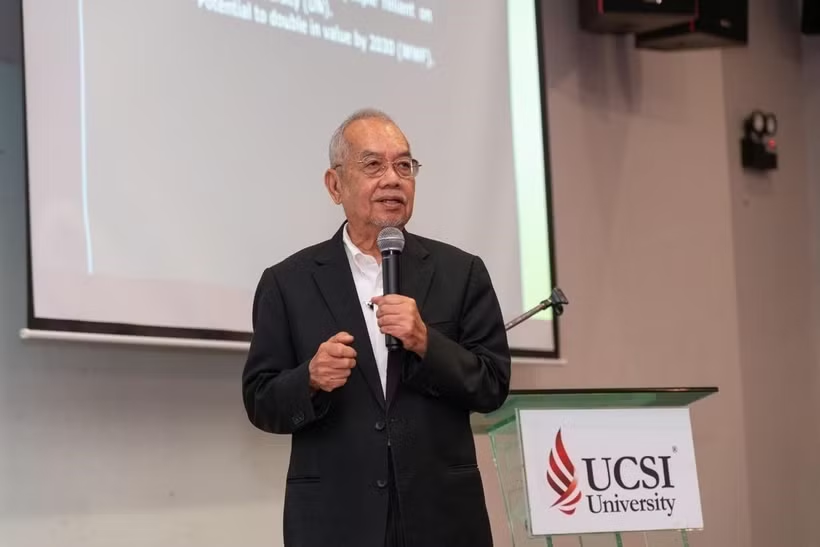
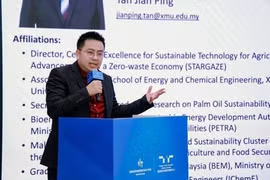
Professor Dato Dr Ahmad Ibrahim, an expert in technology, digital transformation and agricultural value chains at UCSI University (Photo published by VNA)

Kuala Lumpur (VNA) – Malaysia’s National Agrofood Policy 2021-2030 (NAP 2.0), which emphasises smart agriculture, stronger value chains, and research and technology commercialisation, is opening new opportunities for cooperation with Vietnam in agricultural technology, food security, and digital transformation, according to a Malaysian expert.

Speaking to a Vietnam News Agency (VNA) correspondent in Malaysia, Professor Dato Dr Ahmad Ibrahim, an expert in technology, digital transformation and agricultural value chains at UCSI University, said the combination of Malaysia’s ambition to develop high-tech agriculture and Vietnam’s agricultural strengths could provide a solid foundation for bilateral cooperation. The two countries have already taken steps to deepen collaboration, including a Memorandum of Understanding signed in April on agriculture, fisheries and food security.

According to the professor, one promising area is the development of high-tech Halal agriculture and food products. Cooperation between Vietnam’s QHC Global and Malaysia’s Antah Group in developing a wheat-based Halal ecosystem illustrates the potential for collaboration beyond conventional trade.

The two sides can combine Malaysia’s strengths in Halal certification and market access with Vietnam’s agricultural and technological expertise to develop value-added products for Muslim markets. Such cooperation could also extend to deep processing, biotechnology and circular-economy models, he stated.

Digital transformation of the rice value chain represents another major area of potential cooperation under NAP 2.0, Ahmad Ibrahim stressed. Malaysia aims to raise its rice self-sufficiency level to 80% by 2030, while Vietnam has extensive experience in large-scale rice production and smart farming. Bilateral cooperation could therefore focus on joint research and the adaptation of Vietnamese farming technologies to Malaysia’s soil and climatic conditions. Investment and technology partnerships in smart irrigation, AI-powered pest detection and data-based farm management could also contribute to Malaysia’s rice self-sufficiency goals.

The expert also highlighted prospects for joint research and technology development, including climate-resilient crop varieties and automated farming systems suited to Southeast Asian conditions. As Malaysia seeks to develop into a regional digital agriculture hub, cooperation with Vietnam in establishing compatible digital technical standards for agricultural trade could help streamline supply chains and facilitate regional economic integration.

These areas of cooperation would move bilateral agricultural ties beyond traditional buying and selling towards joint research, technology transfer, investment, and co-development of products and solutions.

By leveraging their complementary strengths under the NAP 2.0 framework, Malaysia and Vietnam have considerable potential to deepen cooperation to build a more technology-driven, sustainable, and resilient agricultural sector in Southeast Asia, he added./.

VNA
See more

VinFast electric cars are gathered at Hai Phong Port, ready to be loaded onto a ship for export. (Photo: VNA)

Going global: The competition challenge for "Made in Vietnam" cars

The growing number of exporters shows that Vietnam’s automobile industry is entering a new stage of development. However, international markets also present major challenges related to localisation, supporting industries, technological capabilities, human resources and country-specific technical standards.

Ports in Ho Chi Minh City are always bustling with ships loading and unloading cargo (Photo: VNA)

Ho Chi Minh City helps businesses effectively leverage FTAs

Ho Chi Minh City will implement a range of tasks and solutions to enhance business competitiveness, promote sustainable exports, expand markets, and enable local businesses to engage more deeply in global value and supply chains. The move is also expected to contribute to the development of Ho Chi Minh City as a regional hub for trade, logistics and international economic integration.

Illustrative image (Photo: VNA)

Livestreaming helps Vietnamese goods break past local markets

Once a product goes digital, it can transcend geography entirely. Consumers no longer need to visit a store or craft village in person to learn where a product comes from, how it's made, or whether it's worth buying. They can do all of that, and decide to buy, from a screen.

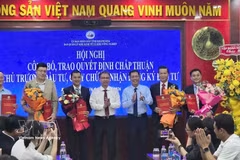
The south-central province of Khanh Hoa on September 16 announces investment approval decisions and investment registration certificates for five projects worth nearly 10.82 trillion VND (415.96 million USD). (Photo: VNA)

Khanh Hoa approves industrial projects with investment of 10.8 trillion VND

The south-central province of Khanh Hoa on September 16 announced investment approval decisions and investment registration certificates for five projects worth nearly 10.82 trillion VND (415.96 million USD), including three industrial park infrastructure projects and two foreign-invested ones.

A view of a ceremony to kick off the Northern Industry and Trade Fair - Bac Ninh 2026 on September 16, 2026 (Photo: VNA)

Northern industry-trade fair 2026 opens in Bac Ninh

The Northern Industry and Trade Fair - Bac Ninh 2026 features more than 222 booths with over 200 participating organisations and businesses, showcasing and introducing industrial and trade products from provinces and cities in the region, One Commune One Product (OCOP) items, typical rural industrial products, traditional craft village products, signature products of businesses, as well as regional trade, tourism and food products.

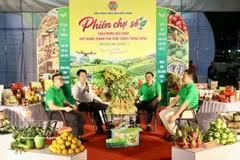
Delegates share information during the livestream programme. (Photo: VNA)

Bac Ninh promotes agricultural products through livestream

More than 300 products from Bac Ninh, Hanoi, Hung Yen, Son La, Thai Nguyen and Phu Tho were showcased during a livestream session held by the Bac Ninh Farmers' Union, ranging from traditional foods, agricultural products and medicinal herbs to natural products, OCOP goods, handicrafts and craft village products.

An automobile assembly line of THACO Truong Hai Group. (Photo: VNA)

Flexible fiscal policy helps drive economic growth

According to the Ministry of Finance, State budget revenue in the first eight months of 2026 was estimated at 2.02 quadrillion VND (77.7 billion USD), equivalent to 80% of the annual estimate and up 16% year-on-year. Domestic revenue reached 1.75 quadrillion VND, accounting for 86.6% of total revenue and rising 16.6%.

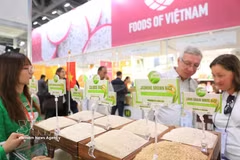
Visitors explore Vietnamese products at WorldFood Moscow 2026. (Photo: VNA)

Vietnamese goods step up market expansion in Russia

The Vietnamese participants are showcasing a wide range of products, including beverages, fresh and dried fruit, processed foods, instant foods and dipping sauces, while seeking distribution partners, expanding their market presence and increasing brand recognition in the country.

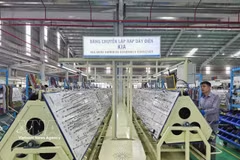
A Vietnamese manufacturer showcases a modern production line at VietnamPrintPack 2026. (Photo: VNA)

VietnamPrintPack 2026 kicks off in Ho Chi Minh City

VietnamPrintPack 2026 serves as a hub connecting the supply chain, showcasing breakthrough solutions in automation, digital printing, radio-frequency identification (RFID)-integrated smart packaging, and eco-friendly materials across Vietnam's industrial landscape.