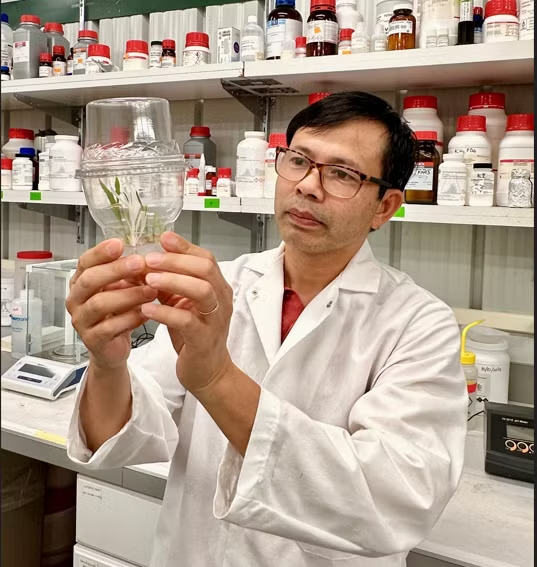
Washington DC (VNA) – Vietnam has significant advantages for making breakthroughs in plant biotechnology if it can effectively harness its rich genetic resources, apply new technologies, and strengthen links between research and businesses, said Dr Quach Truyen, a plant biotechnology scientist and the founder of PlantEdits, a US-based specialised plant transformation and genome editing service.
Talking to a Vietnam News Agency correspondent in the US, the expert said one approach Vietnam should prioritise is the application of Big Data, AI and bioinformatics in genetic resource research, thereby shortening the time needed to identify genes of economic value. This direction is particularly suitable for the Southeast Asian country, which possesses rich plant genetic resources, including many specialty crops, medicinal plants and genetic resources with the potential to withstand adverse conditions.
He affirmed that precise gene-editing technologies such as CRISPR also offer major opportunities for Vietnam, particularly as costs continue to fall.
He said combining new technologies with indigenous genetic resources could help Vietnam develop products with high intellectual property value. Vietnam could focus on crops in which it has distinctive advantages, such as aromatic rice, fruit crops, industrial crops and medicinal plants, while leveraging its diverse natural conditions to research varieties adapted to drought, flooding and saltwater intrusion.
According to him, mechanisms should be strengthened to encourage businesses to invest in research and development, enhance technology transfer and intellectual property management capacity, and digitalise the agricultural extension system to better connect field data with research institutes and businesses.
The scientist suggested Vietnam use Big Data to identify genetic resources with valuable qualities, medicinal properties or resistance traits, and then apply next-generation genetic techniques to precisely improve desired characteristics.
This approach would not only increase the value of agricultural products but could also create crop varieties and technologies suited to local conditions, while opening up opportunities to transfer varieties and licences to countries with similar climatic conditions, he said. This could provide a pathway for the country to turn its advantages in genetic resources and natural conditions into advantages in science and technology and greater added value in agriculture./.
See more
Vietnam seeks to build safe AI future with China, ASEAN
Deputy Minister of Science and Technology Hoang Minh said a safe AI future must be built on each country's governance capacity and trust among partners. Vietnam, therefore, wishes to work with China and ASEAN member states to contribute to such a future for the benefit of the people and the prosperity of the region.
Vietnamese students compete in Global HackAtom 2026 finals in Russia
Participation in the international finals of Global HackAtom 2026 in Russia from September 11–17 offers Vietnamese students an opportunity to compete directly with peers from leading Russian universities with long-standing traditions in nuclear science, including Tomsk Polytechnic University and the National Research Nuclear University MEPhI.
AI contest to be organised in Vietnam
Jointly organised by Sea Limited and OpenAI, the contest is expected to provide participants with hands-on experience in artificial intelligence, while also offering a platform to exchange ideas and connect with members of the country’s fast-growing AI and developer community.
Vietnam, France step up cooperation in science, innovation
A delegation from the Communist Party of Vietnam (CPV) Central Committee’s Commission for Policy and Strategy paid a working visit to France from September 13-16, focusing on exchanging experience in science and technology, innovation, startup ecosystems and human resources development.
Digital transformation promotes sustainable development in Mekong Delta
Experts said the Mekong Delta region does not lack data, but valuable information collected by government agencies, universities, businesses, projects and communities is scattered across different locations and formats, making it difficult to access, compare and use effectively.
Population data, DNA technology aid efforts to identify fallen soldiers
Under the direction of the Government and the Ministry of Public Security, the ministry’s Police Department for Administrative Management of Social Order (C06) has led efforts to review and standardise information on martyrs and their relatives, collect DNA samples from relatives, and build and manage a DNA database. It also coordinates with forensic agencies to compare DNA data and identify the remains of fallen soldiers.
Integrated planning needed for urban e-vehicle charging networks: expert
The rapid growth of EVs is creating new infrastructure challenges for cities, requiring charging networks to be planned according to travel demand, power supply capacity and available urban space.
Controlled sandboxes needed to speed up application of new technologies
Although the Political Bureau’s Resolution No. 57-NQ/TW allows pilot schemes for new practical issues and accepts risks and delays in science, technology and innovation, concerns over risks and responsibility persist.
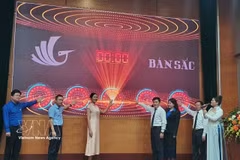
‘Ban Sac’ 2026 brings Vietnamese cultural values to life in digital space
“Ban Sac” is an online platform combining culture, digital communications and artificial intelligence (AI), running from September 15 to October 31 on its official website, www.bansac.vn.
VNA accelerates digital transformation, builds modern information ecosystem
Digital technology may change how journalism is practiced, but the core mission of journalists at a news agency remains unchanged: serving the nation and the people while ensuring a flow of official and reliable information that helps build public trust in the Party’s leadership.
Vietnam steps up semiconductor talent training to meet market demand
Vietnam needs to step up semiconductor workforce training to meet growing market demand and enhance its capacity to participate in the global technology value chain, experts said, highlighting the importance of closely linking training with businesses, production and technological research.
Vietnam seeks to boost education and technology cooperation with France
Education and training, science and technology, and high-quality human resources are key areas of cooperation in Vietnam-France relations, said Politburo Member, Secretary of the Communist Party of Vietnam Central Committee, and Chairman of its Commission for Organisation Nguyen Duy Ngoc while visiting the Institut Polytechnique de Paris on September 11.
Vietnam, France deepen cooperation in science, technology, workforce training
The University of Science and Technology of Hanoi (USTH), under the Vietnam Academy of Science and Technology (VAST), and the French Alternative Energies and Atomic Energy Commission (CEA) exchanged two cooperation agreements in Paris on September 11, in the presence of General Secretary of the Communist Party of Vietnam Central Committee and President To Lam.
Vietnam eyes UAV industry as key driver of low-altitude economy
For Vietnam, the opportunity presented by unmanned aerial vehicles (UAVs) lies not only in expanding their applications but, more importantly, in gradually building industrial capacity, mastering technologies and engaging more deeply in global value chains.
Vietnam seeks deeper integration into global semiconductor value chains
Nguyen Anh Tuan, Director of the National Centre for Pilot Semiconductor Chip Manufacturing Support under the Ministry of Science and Technology, said that amid increasingly intense global technological competition, the semiconductor industry is not only a high-value-added economic sector but also a foundation for technological self-reliance, national security and economic competitiveness.
Hanoi approves controlled pilot of two technology projects
The two projects involve an intelligent autonomous transportation system developed by Phenikaa-X JSC and a technology for producing mixed rare-earth oxides with a purity of over 95% on a semi-industrial scale developed by the Mining Technology and Construction Consultancy JSC.
Vietnam, Czech Republic expand cooperation in education, science, technology
Vietnamese Ambassador Duong Hoai Nam stressed the need to strengthen cooperation between educational and research institutions of the two countries, shifting from exchanges and individual projects towards long-term partnerships with tangible outcomes.
Vietnam, Russia develop quantum technology cooperation roadmap
Quantum technology is an emerging field undergoing rapid breakthroughs and requiring enormous investment resources. Learning from the experience of pioneering countries such as Russia will enable Vietnam to significantly shorten the time needed to build its workforce and develop endogenous capabilities.
Core technologies open new avenues for Vietnam-France cooperation: expert
General Secretary of the Communist Party of Vietnam Central Committee and President To Lam’s upcoming official visit to France is expected to provide fresh momentum for Vietnam-France ties as it comes at a pivotal time for Vietnam’s economic restructuring.
Major shifts expected in Vietnam–Russia technology cooperation
Leaders of the Vietnam Academy of Science and Technology (VAST) and AFK Sistema agreed to promote cooperation in three priority strategic technology areas, namely green hydrogen, small satellites, and unmanned aerial vehicle (UAV) systems.