Vietnam seeks to build safe AI future with China, ASEAN

Deputy Minister of Science and Technology Hoang Minh said a safe AI future must be built on each country's governance capacity and trust among partners. Vietnam, therefore, wishes to work with China and ASEAN member states to contribute to such a future for the benefit of the people and the prosperity of the region.

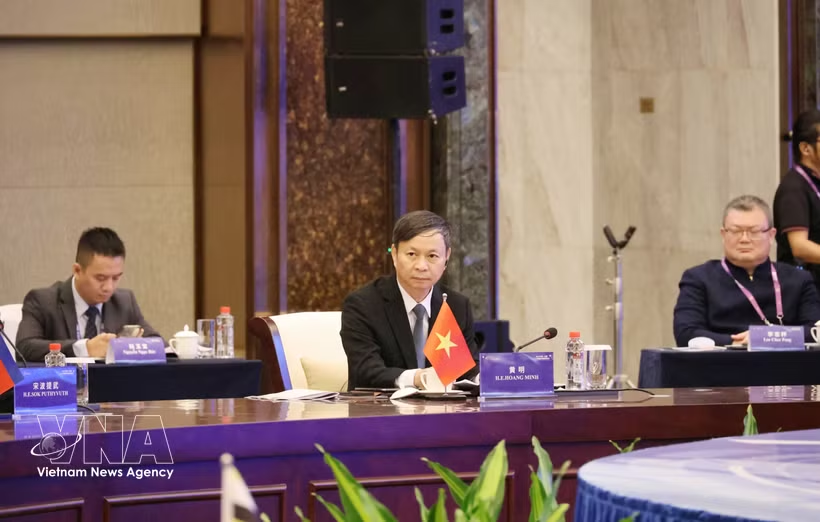
Vietnamese Deputy Minister of Science and Technology Hoang Minh attends the 2026 China–ASEAN Ministerial Roundtable on Artificial Intelligence in Nanning, China, on September 17. (Photo: VNA)

Nanning (VNA) – Vietnam has proposed that China and ASEAN member states strengthen dialogue on artificial intelligence (AI) governance, cooperate in research and safe AI testing, and develop human resources, with a view to promoting responsible AI application in the future.

Vietnamese Deputy Minister of Science and Technology Hoang Minh made the suggestions at the 2026 China–ASEAN Ministerial Roundtable on AI in Nanning, China, on September 17.

The event brought together officials from China's AI regulatory authorities and representatives from all 11 ASEAN member states, as well as leading AI businesses, research institutes and financial organisations from both sides.

Participants held in-depth discussions on key issues, including building consensus on AI safety and ethics, regional cooperation governance, regulations and risk prevention, and industry cooperation. They also discussed developing regional rules on AI ethics and safety governance between China and ASEAN, promoting resource connectivity, enhancing cooperation in AI application, and stepping up the practical implementation of AI cooperation outcomes.

Speaking at the conference, Minh said effective AI governance is, for Vietnam, a foundation for sustainable innovation and for ensuring that technological development benefits people and businesses.

Vietnam has enacted the AI Law and issued a decree guiding its enforcement. It has also approved a national AI strategy through 2030, with a vision to 2045, to promote AI development alongside safe and responsible governance.

The deputy minister stressed that Vietnam's consistent approach is to put people at the centre. AI must serve people rather than replace human authority and responsibility, while AI development must protect human rights and privacy and ensure fairness, transparency and accountability.

Vietnam's national AI strategy identifies AI as a core capability for transforming governance, production and service delivery. The country places emphasis on human resources, computing infrastructure and data, and it is developing technological mastery in tandem with expanded international cooperation and strategic autonomy, he noted.

Alongside its domestic efforts, Minh said that Vietnam signed an agreement in July to establish the World Artificial Intelligence Cooperation Organisation (WAICO). It attaches importance to multilateral cooperation to develop AI for peaceful, safe and inclusive purposes, in line with the United Nations Charter.

Regarding China–ASEAN cooperation, the official said cooperation between the two sides could leverage their respective strengths, thereby helping enhance AI governance capacity and expand opportunities for AI development in the region.
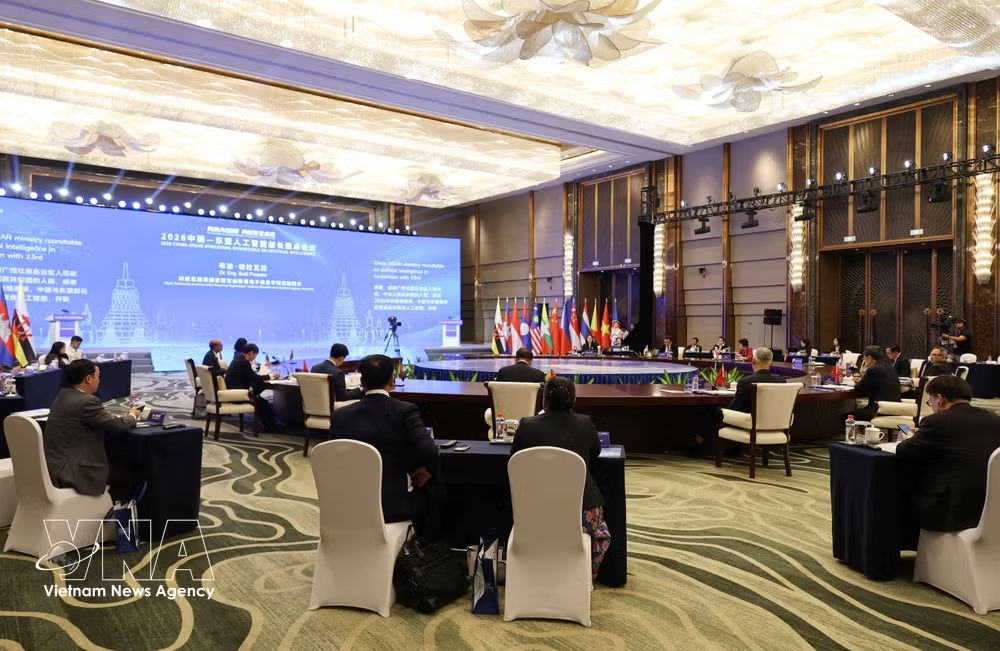
vnanet-2026-chinaasean-ministerial-roundtable-on-artificial-intelligence.jpg
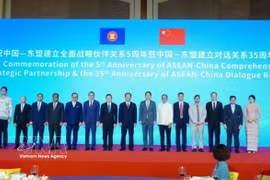
The 2026 China–ASEAN Ministerial Roundtable on Artificial Intelligence takes place in Nanning, China, on September 17. (Photo: VNA)

On the basis of equality, mutual benefit, and respect for sovereignty and laws of each country, he said Vietnam wishes to promote cooperation in three areas.

First, he proposed strengthening policy dialogue and sharing experience in AI governance, noting Vietnam wishes to share its experience in developing legal frameworks while learning from the practices of its partners.

ASEAN guidelines on AI governance and ethics, including generative AI, are useful references for enhancing mutual understanding and compatibility among different approaches, he said.

Second, cooperation in AI research, testing and safety assessment should be strengthened. Vietnam hopes to promote connections among research institutes, universities and businesses to conduct joint research, share risk-assessment methods and exchange experience in technical standards.

Minh perceived that AI development and testing should take into account specific linguistic and cultural characteristics, as well as data protection and the legitimate rights and interests of all parties.

Third, cooperation in developing human resources and narrowing the AI gap should be enhanced. Vietnam attaches importance to cooperation in training, expert exchanges and capacity building for AI developers, managers and users alike.

Such cooperation should be aligned with practical needs, helping people and businesses, particularly small- and medium-sized enterprises, access and apply AI safely and responsibly, according to the deputy minsiter.

Minh said a safe AI future must be built on each country's governance capacity and trust among partners. Vietnam, therefore, wishes to work with China and ASEAN member states to contribute to such a future for the benefit of the people and the prosperity of the region.

The first China–ASEAN Ministerial Roundtable on AI was held in Nanning in September last year, playing an active role in promoting exchanges and cooperation on AI between China and ASEAN member states./.

VNA

See more

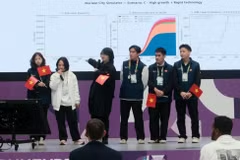
The Vietnamese team at the finals of Global HackAtom 2026 in Russia from September 11–17. (Photo: published by VNA)

Vietnamese students compete in Global HackAtom 2026 finals in Russia

Participation in the international finals of Global HackAtom 2026 in Russia from September 11–17 offers Vietnamese students an opportunity to compete directly with peers from leading Russian universities with long-standing traditions in nuclear science, including Tomsk Polytechnic University and the National Research Nuclear University MEPhI.

(Photo: Organising board)

AI contest to be organised in Vietnam

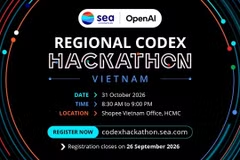
Jointly organised by Sea Limited and OpenAI, the contest is expected to provide participants with hands-on experience in artificial intelligence, while also offering a platform to exchange ideas and connect with members of the country’s fast-growing AI and developer community.

The meeting between the delegation from the CPV Central Committee’s Commission for Policy and Strategy and Station F (Photo: VNA)

Vietnam, France step up cooperation in science, innovation

A delegation from the Communist Party of Vietnam (CPV) Central Committee’s Commission for Policy and Strategy paid a working visit to France from September 13-16, focusing on exchanging experience in science and technology, innovation, startup ecosystems and human resources development.

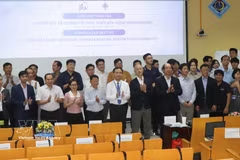
Delegates at the workshop pose for a group photo (Photo: VNA)

Digital transformation promotes sustainable development in Mekong Delta

Experts said the Mekong Delta region does not lack data, but valuable information collected by government agencies, universities, businesses, projects and communities is scattered across different locations and formats, making it difficult to access, compare and use effectively.

Soldiers from the Dien Bien provincial Military Command offer incense at the graves of fallen soldiers at A1 Martyrs’ Cemetery before exhuming remains to collect samples (Photo: VNA)

Population data, DNA technology aid efforts to identify fallen soldiers

Under the direction of the Government and the Ministry of Public Security, the ministry’s Police Department for Administrative Management of Social Order (C06) has led efforts to review and standardise information on martyrs and their relatives, collect DNA samples from relatives, and build and manage a DNA database. It also coordinates with forensic agencies to compare DNA data and identify the remains of fallen soldiers.

Students practice microcontroller programming at the Viet - Han College of Technology in Bac Ninh province (Photo: VNA)

Vietnam steps up semiconductor talent training to meet market demand

Vietnam needs to step up semiconductor workforce training to meet growing market demand and enhance its capacity to participate in the global technology value chain, experts said, highlighting the importance of closely linking training with businesses, production and technological research.

Vietnam seeks to boost education and technology cooperation with France

Vietnam seeks to boost education and technology cooperation with France

Education and training, science and technology, and high-quality human resources are key areas of cooperation in Vietnam-France relations, said Politburo Member, Secretary of the Communist Party of Vietnam Central Committee, and Chairman of its Commission for Organisation Nguyen Duy Ngoc while visiting the Institut Polytechnique de Paris on September 11.

General Secretary of the Communist Party of Vietnam Central Committee and President To Lam witnesses the exchange of cooperation agreements between the two countries. (Photo: VNA)

Vietnam, France deepen cooperation in science, technology, workforce training

The University of Science and Technology of Hanoi (USTH), under the Vietnam Academy of Science and Technology (VAST), and the French Alternative Energies and Atomic Energy Commission (CEA) exchanged two cooperation agreements in Paris on September 11, in the presence of General Secretary of the Communist Party of Vietnam Central Committee and President To Lam.

A display area for unmanned aerial vehicles (UAVs) at a workshop in Da Nang city on June 12, 2026. (Photo: VNA)

Vietnam eyes UAV industry as key driver of low-altitude economy

For Vietnam, the opportunity presented by unmanned aerial vehicles (UAVs) lies not only in expanding their applications but, more importantly, in gradually building industrial capacity, mastering technologies and engaging more deeply in global value chains.

A semiconductor chip by TSMC (Photo: VCG)

Vietnam seeks deeper integration into global semiconductor value chains

Nguyen Anh Tuan, Director of the National Centre for Pilot Semiconductor Chip Manufacturing Support under the Ministry of Science and Technology, said that amid increasingly intense global technological competition, the semiconductor industry is not only a high-value-added economic sector but also a foundation for technological self-reliance, national security and economic competitiveness.

Demonstration of an autonomous electric street sweeper. (Photo: VNA)

Hanoi approves controlled pilot of two technology projects

The two projects involve an intelligent autonomous transportation system developed by Phenikaa-X JSC and a technology for producing mixed rare-earth oxides with a purity of over 95% on a semi-industrial scale developed by the Mining Technology and Construction Consultancy JSC.

Prof. Dr. Tran Hong Thai, President of the Vietnam Academy of Science and Technology (VAST), has a working session with leaders of Russia’s State Atomic Energy Corporation Rosatom. (Photo: VNA)

Vietnam, Russia develop quantum technology cooperation roadmap

Quantum technology is an emerging field undergoing rapid breakthroughs and requiring enormous investment resources. Learning from the experience of pioneering countries such as Russia will enable Vietnam to significantly shorten the time needed to build its workforce and develop endogenous capabilities.