Hanoi (VNA) – When digital technology and artificial intelligence (AI) continue to reshape how information is produced, distributed and consumed, digital transformation has become an essential requirement for press agencies. As the national news agency, the Vietnam News Agency (VNA) is steadily modernising its operations, from infrastructure and data systems to technology application and news production, with the goal of building a modern multimedia news agency operating on digital platforms.
Building a VNA digital ecosystem
The VNA has pursued digital transformation across three main areas: technological infrastructure, news production processes and human resources. Alongside investment in content management systems, data centres and shared digital platforms, many new technologies, particularly AI, are being gradually introduced into the news production process.
A notable milestone is the launch of the “Chuyen dong so” (Digital Movement) information portal at chuyendongso.vnanet.vn. The new journalistic product is also a concrete step by the VNA to implement Politburo Resolution No. 57-NQ/TW on breakthroughs in science – technology development, innovation and national digital transformation.
Nguyen Duc Vu, Director of the VNA’s Technical Centre, said the portal is an example of a “news complex” model, under which different newsrooms and source-news units work together to produce content for a specialised information channel.
The Technical Centre is continuing to improve the system by strengthening connections between the content management systems (CMS) of VNA units. It is also promoting cross-platform content between the “Digital Movement” portal and other VNA information channels to broaden the reach of content and shorten the time needed to process information.
AI is also being used in the portal’s “Resources” section to automatically collect and organise information related to Resolution No. 57-NQ/TW according to the structure of “guidelines – implementation – results”.
Vu said AI is now being applied in many stages of news production and should be viewed as a “professional assistant”. It can be used extensively for tasks such as information gathering, data processing and synthesis.
However, the specific requirements of journalism mean that accuracy and reliability must remain the top priorities. The assessment and verification of information, as well as the final decision on whether it should be used, remain the responsibility of reporters and editors, he stressed.
This is a key principle in the agency’s application of AI: technology should support journalists and improve their efficiency, but should not replace their professional responsibility or journalistic judgment.
Vu said changing mindsets is a necessary condition for digital transformation while technological transformation provides the means needed for success. The two aspects have been and will continue to be implemented at increasingly comprehensive levels.
In terms of mindset, the VNA has started from the highest level by establishing a strategic vision and linking digital initiatives with the agency’s core objectives. A digital-transformation mindset is also gradually taking shape among its reporters, editors and technological engineers.
At the same time, the VNA is stepping up technological transformation according to an established roadmap, focusing on developing a digital architecture framework, expanding the use of AI and big data, and strengthening connections among applications and information systems. The aim is to build an integrated VNA digital ecosystem.
Vu noted that digital transformation is not simply about digitising existing work processes. It requires upgrading and redesigning existing processes while creating new ones to improve operational efficiency.
He acknowledged that some VNA units still face limitations in changing their workflows. Following direction from VNA leaders, the Technical Centre is reviewing digital processes across the agency to provide a basis for proposing ways to optimise journalistic operations.
Another priority in the coming period will be to develop new, creative and effective information models suited to the VNA’s functions and tasks as the national news agency now serves as a public non-business unit under the Party Central Committee.
New thinking, modern journalism
At the newsroom level, the development of online newspaper VietnamPlus illustrates how technology is changing both the production and presentation of news products.
Tran Tien Duan, Editor-in-Chief of VietnamPlus, said that during its digital transformation and efforts to build a modern newsroom, the newspaper has sought to take the lead in innovation. It has developed a professional content management system while paying attention to creative, in-depth and modern journalistic products that make use of multimedia technology.
The newspaper has gradually adopted new technologies in content production and distribution, including interactive chatbots, delivery of content through smart speakers, podcasts on digital platforms and interactive 3D journalistic products.
Its special 3D interactive projects, developed for major events, combine information with technology, data and games to create more engaging experiences for readers. Such products allow readers not only to receive information but also to interact with it in new ways, he went on.
Duan said VietnamPlus has also received recognition for its storytelling, with a style that combines information with emotion and appeal to readers of different ages. These products also contribute to preserving and promoting clear and standard Vietnamese language.
Among its innovative journalistic products is an interactive 3D project marking the 70th anniversary of the Liberation of Hanoi. Historical stories were presented in an interactive format, allowing readers to explore key moments through a 3D model of Hanoi’s Flag Tower, the moment President Ho Chi Minh read the Declaration of Independence, the December 1946 appeal for nationwide resistance and the Dien Bien Phu Victory.
Another multimedia 3D project, “Epic of National Reunification”, takes readers through the long journey towards national reunification using archival videos, interactive features on desktop and smartphone screens, and a graphic 3D game.
The two products won two international journalism awards, according to the Editor-in-Chief.
More recently, VietnamPlus launched a special project titled “The Legendary Temple of FIFA World Cup”. Designed as an interactive journey, the project recounts the history of the World Cup through emotional, nostalgic and cinematic storytelling. Rather than focusing only on football statistics and famous matches, it uses a new visual approach to create the feeling of entering a “museum of memories” of world football.
Duan said technology-based journalistic products with a high level of interactivity have attracted considerable interest from readers.
He noted that digital transformation is no longer a new trend in journalism but a mandatory requirement for newsrooms. Its effectiveness and reach, however, depend largely on how individual press agencies manage and apply digital technologies.
He identified newsroom governance thinking as one of the major limitations facing the sector.
If newsroom leaders lack an innovative mindset and do not embrace technology and AI in management, news production and the development of new journalistic products, it is difficult to achieve comprehensive change across the newsroom, Duan added.
Technological infrastructure is another key factor, closely linked to investment capacity and financial resources. Inadequate infrastructure may hinder the development of content management and newsroom management systems as well as the production of new journalistic products.
Human resources are equally important. He pointed to differences in technological skills and access among reporters, editors, technicians and designers as a challenge that requires press agencies to strengthen training, particularly self-training.
Young staff have advantages in adopting new technologies, but journalism personnel in general still need systematic training to meet the requirements of producing content in the digital environment, he said, adding that management thinking, technological infrastructure and human-resource quality therefore have a direct impact on the development of modern multimedia newsrooms operating on digital platforms.
From this perspective, the VietnamPlus leader said the development of a digital newsroom should be part of the country’s broader digital transformation process and closely adhere to the Party and State’s resolutions, policies and orientations on journalism and science – technology.
Press agencies need not only to renew their products but also improve their efficiency, creativity and reach, helping shape public opinion and contributing to the country's socio-economic development in the new era, he opined.
Under the leadership and direction of the VNA Party Committee and leaders, VietnamPlus will continue to focus on technology application and digital transformation while developing new journalistic products.
The newspaper aims to build a diverse, modern and engaging journalism ecosystem capable of interacting with and attracting readers through professional, specialised and appealing content. It also plans to develop more information formats, channels for reaching the public and information packages, enabling the newsroom to operate more proactively and strengthen its integration with modern media.
VietnamPlus is also working towards becoming an official information channel on the Party and State’s foreign policy, enhancing its role in external relations information, effectively spreading Vietnam’s policies to domestic and international readers, helping shape public opinion and publicly countering false and distorted views while firmly maintaining its political and social orientation.
Developments at individual VNA units show that digital transformation is gradually bringing changes across the entire agency.
Vu Viet Trang, VNA Party Committee Secretary, VNA General Director and Vice Chairwoman of the Party Central Committee’s Commission for Publicity, said the agency has completed its digital architecture framework as part of efforts to carry out Politburo Resolution No. 57-NQ/TW on promoting science – technology, innovation and digital transformation.
Its digital transformation is built around four priorities: data as the foundation, technology as the driving force, innovation in professional processes as the focus, and people as the decisive factor. The ultimate goal is to build a modern multimedia national news agency operating on digital platforms and capable of providing information in a fast, accurate and diverse manner.
One of the agency’s key tasks is to develop and make effective use of large-scale shared databases, creating a conerstone for management, administration and professional operations.
The VNA will also expand the use of AI throughout the news production process, from detecting and collecting information to analysing and verifying it and coordinating the distribution of content across digital platforms.
Technologies including AI, big data and cloud computing will be deployed for shared use across the agency. They are expected to improve productivity and information quality, speed up news processing and support the detection of and response to fake news and misinformation in cyberspace, Trang said.
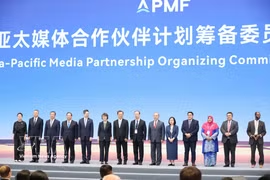
As the country’s key agency of external relations information and national news agency, the VNA will continue expanding cooperation with international news agencies and media organisations. It will gradually develop modern connectivity infrastructure and reinforce its role as a reliable hub for collecting, exchanging and distributing information.
These efforts will contribute to promoting Vietnam’s position and image internationally, according to the official.
In the digital era, revolutionary journalism is tasked not only with delivering information quickly and accurately but also with helping guide the flow of information, spread positive values, strengthen public trust and protect the Party’s ideological foundation.
Digital technology may change how journalism is practiced, but the core mission of journalists at a news agency remains unchanged: serving the nation and the people while ensuring a flow of official and reliable information that helps build public trust in the Party’s leadership, she stressed./.
VNA