Digital transformation promotes sustainable development in Mekong Delta

Experts said the Mekong Delta region does not lack data, but valuable information collected by government agencies, universities, businesses, projects and communities is scattered across different locations and formats, making it difficult to access, compare and use effectively.

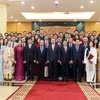
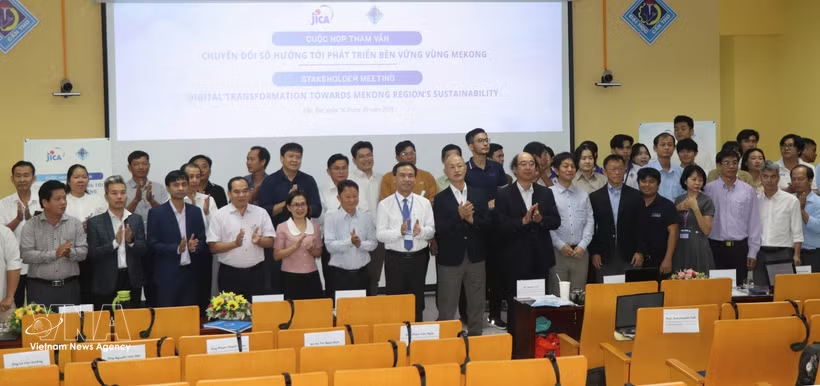
Delegates at the workshop pose for a group photo (Photo: VNA)

Can Tho (VNA) – A stakeholder consultation workshop on the Knowledge Hub platform was held in Can Tho city on September 16 to promote digital transformation, knowledge sharing and the use of advanced technologies to strengthen climate resilience and sustainable development in the Mekong Delta.

The event was jointly organised by the Japan International Cooperation Agency (JICA), Mekong Institute and Can Tho University.

The Mekong Delta, a major agricultural and fisheries production hub of Vietnam, faces mounting challenges from climate change, saltwater intrusion, drought, flooding, environmental pollution, rising production costs and unstable markets. Changes in water resources and weather can have far-reaching impacts on farming, livelihoods and local development planning.

Experts said the region does not lack data, but valuable information collected by government agencies, universities, businesses, projects and communities is scattered across different locations and formats, making it difficult to access, compare and use effectively.

To address this issue, Model 12 under the second phase of a JICA-funded project for “enhancing science-based integrated collaborations towards sustainable development of the Mekong Delta region under climate change” has developed the Knowledge Hub – the Mekong Delta sustainable development data exploitation centre, implemented by the Mekong Institute of Can Tho University.
vnanet-mekong-dang-tri.jpg
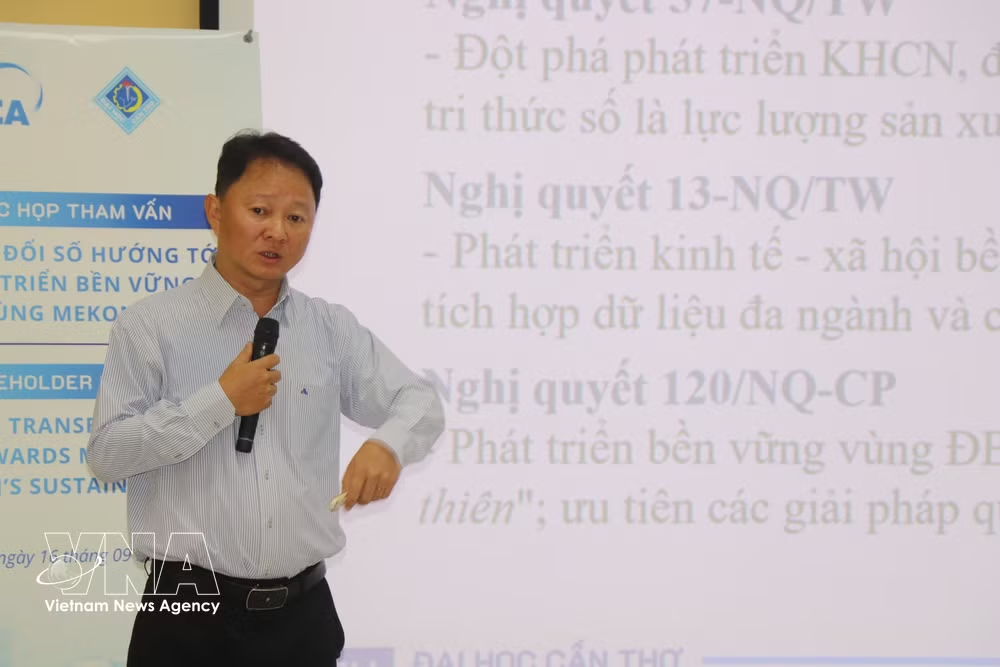
Assoc. Prof. Dr. Van Pham Dang Tri, Director of the Mekong Institute, speaks at the workshop on the Knowledge Hub platform(Photo: VNA)

Assoc. Prof. Dr. Van Pham Dang Tri, Director of the Mekong Institute and head of Model 12, said regional challenges stem not only from insufficient data but also from how data are generated, shared and transformed into knowledge for action.

The Knowledge Hub digitises, standardises and integrates multidisciplinary datasets through a common Web Geographic Information System (WebGIS), creating a dynamic platform for information sharing and decision-making.

It integrates land databases, land-use maps, and agricultural and fisheries statistics, enabling users to compare natural conditions with livelihood models and identify areas vulnerable to climate change.

The platform also links surface-water monitoring data with field information collected by communities, while incorporating groundwater data and providing six-day short-term salinity forecasts. The information can help authorities and residents plan water collection, operate irrigation gates and protect crops.

The Knowledge Hub Toolkit offers free digital tools for policymakers, technical officials, businesses and communities. Its VietMap-based system allows users to overlay datasets, including agrifishery business networks and salinity-risk maps, to support value-chain analysis and impact assessment.

The platform also translates scientific research into accessible thematic articles and provides a space for universities, authorities, businesses and communities to co-create knowledge.

Experts said the Knowledge Hub could facilitate links with other research models, improve database interoperability and incorporate more community initiatives, helping establish a “living” knowledge platform for the delta's sustainable development.

Dr. Le Van Lam, Vice Rector of Can Tho University, said the platform should focus on three priorities: connecting and standardising data on climate, water resources, environment, agriculture, fisheries and socio-economic conditions; transforming data into practical maps, indicators, forecasts and guidelines; and connecting data providers with users according to the needs of localities, businesses and researchers.

At the workshop, scientists and experts from research institutes, universities and relevant ministries and sectors, together with JICA representatives, discussed measures to maximise the potential of digital transformation in addressing challenges facing the Mekong Delta./.
VNA

See more

Soldiers from the Dien Bien provincial Military Command offer incense at the graves of fallen soldiers at A1 Martyrs’ Cemetery before exhuming remains to collect samples (Photo: VNA)

Population data, DNA technology aid efforts to identify fallen soldiers

Under the direction of the Government and the Ministry of Public Security, the ministry’s Police Department for Administrative Management of Social Order (C06) has led efforts to review and standardise information on martyrs and their relatives, collect DNA samples from relatives, and build and manage a DNA database. It also coordinates with forensic agencies to compare DNA data and identify the remains of fallen soldiers.

Students practice microcontroller programming at the Viet - Han College of Technology in Bac Ninh province (Photo: VNA)

Vietnam steps up semiconductor talent training to meet market demand

Vietnam needs to step up semiconductor workforce training to meet growing market demand and enhance its capacity to participate in the global technology value chain, experts said, highlighting the importance of closely linking training with businesses, production and technological research.

Vietnam seeks to boost education and technology cooperation with France

Vietnam seeks to boost education and technology cooperation with France

Education and training, science and technology, and high-quality human resources are key areas of cooperation in Vietnam-France relations, said Politburo Member, Secretary of the Communist Party of Vietnam Central Committee, and Chairman of its Commission for Organisation Nguyen Duy Ngoc while visiting the Institut Polytechnique de Paris on September 11.

General Secretary of the Communist Party of Vietnam Central Committee and President To Lam witnesses the exchange of cooperation agreements between the two countries. (Photo: VNA)

Vietnam, France deepen cooperation in science, technology, workforce training

The University of Science and Technology of Hanoi (USTH), under the Vietnam Academy of Science and Technology (VAST), and the French Alternative Energies and Atomic Energy Commission (CEA) exchanged two cooperation agreements in Paris on September 11, in the presence of General Secretary of the Communist Party of Vietnam Central Committee and President To Lam.

A display area for unmanned aerial vehicles (UAVs) at a workshop in Da Nang city on June 12, 2026. (Photo: VNA)

Vietnam eyes UAV industry as key driver of low-altitude economy

For Vietnam, the opportunity presented by unmanned aerial vehicles (UAVs) lies not only in expanding their applications but, more importantly, in gradually building industrial capacity, mastering technologies and engaging more deeply in global value chains.

A semiconductor chip by TSMC (Photo: VCG)

Vietnam seeks deeper integration into global semiconductor value chains

Nguyen Anh Tuan, Director of the National Centre for Pilot Semiconductor Chip Manufacturing Support under the Ministry of Science and Technology, said that amid increasingly intense global technological competition, the semiconductor industry is not only a high-value-added economic sector but also a foundation for technological self-reliance, national security and economic competitiveness.

Demonstration of an autonomous electric street sweeper. (Photo: VNA)

Hanoi approves controlled pilot of two technology projects

The two projects involve an intelligent autonomous transportation system developed by Phenikaa-X JSC and a technology for producing mixed rare-earth oxides with a purity of over 95% on a semi-industrial scale developed by the Mining Technology and Construction Consultancy JSC.

Prof. Dr. Tran Hong Thai, President of the Vietnam Academy of Science and Technology (VAST), has a working session with leaders of Russia’s State Atomic Energy Corporation Rosatom. (Photo: VNA)

Vietnam, Russia develop quantum technology cooperation roadmap

Quantum technology is an emerging field undergoing rapid breakthroughs and requiring enormous investment resources. Learning from the experience of pioneering countries such as Russia will enable Vietnam to significantly shorten the time needed to build its workforce and develop endogenous capabilities.

Senior Vice-President of Latin America and Asia at Thales Group Guy Bonassi (L) at a meeting with Vietnamese Ambassador to France Trinh Duc Hai (Photo published by VNA)

Vietnam, France should expand cooperation in strategic fields: business leader

General Secretary of the Communist Party of Vietnam Central Committee and President To Lam’s visit to France, Guy Bonassi, Senior Vice-President of Latin America and Asia at Thales Group, said the upgrade of bilateral ties to a Comprehensive Strategic Partnership reflects their shared desire to deepen and broaden cooperation, with technological autonomy, resilience and human resources development assuming increasingly important roles.

The Vietnamese delegation led by Deputy Prime Minister Ho Quoc Dung visits the Korea Institute of Science and Technology (KIST). (Photo: VNA)

Vietnam, RoK promote strategic technological cooperation

Deputy Prime Minister Ho Quoc Dung proposed expanding joint research programmes, particularly in strategic areas where Vietnam has development needs, and KIST has strengths, including semiconductor integrated circuits, AI, batteries and energy storage, and biotechnology.