Hanoi (VNA) – In recent years, the Party and State have placed particular emphasis on digital transformation among ethnic minority communities. However, those facing significant geographical, economic, educational and linguistic constraints are at growing risk of experiencing greater digital inequality.
The challenge, therefore, is to develop specific and effective solutions to ensure that all citizens have the capacity to use and benefit from the digital transformation process.
The risk of digital inequality
The national digital transformation programme to 2025, with a vision to 2030, aims to develop digital government, the digital economy and digital society while narrowing the digital divide between different regions. Decision No. 1719/QD-TTg on the national target programme for socio-economic development in ethnic minority and mountainous areas for 2021-2030 identifies digital transformation as an important component of regional development. After more than a year of implementing the two-tier local administration model, access to and use of digital services is gradually becoming essential for all citizens.
However, Dr Ro Dam Thi Bich Ngoc from the Institute of Sociology and Psychology under the Vietnam Academy of Social Sciences said the proportion of applications submitted online should not be equated with the level of digital proficiency among citizens, particularly in ethnic minority areas.
Following a period of research into people's participation in digital governance, Ngoc identified three specific barriers that could contribute to a widening digital divide in these communities.
The first is language. For a significant proportion of ethnic minority people, their mother tongue continues to play an important role in everyday life and communications. Meanwhile, public service platforms, digital banking and e-commerce services primarily use standard Vietnamese and contain numerous administrative and technological terms. This presents a considerable challenge for people trying to understand the information displayed on screen.
Another difficulty lies in the gap between the digital environment and the cultural space of local communities. Many ethnic minority cultures place a strong emphasis on community and collective life, which contrasts with the individualised approach to users often embedded in digital services.
Financial constraints are another obstacle. For many poor and near-poor households in ethnic minority areas, the cost of purchasing devices and maintaining an internet connection remains a significant consideration. Such spending often has to take a back seat to essential needs such as children's school fees, food and agricultural seeds.
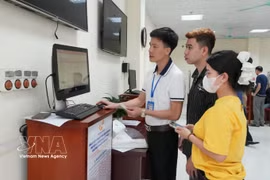
H’Loan Bdap, Vice Chairwoman of the People's Council of Dak Lieng commune in the central province of Dak Lak, said that in some ethnic minority hamlets and villages in the locality, many residents own smartphones but do not know how to create accounts, use online public services, complete electronic authentication or make cashless payments.
They also face difficulties in finding information and verifying its accuracy, while lacking the skills needed to protect personal data and identify the risks of online scams.
Turning technology into a capacity for development
Dr Pham Thi Xuan Nga, Deputy Director of the central and Central Highlands branch of the Vietnam Academy of Social Sciences, said narrowing the digital divide was an urgent requirement to ensure sustainable development and prevent anyone from being left behind. A clear implementation strategy is therefore needed to close the digital gap.
The expert said the mindset needed to shift from simply bringing technology to people towards empowering people with the ability to use technology.
Under this approach, every hamlet and village should have people with basic digital skills who can provide support for local residents. The network could include hamlet and village officials, young people's union members, teachers, members of women's associations, respected community figures, police and military personnel, as well as postal and telecommunications workers. Such a network would need to operate regularly and provide sustained support.
Ngoc stressed that improving digital capabilities among ethnic minority communities would require data and digital content to be localised. Digital assistant tools should be developed to support people in their mother tongues, thereby reducing language barriers.
Moreover, the goal of digital transformation should not stop at teaching people how to use a smartphone. It should enable them to use technology to improve their livelihoods and quality of life.
In some localities, ethnic minority communities have already received training in using technology to livestream the sale of coffee, pepper and durian, promote OCOP products, list goods on e-commerce platforms and develop community-based tourism. Such models should be expanded, she said.
Hamlets, settlements and villages should also have support points for accessing public services, avoiding a situation in which the government becomes increasingly digitalised while citizens find it more difficult to access public authorities.
Digital transformation governance at grassroots level must always put people at the centre. Citizens should not merely be regarded as beneficiaries of policy; they must genuinely become active participants and key agents in the digital transformation process./.
See more
Ca Mau step ups 100-day digital transformation campaign
Ca Mau province is stepping up a 100-day campaign to remove bottlenecks in digital transformation and improve public services, with local authorities focusing on online administrative procedures, digital data and digital infrastructure.
Vietnam News Agency accompanies national development journey: KPL leader
Director General of the Lao News Agency (KPL) Vannasin Simmavong said over its 81-year history, VNA has not only fulfilled its role as a national news agency by providing timely and reliable information, but also accompanied the Party, State and people through important periods of the country’s revolutionary history.
Vietnam, Laos coordinate efforts to combat drug crime
In recent years, the Vietnam Border Guard and Laos's law enforcement forces have effectively maintained mechanisms for information exchange and coordinated patrols, inspections and efforts to combat various types of crime, helping maintain stability along the border and creating favourable conditions for people on both sides to develop their socio-economic activities.
Vietnamese delegation departs for 48th Worldskills Competition in China
Le Thi Hang, Deputy Director of the Department of Vocational Education and Continuing Education, said the Vietnamese delegation this year comprises 12 competitors, 11 experts and 11 interpreters.
Vietnam, Laos, Cambodia discuss strategic infrastructure connectivity
Strengthening connectivity among the three countries would help them better leverage their respective advantages and expand links with broader regional frameworks, including the Greater Mekong Subregion (GMS) and ASEAN, said Prof. Dr. Le Van Loi, VASS President.
War martyrs' remains, artifacts discovered at mass grave in Da Nang
During the excavation, the team found various artifacts, including parachute cord, hammock fabric, a leather wallet and a toothbrush, along with other traces.
Vietnam seeks to advance gender equality amid public-sector reform
Organisational restructuring presents an opportunity to review personnel standards, procedures and working methods. If gender considerations are integrated into the process, it can help remove long-standing barriers, make better use of female talent and build a fairer and more accountable working environment.
Bac Ninh to launch eight projects in September to celebrate new status
The project series marking this milestone aims to expand space for industrial and urban development while gradually building out infrastructure for production and daily life.
Quang Ninh police bust 38.4 million USD transnational cybercrime ring
Quang Ninh city's Public Security Department warned individuals, agencies and businesses not to publicly disclose or provide personal information or bank account details on social media, and urged organisations and businesses to strictly comply with regulations on protecting customers’ personal data.
Vietnam, Germany cooperate to ensure clean water for disaster-hit areas
The delivery of PAUL systems to Vietnam for disaster relief in recent years shows that such cooperation can go beyond exchanges of experience and produce direct benefits for local communities.
Vietnam races to DNA-test 18,000 samples of martyrs’ remains by July 2027
The Ministry of Public Security will fast-track a project to build a repository capable of storing about 2 million biological samples from relatives for at least 50 years.
Vietnam to provide tuition support for preschoolers
Eligible children will be entitled to tuition exemptions, reductions or support, assistance with learning costs and other benefits in accordance with laws on education, children, people with disabilities, ethnic affairs and social assistance.
Overseas Vietnamese a key resource for Vietnam’s economic growth: Chinese expert
Resolution No. 23 reflects a shift in Vietnam’s approach to overseas Vietnamese, increasingly recognising them as an important resource for national development. It also demonstrates Vietnam’s continued commitment to openness and deeper international engagement.
Ecological agriculture for sustainable future
The workshop “Ecological agriculture for a sustainable future”, organised by ActionAid International in Vietnam, emphasised that women and young people must be the subjects and leaders of change, rather than merely participants or beneficiaries.
Nguyen Du bilingual school in Vientiane opens new academic year
The Nguyen Du Lao–Vietnamese Bilingual School in Vientiane plays a special role as not only a place of learning but also a space where Lao and Vietnamese cultures meet and where the two languages are part of students’ daily lives.
Phan Anh Son re-elected VUFO president
For the 2026–2031 term, the Vietnam Union of Friendship Organisations (VUFO) will follow the motto “Proactive adaptation, creative breakthroughs, practical effectiveness”.
Vietnam backs efforts to prevent use of cluster munitions, anti-personnel mines
Over the past five years, Vietnam has stepped up mine action, clearing an average of 40,000 hectares a year, supporting victims and expanding risk education programmes in affected communities.
Identifying martyrs’ remains requires whole political system’s efforts: Deputy PM
Deputy Prime Minister Pham Thi Thanh Tra inspected the practical implementation of DNA identification technology at the Centre for DNA Identification under the Institute of Biology of the Vietnam Academy of Science and Technology, and the Military Institute of Forensic Medicine under the Military Medical Department of the Ministry of National Defence on September 14.
Vietnam, RoK promote cooperation, youth’s role
Le Thi Viet Lam, Deputy Director of the Department of International Cooperation under the Ministry of Science and Technology, said Vietnam wishes to continue building an ecosystem that connects the State, research institutes, universities and businesses, enabling them to share resources and create value. This is also an area in which Vietnam is interested in learning from Korean experience.
Vietnam’s image from history to 2045 aspirations showcased in Paris
As part of the festival’s international space, the display booth of Nhan Dan newspaper, the official organ of the Communist Party of Vietnam, once again served as a meeting point between Vietnam and the French public as well as international friends.