Ca Mau (VNA) – Ca Mau province is stepping up a 100-day campaign to remove bottlenecks in digital transformation and improve public services, with local authorities focusing on online administrative procedures, digital data and digital infrastructure.
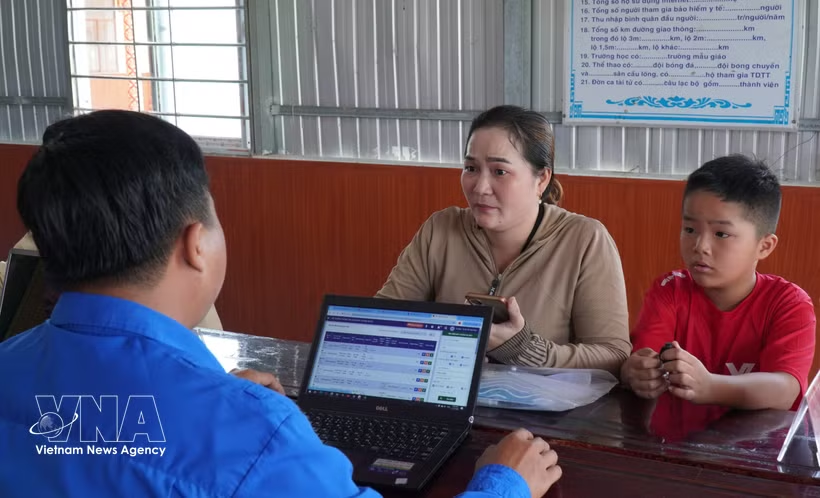
In Tran Phan commune, the campaign has been implemented urgently since the provincial plan was launched. The commune is focusing on increasing the rate of electronic certification and online processing of administrative dossiers.
It has also set up a mobile administrative service team to visit hamlets and help residents who face difficulties travelling to commune offices.
Son Van Ten, a local resident, said the initiative is particularly helpful for elderly people and those with limited mobility.
“Previously, we had to travel to the commune office to complete administrative procedures. Now, officials come to our homes and residential areas to help us. We are very pleased and grateful for the local authorities’ support,” he said.
Ten added that digital transformation has brought practical benefits to local people by reducing paperwork and making it easier to access market information online, helping them improve their production and business activities.

Vice Chairman of the communal People’s Committee Van Hoai Thuong said that although the disbursement of funds for digital transformation remains slow, the commune is adopting flexible solutions.
For tasks that require little or no funding, the commune is mobilising social resources and giving them priority. Major tasks requiring substantial funding will be implemented once resources are allocated by higher-level authorities.
“The entire political system of Tran Phan is making every effort to implement the 100-day campaign to remove digital transformation bottlenecks. This will also serve as a measure of the performance of local officials and civil servants in the coming period,” Thuong said.
In Vinh Phuoc commune, the campaign has also produced positive results. Chairman of the communal People’s Committee Nguyen Thanh Hoang said the locality has achieved a 100% rate in receiving and returning results for online administrative procedures and digitising dossiers.
However, he said improving service quality requires further efforts to standardise staff capacity and synchronise equipment.
Hoang identified human resources and digital infrastructure as the main bottlenecks. He called for investment in network infrastructure and modern equipment at public administrative service centres.
The commune also plans to strengthen technology training for specialised staff, focusing on cleaning and standardising civil-status and land data and using digital signatures.
59 tasks across 10 areas
Under Ca Mau’s 100-day action plan launched in mid-July, the province has identified 59 tasks requiring focused efforts to address obstacles in 10 areas: institutions, digital infrastructure, digital data, digital platforms, online public services, digital economy, digital society, human resources, finance and disbursement, and implementation discipline.
The campaign runs from July 10 to November 30, 2026, across agencies within the political system and commune-level administrations.
Vice Chairman of the Ca Mau provincial People’s Committee Nguyen Minh Luan said agencies and localities are implementing the campaign with the highest sense of responsibility. Heads of agencies and units are required to directly oversee implementation and take responsibility for their results.
He stressed that the campaign is not simply a technology programme but a strategic lever for advancing science and technology, innovation and digital transformation, creating new momentum for Ca Mau’s goal of achieving double-digit economic growth.
The province is accelerating the disbursement of funding for science and technology, innovation and digital transformation. Priority will be given to information technology infrastructure for Party agencies during 2025–2028 and to providing IT equipment for commune-level administrations.
Ca Mau aims to complete a review and standardisation of provincial data according to set criteria in 2026, addressing the current fragmentation and lack of connectivity among databases.
The province has also identified six key tasks, including clearing overdue assignments and outstanding documents, developing data and data platforms, ensuring effective operation of the two-tier local government system, and safely applying artificial intelligence while maintaining cybersecurity./.