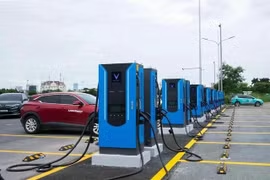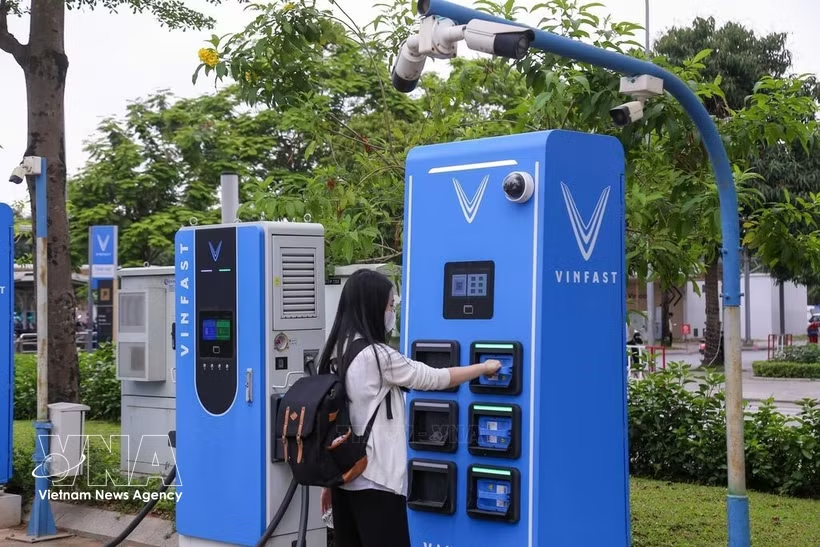
Hanoi (VNA) - The development of electric vehicle (EV) charging networks should be integrated into urban planning, linking transport, land use and urban space while ensuring adequate power supply, Assoc. Prof. Dr. Vu Anh Tuan from the Vietnamese-German University (VGU) has said.
The rapid growth of EVs is creating new infrastructure challenges for cities, requiring charging networks to be planned according to travel demand, power supply capacity and available urban space.
In Hanoi, as part of a survey of infrastructure serving the transition to EVs in the Ring Road No. 1 area, Hanoi Parking Co., Ltd. reviewed 150 parking sites and initially identified around 40 locations suitable for charging stations. The approach links charging infrastructure with parking facilities, traffic organisation and vehicle conversion needs.
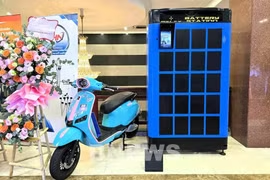
Under its Plan No. 215/KH-UBND, the municipal People’s Committee identified 180 locations suitable for battery-swapping cabinets across the Ring Road No. 1 area. Of these, 77 are in the two core wards of Hoan Kiem and Cua Nam, with two cabinets planned at each location.
Tran Minh Dung, a resident of Hanoi's Dai Kim area, said battery-swapping cabinets near residential areas could make EVs more convenient, especially for apartment dwellers who cannot charge at home.
Dr. Pham Duy Hoang, a transport expert from the United Nations Development Programme (UNDP), said public charging networks should be located according to actual demand, particularly in apartment complexes, urban areas, and public facilities.
Preparing power systems, parking spaces, and cabling from the design stage would support future expansion as the number of EVs grows, while avoiding higher costs and problems related to power capacity, space, and technical safety, he noted.
In Ho Chi Minh City, forecasts indicate a need for about 17,000-23,000 public charging points for electric cars by 2030. More than 80% are expected to be Level 2 chargers, with over 60% located in residential areas. These chargers are suitable for parking lots, shopping centres and residential areas, where vehicles tend to remain parked for longer periods, while DC fast chargers are more appropriate for major transport corridors, expressways and locations requiring rapid charging.
Meanwhile, electric motorbikes pose an even larger infrastructure challenge. By 2030, Ho Chi Minh City is forecast to need about 13,000-15,000 battery-swapping cabinets and 18,300-27,400 Level 1 charging points, with 59-64% of public charging points for electric motorbikes expected to be located at public sites. The figures highlight the need not only to increase the number of facilities but also to secure land, power supply and an integrated network suited to urban space.
A survey by the Ho Chi Minh City People's Committee identified about 90 potential sites meeting criteria including accessibility, traffic volume, land availability and grid capacity. Of these, 58% are on public land and 42% on private land. If developed, the sites could add about 1,094 charging points, including 125 slow, 541 fast and 428 ultra-fast chargers. The additional network could serve more than 34,000 EVs per day.
Tuan said infrastructure for EVs should be planned alongside housing, workplaces, schools, hospitals, parking facilities, transport hubs and public transport. New urban areas, apartment complexes, shopping centres and public facilities should reserve space and prepare power capacity, with built-in technical infrastructure being more efficient than retrofitting.
Experts also called for databases covering vehicles, charging demand, potential station locations and grid capacity. They said that electricity providers should be involved from the planning stage to assess power supply capacity, identify areas with available capacity and recommend locations compatible with the existing grid./.
See more
Population data, DNA technology aid efforts to identify fallen soldiers
Under the direction of the Government and the Ministry of Public Security, the ministry’s Police Department for Administrative Management of Social Order (C06) has led efforts to review and standardise information on martyrs and their relatives, collect DNA samples from relatives, and build and manage a DNA database. It also coordinates with forensic agencies to compare DNA data and identify the remains of fallen soldiers.
Controlled sandboxes needed to speed up application of new technologies
Although the Political Bureau’s Resolution No. 57-NQ/TW allows pilot schemes for new practical issues and accepts risks and delays in science, technology and innovation, concerns over risks and responsibility persist.
‘Ban Sac’ 2026 brings Vietnamese cultural values to life in digital space
“Ban Sac” is an online platform combining culture, digital communications and artificial intelligence (AI), running from September 15 to October 31 on its official website, www.bansac.vn.
VNA accelerates digital transformation, builds modern information ecosystem
Digital technology may change how journalism is practiced, but the core mission of journalists at a news agency remains unchanged: serving the nation and the people while ensuring a flow of official and reliable information that helps build public trust in the Party’s leadership.
Vietnam steps up semiconductor talent training to meet market demand
Vietnam needs to step up semiconductor workforce training to meet growing market demand and enhance its capacity to participate in the global technology value chain, experts said, highlighting the importance of closely linking training with businesses, production and technological research.
Vietnam seeks to boost education and technology cooperation with France
Education and training, science and technology, and high-quality human resources are key areas of cooperation in Vietnam-France relations, said Politburo Member, Secretary of the Communist Party of Vietnam Central Committee, and Chairman of its Commission for Organisation Nguyen Duy Ngoc while visiting the Institut Polytechnique de Paris on September 11.
Vietnam, France deepen cooperation in science, technology, workforce training
The University of Science and Technology of Hanoi (USTH), under the Vietnam Academy of Science and Technology (VAST), and the French Alternative Energies and Atomic Energy Commission (CEA) exchanged two cooperation agreements in Paris on September 11, in the presence of General Secretary of the Communist Party of Vietnam Central Committee and President To Lam.
Vietnam eyes UAV industry as key driver of low-altitude economy
For Vietnam, the opportunity presented by unmanned aerial vehicles (UAVs) lies not only in expanding their applications but, more importantly, in gradually building industrial capacity, mastering technologies and engaging more deeply in global value chains.
Vietnam seeks deeper integration into global semiconductor value chains
Nguyen Anh Tuan, Director of the National Centre for Pilot Semiconductor Chip Manufacturing Support under the Ministry of Science and Technology, said that amid increasingly intense global technological competition, the semiconductor industry is not only a high-value-added economic sector but also a foundation for technological self-reliance, national security and economic competitiveness.
Hanoi approves controlled pilot of two technology projects
The two projects involve an intelligent autonomous transportation system developed by Phenikaa-X JSC and a technology for producing mixed rare-earth oxides with a purity of over 95% on a semi-industrial scale developed by the Mining Technology and Construction Consultancy JSC.
Vietnam, Czech Republic expand cooperation in education, science, technology
Vietnamese Ambassador Duong Hoai Nam stressed the need to strengthen cooperation between educational and research institutions of the two countries, shifting from exchanges and individual projects towards long-term partnerships with tangible outcomes.
Vietnam, Russia develop quantum technology cooperation roadmap
Quantum technology is an emerging field undergoing rapid breakthroughs and requiring enormous investment resources. Learning from the experience of pioneering countries such as Russia will enable Vietnam to significantly shorten the time needed to build its workforce and develop endogenous capabilities.
Core technologies open new avenues for Vietnam-France cooperation: expert
General Secretary of the Communist Party of Vietnam Central Committee and President To Lam’s upcoming official visit to France is expected to provide fresh momentum for Vietnam-France ties as it comes at a pivotal time for Vietnam’s economic restructuring.
Major shifts expected in Vietnam–Russia technology cooperation
Leaders of the Vietnam Academy of Science and Technology (VAST) and AFK Sistema agreed to promote cooperation in three priority strategic technology areas, namely green hydrogen, small satellites, and unmanned aerial vehicle (UAV) systems.
Deputy PM expects FPT to further connect Vietnam, RoK in technology
Dung acknowledged FPT’s progress in the Korean market and said he expects the company to further foster exchanges in technology and advanced research and development (R&D) models, helping connect Vietnamese technology companies in the RoK.
Vietnam, France should expand cooperation in strategic fields: business leader
General Secretary of the Communist Party of Vietnam Central Committee and President To Lam’s visit to France, Guy Bonassi, Senior Vice-President of Latin America and Asia at Thales Group, said the upgrade of bilateral ties to a Comprehensive Strategic Partnership reflects their shared desire to deepen and broaden cooperation, with technological autonomy, resilience and human resources development assuming increasingly important roles.
New momentum for Vietnam-France energy, technology cooperation
Schneider Electric remains committed to long-term cooperation with Vietnam, contributing to a more resilient, competitive and sustainable economy.
Vietnam enters global top 10 for mobile and fixed broadband speeds
According to Ookla’s Speedtest Global Index for July 2026, Vietnam’s mobile Internet ranking jumped 10 places to 10th globally, with a median download speed of 205.58 Mbps.
Vietnam, RoK promote strategic technological cooperation
Deputy Prime Minister Ho Quoc Dung proposed expanding joint research programmes, particularly in strategic areas where Vietnam has development needs, and KIST has strengths, including semiconductor integrated circuits, AI, batteries and energy storage, and biotechnology.
Vietnam, Israel explore stronger cooperation in cybersecurity, AI, innovation
Vietnamese Ambassador to Israel Nguyen Ky Son held working sessions with leaders of the Israeli Cyber Emergency Response Team (CERT), the Israel National Cyber Directorate (INCD), the Be’er Sheva Innovation District and the cyber security research centre at Ben-Gurion University of the Negev (BGU).