Can Tho seeks to improve FDI quality, create new growth momentum

Can Tho is now facing a “window of opportunity” to upgrade the quality of FDI, but needs to shift from a mindset of attracting capital to one focused on selecting, absorbing and spreading investment value.

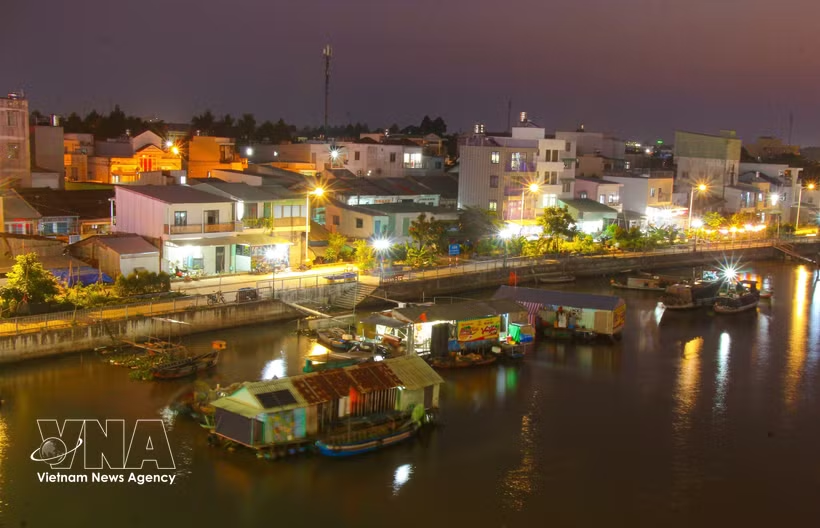
A corner of Can Tho city (Photo: VNA)

Can Tho (VNA) – Following the expansion of its development space, together with the formation and completion of its network of transport infrastructure, industrial parks and logistics centres, Can Tho is presented with an opportunity to redefine its role in attracting foreign direct investment (FDI) to the Mekong Delta.

In the new development phase, the goal is not only to attract more capital, but more importantly to retain a greater share of the value generated by each investment project.

According to Associate Professor Dr Phan Anh Tu, Vice Rector of the School of Economics at Can Tho University, FDI is a relatively stable “pillar” of the city's economy but has yet to become a new growth driver. Therefore, rather than simply increasing the number of projects and registered capital, Can Tho should focus on selecting suitable investment flows, shortening the time needed to put projects into operation, improving its capacity to absorb investment and strengthening linkages between FDI enterprises and the domestic sector.

In the first eight months, the delta city attracted three new FDI projects with a total registered capital of 25.22 million USD, bringing its total number of such projects to 125 and their capital to over 7.15 billion USD.

During the period, the Can Tho Export Processing & Industrial Zone Authority received and worked with around 30 investors. Between January and July, the city welcomed 525 foreign delegations comprising 3,535 visitors. However, the number of new FDI projects remained modest.

According to Tu, Can Tho should prepare “investment-ready” dossiers for each priority industrial park, clearly setting out available land, planning, infrastructure, land rental prices, electricity and water supply capacity, wastewater treatment facilities and the time required to complete inter-agency procedures. This would shift investment promotion from simply “inviting” investors to proactively developing a portfolio of projects.

Expanding infrastructure, strengthening linkages to create value


Following the reorganisation of administrative units, the city's industrial park network now stretches from Tra Noc, Thot Not, Vinh Thanh, Tan Phu Thanh, Dong Phu and Song Hau to An Nghiep, Tran De, Dai Ngai, Long Thanh and Tan Binh. The city is also coordinating surveys and proposing the scale and boundaries of the Tran De economic zone, creating additional space for industry, logistics and the marine economy.

Inter-regional transport infrastructure is expected to further change Can Tho's locational advantages. The 175.2km Ho Chi Minh City-Can Tho railway, passing through five provinces and cities, is expected to help restructure the economic landscape and reduce logistics costs. Logistics costs in the Mekong Delta currently account for around 18-22% of the value of goods, while the project is targeted to begin construction in 2027.

However, infrastructure only creates opportunities; the ability to turn them into investment flows and economic value depends on the locality's preparedness.

According to Tu, human resources and logistics are not yet the biggest obstacles to FDI but could become decisive factors for future investment flows. Therefore, workforce training needs to be carried out in advance and closely linked to specific business needs.

Can Tho capitalises on its strengths in logistics, finance, science and technology, high-quality human resources and business services, while other localities can undertake appropriate stages involving raw materials, processing, energy and the marine economy, he noted.

This orientation opens room for a new generation of FDI in deep processing of agricultural and aquatic products, food technology, biotechnology, multimodal logistics, the circular economy, clean energy, automation, digital transformation and knowledge-based services.

According to Dr Tran Huu Hiep, an economic expert, Can Tho is now facing a “window of opportunity” to upgrade the quality of FDI, but needs to shift from a mindset of attracting capital to one focused on selecting, absorbing and spreading investment value.

The effectiveness of FDI should be assessed in terms of the amount of added value retained locally, quality employment, the transfer of technology and management capacity, and the extent to which domestic businesses participate in value chains./.


VNA
See more

VinFast electric cars are gathered at Hai Phong Port, ready to be loaded onto a ship for export. (Photo: VNA)

Going global: The competition challenge for "Made in Vietnam" cars

The growing number of exporters shows that Vietnam’s automobile industry is entering a new stage of development. However, international markets also present major challenges related to localisation, supporting industries, technological capabilities, human resources and country-specific technical standards.

Ports in Ho Chi Minh City are always bustling with ships loading and unloading cargo (Photo: VNA)

Ho Chi Minh City helps businesses effectively leverage FTAs

Ho Chi Minh City will implement a range of tasks and solutions to enhance business competitiveness, promote sustainable exports, expand markets, and enable local businesses to engage more deeply in global value and supply chains. The move is also expected to contribute to the development of Ho Chi Minh City as a regional hub for trade, logistics and international economic integration.

Illustrative image (Photo: VNA)

Livestreaming helps Vietnamese goods break past local markets

Once a product goes digital, it can transcend geography entirely. Consumers no longer need to visit a store or craft village in person to learn where a product comes from, how it's made, or whether it's worth buying. They can do all of that, and decide to buy, from a screen.

The south-central province of Khanh Hoa on September 16 announces investment approval decisions and investment registration certificates for five projects worth nearly 10.82 trillion VND (415.96 million USD). (Photo: VNA)

Khanh Hoa approves industrial projects with investment of 10.8 trillion VND

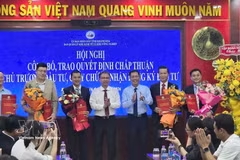
The south-central province of Khanh Hoa on September 16 announced investment approval decisions and investment registration certificates for five projects worth nearly 10.82 trillion VND (415.96 million USD), including three industrial park infrastructure projects and two foreign-invested ones.

A view of a ceremony to kick off the Northern Industry and Trade Fair - Bac Ninh 2026 on September 16, 2026 (Photo: VNA)

Northern industry-trade fair 2026 opens in Bac Ninh

The Northern Industry and Trade Fair - Bac Ninh 2026 features more than 222 booths with over 200 participating organisations and businesses, showcasing and introducing industrial and trade products from provinces and cities in the region, One Commune One Product (OCOP) items, typical rural industrial products, traditional craft village products, signature products of businesses, as well as regional trade, tourism and food products.

Delegates share information during the livestream programme. (Photo: VNA)

Bac Ninh promotes agricultural products through livestream

More than 300 products from Bac Ninh, Hanoi, Hung Yen, Son La, Thai Nguyen and Phu Tho were showcased during a livestream session held by the Bac Ninh Farmers' Union, ranging from traditional foods, agricultural products and medicinal herbs to natural products, OCOP goods, handicrafts and craft village products.

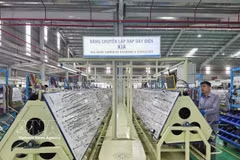
An automobile assembly line of THACO Truong Hai Group. (Photo: VNA)

Flexible fiscal policy helps drive economic growth

According to the Ministry of Finance, State budget revenue in the first eight months of 2026 was estimated at 2.02 quadrillion VND (77.7 billion USD), equivalent to 80% of the annual estimate and up 16% year-on-year. Domestic revenue reached 1.75 quadrillion VND, accounting for 86.6% of total revenue and rising 16.6%.

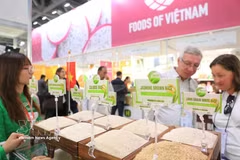
Visitors explore Vietnamese products at WorldFood Moscow 2026. (Photo: VNA)

Vietnamese goods step up market expansion in Russia

The Vietnamese participants are showcasing a wide range of products, including beverages, fresh and dried fruit, processed foods, instant foods and dipping sauces, while seeking distribution partners, expanding their market presence and increasing brand recognition in the country.

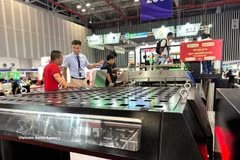
A Vietnamese manufacturer showcases a modern production line at VietnamPrintPack 2026. (Photo: VNA)

VietnamPrintPack 2026 kicks off in Ho Chi Minh City

VietnamPrintPack 2026 serves as a hub connecting the supply chain, showcasing breakthrough solutions in automation, digital printing, radio-frequency identification (RFID)-integrated smart packaging, and eco-friendly materials across Vietnam's industrial landscape.