Lai Chau ginseng targeting international markets

To reach global markets, Lai Chau ginseng needs a clear roadmap: standardising growing areas, ensuring transparent traceability, promoting deep processing and building a national brand.

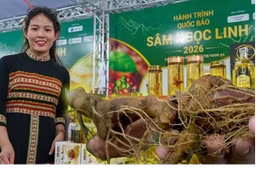
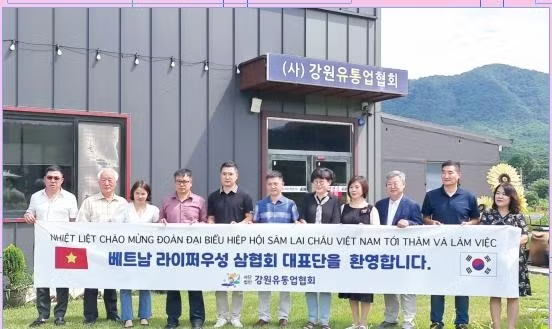
A delegation from the Lai Chau ginseng association learns about ginseng processing technology in the Republic of Korea. (Photo: baolaichau.vn)

Lai Chau (VNA) – Lai Chau ginseng is now entering a new phase of development, with a vision that goes beyond simply preserving and cultivating the plant. More than a valuable medicinal herb, it is being position as a high-value economic sector, linked to sustainable forest-based development and international integration.

To reach global markets, Lai Chau ginseng needs a clear roadmap: standardising growing areas, ensuring transparent traceability, promoting deep processing and building a national brand.

One of Lai Chau's breakthrough steps has been the issuance of growing-area establishment codes.

Nguyen Thanh Dong, Deputy Director of the provincial Department of Agriculture and Environment, said that the issuance of codes is not simply a management tool, but a strategic step in standardising local ginseng production areas.

To date, 112 growing establishments across the province have been issued codes – an important foundation for moving towards the official registration of growing-area codes, meeting traceability requirements and expanding export markets. Each code not only ensures transparency but also reflects a clear shift from small-scale production towards more professional models that are increasingly aligned with international standards.

If growing-area codes are a necessary condition, deep processing is the sufficient one for raising the value of the product.

According to forestry scientist Dr Pham Quang Tuyen of the Vietnam Academy of Forest Sciences, the current priority is to strengthen the scientific foundation and develop products. It is necessary to quickly establish a set of quality standards and complete the dossier for the inclusion of Lai Chau ginseng in the Vietnamese pharmacopoeia. At the same time, sustainable growing areas under forest canopies should be developed in association with the livelihoods of ethnic minority communities. More importantly, investment in deep processing is needed to create products such as functional foods, pharmaceuticals and healthcare products.

In Bum Nua commune, Pusilung Ginseng JSC is among the pioneers in this field. With nearly 20 hectares of ginseng, the company is not only focused on cultivation but is also working with Japanese experts to apply modern farming technologies to improve the medicinal properties and quality of its products. At the same time, processed products such as ginseng tea, ginseng honey and ginseng extract drinks are gradually being researched and brought to market.

Its General Director Dinh Van Do said: “Applying Japanese technology helps improve the quality of the medicinal materials while opening up opportunities to access demanding markets such as Japan and the Republic of Korea. This is an inevitable path towards increasing value and affirming the position of Lai Chau ginseng.”

These developments clearly show that, if local ginseng is to go further, it cannot simply be sold as a raw material; it must become more deeply integrated into the global value chain. No industry can develop sustainably without strong linkages. For Lai Chau ginseng, the “four-party” model is gradually becoming a key pillar. The State provides mechanisms, policies and planning; scientists conduct research and transfer technology; businesses invest, organise production and expand markets; and local people directly cultivate the crop and benefit from it. In particular, the establishment of the Lai Chau ginseng association has played a role in connecting businesses, promoting international cooperation and developing a long-term strategy.

From fragmented and spontaneous development, the province now has hundreds of hectares of ginseng involving more than 50 businesses and cooperatives, together with hundreds of farming households. This scale is expected to expand rapidly, with a target of around 3,000 hectares by 2030. Alongside the expansion of cultivation areas, comprehensive standardisation is under way – from seed quality and farming processes meeting international standards to the establishment of geographical indications, the issuance of growing-area codes and the gradual development of a deep-processing industry.

Notably, proactive participation in international events such as the Geumsan World Ginseng Festival in the Republic of Korea has helped Lai Chau ginseng gradually establish its identity on the global medicinal-herb map, opening up opportunities to connect with markets and attract investment./.

VNA

See more

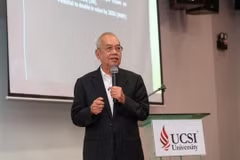
Professor Dato Dr Ahmad Ibrahim, an expert in technology, digital transformation and agricultural value chains at UCSI University (Photo published by VNA)

Malaysia-Vietnam cooperation potential under NAP 2.0: expert

By leveraging their complementary strengths under the NAP 2.0 framework, Malaysia and Vietnam have considerable potential to deepen cooperation to build a more technology-driven, sustainable, and resilient agricultural sector in Southeast Asia.

VinFast electric cars are gathered at Hai Phong Port, ready to be loaded onto a ship for export. (Photo: VNA)

Going global: The competition challenge for "Made in Vietnam" cars

The growing number of exporters shows that Vietnam’s automobile industry is entering a new stage of development. However, international markets also present major challenges related to localisation, supporting industries, technological capabilities, human resources and country-specific technical standards.

Ports in Ho Chi Minh City are always bustling with ships loading and unloading cargo (Photo: VNA)

Ho Chi Minh City helps businesses effectively leverage FTAs

Ho Chi Minh City will implement a range of tasks and solutions to enhance business competitiveness, promote sustainable exports, expand markets, and enable local businesses to engage more deeply in global value and supply chains. The move is also expected to contribute to the development of Ho Chi Minh City as a regional hub for trade, logistics and international economic integration.

Illustrative image (Photo: VNA)

Livestreaming helps Vietnamese goods break past local markets

Once a product goes digital, it can transcend geography entirely. Consumers no longer need to visit a store or craft village in person to learn where a product comes from, how it's made, or whether it's worth buying. They can do all of that, and decide to buy, from a screen.

The south-central province of Khanh Hoa on September 16 announces investment approval decisions and investment registration certificates for five projects worth nearly 10.82 trillion VND (415.96 million USD). (Photo: VNA)

Khanh Hoa approves industrial projects with investment of 10.8 trillion VND

The south-central province of Khanh Hoa on September 16 announced investment approval decisions and investment registration certificates for five projects worth nearly 10.82 trillion VND (415.96 million USD), including three industrial park infrastructure projects and two foreign-invested ones.

A view of a ceremony to kick off the Northern Industry and Trade Fair - Bac Ninh 2026 on September 16, 2026 (Photo: VNA)

Northern industry-trade fair 2026 opens in Bac Ninh

The Northern Industry and Trade Fair - Bac Ninh 2026 features more than 222 booths with over 200 participating organisations and businesses, showcasing and introducing industrial and trade products from provinces and cities in the region, One Commune One Product (OCOP) items, typical rural industrial products, traditional craft village products, signature products of businesses, as well as regional trade, tourism and food products.

Delegates share information during the livestream programme. (Photo: VNA)

Bac Ninh promotes agricultural products through livestream

More than 300 products from Bac Ninh, Hanoi, Hung Yen, Son La, Thai Nguyen and Phu Tho were showcased during a livestream session held by the Bac Ninh Farmers' Union, ranging from traditional foods, agricultural products and medicinal herbs to natural products, OCOP goods, handicrafts and craft village products.

An automobile assembly line of THACO Truong Hai Group. (Photo: VNA)

Flexible fiscal policy helps drive economic growth

According to the Ministry of Finance, State budget revenue in the first eight months of 2026 was estimated at 2.02 quadrillion VND (77.7 billion USD), equivalent to 80% of the annual estimate and up 16% year-on-year. Domestic revenue reached 1.75 quadrillion VND, accounting for 86.6% of total revenue and rising 16.6%.