Vietnam calls on JBIC, Japanese firms to boost quality investment in strategic sectors

Representatives of Japanese businesses praised Vietnam’s foreign investment policies and expressed their commitment to continuing to accompany and closely coordinate with the country. They also shared Japan’s perspectives on energy transition and ensuring electricity supply in Vietnam.

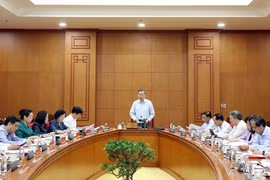
An overview of the meeting between Secretary of the Communist Party of Vietnam Central Committee and head of its Commission for Policy and Strategy Nguyen Thanh Nghi Maeda Tadashi, Managing Director and Chairman of the Board of Directors of JBIC and a delegation of Japanese businesses (Photo: VNA)

​Hanoi (VNA) — Politburo member, Secretary of the Communist Party of Vietnam Central Committee and head of its Commission for Policy and Strategy Nguyen Thanh Nghi has called on the Japan Bank for International Cooperation (JBIC), Japanese businesses and partners to continue sharing experience in effective investment cooperation models and support Vietnam in enhancing the self-reliance and resilience of its economy through high-quality Japanese investment in strategic sectors.

At a reception for Maeda Tadashi, Managing Director and Chairman of the Board of Directors of JBIC and a delegation of Japanese businesses on October 2, the official affirmed that Japan is one of Vietnam’s leading important partners in the region and the world and highly valued JBIC’s role as a bridge connecting Vietnam with Japanese capital, technology and business community, particularly in infrastructure, energy and green transition.

As a strategic advisory body to the Party Central Committee on major orientations, policies and solutions for socio-economic development, the Commission for Policy and Strategy also conducts research and analysis and provides strategic advice to the Party and State on major, long-term issues facing Vietnam. Therefore, establishing a strategic dialogue mechanism between the commission and JBIC is of great importance in strengthening substantive cooperation between the two bodies and contributing to deepening and effectively implementing the Comprehensive Strategic Partnership between Vietnam and Japan, he said.

For his part, Maeda spoke highly of Vietnam’s growth targets, saying that the strategic dialogue framework between JBIC and the commission would make a practical contribution to enhancing cooperation between Vietnam and Japan.

The two sides discussed major global trends, orientations for strengthening bilateral cooperation, and issues related to energy security and the mobilisation and attraction of international investment capital to Vietnam.

Representatives of Japanese businesses praised Vietnam’s foreign investment policies and expressed their commitment to continuing to accompany and closely coordinate with the country. They also shared Japan’s perspectives on energy transition and ensuring electricity supply in Vietnam.

Representatives of Vietnamese ministries and sectors exchanged views with Japanese businesses on issues of interest to the Japanese side.

Appreciating Japan’s analysis and sharing on major shifts in the global economic and geopolitical environment, Nghi took note of Japanese businesses’ views on ensuring electricity and energy supplies for Vietnam.

He said Vietnam’s goal is not only to ensure sufficient electricity, but also to build an energy system that is safe, stable, flexible and resilient to shocks, while keeping costs reasonable and becoming increasingly green.

Vietnam therefore needs to select solutions that match its resource-balancing capacity and development conditions, Nghi said, adding that the Vietnamese side will seriously study proposals from Japanese businesses based on Vietnam’s conditions and interests.
vnanet-nhat-ban3.jpg
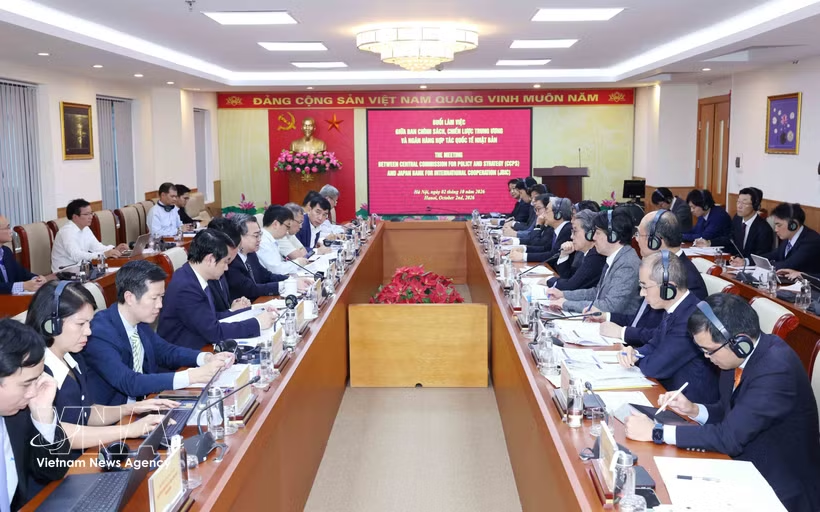
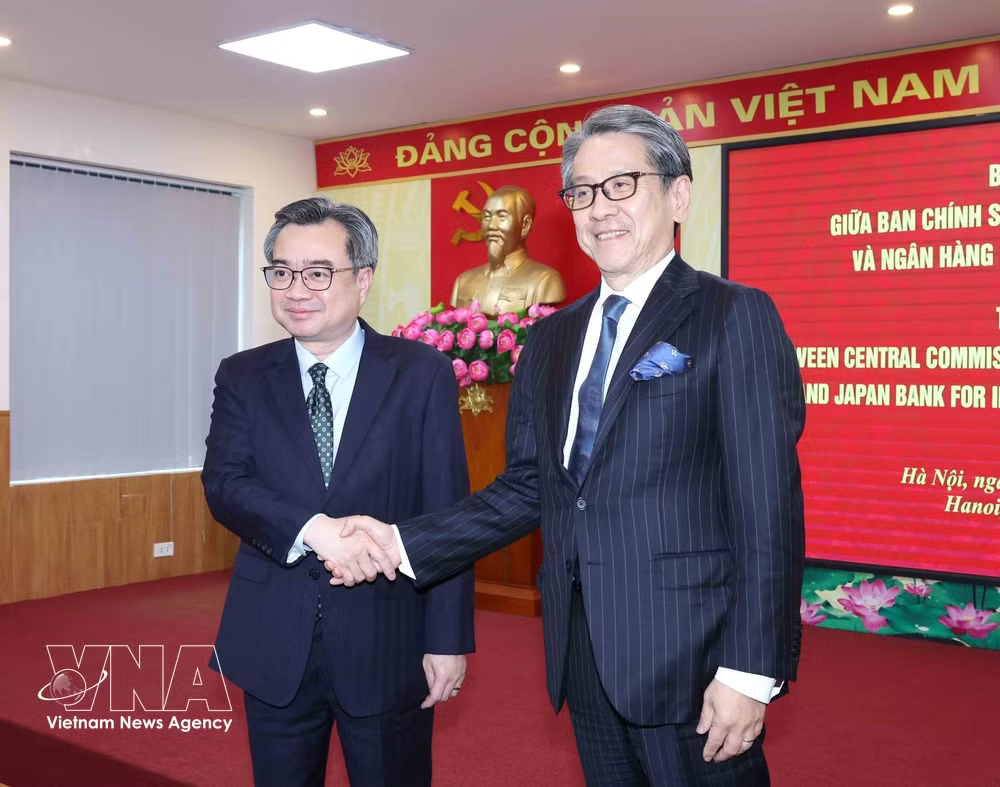
Politburo member, Secretary of the Communist Party of Vietnam Central Committee and head of its Commission for Policy and Strategy Nguyen Thanh Nghi (left) and Maeda Tadashi, Managing Director and Chairman of the Board of Directors of JBIC at the meeting (Photo: VNA)

Nghi also highlighted several areas for cooperation in the coming period, including stronger exchanges on major shifts in the global economy and their impacts on the development strategies of the two countries; closer cooperation in science and technology, innovation and strategic industries; and greater attraction of high-quality Japanese investment to jointly develop resilient supply chains. He also called for stronger cooperation in energy and development finance.

The official proposed that Japan maintain the Strategic Dialogue as a regular mechanism for discussions on Vietnam’s long-term development issues. He also asked JBIC to help connect Vietnam with Japanese investors and businesses possessing strong financial and technological capacity to invest in energy development projects, support upgrades to Vietnam’s power transmission grid and develop large-scale renewable energy sources.

Nghi expressed his hope that JBIC and Japanese businesses will continue accompanying Vietnam not only as financiers or investors, but also as partners working with Vietnam to address long-term development challenges, thereby contributing to stronger bilateral cooperation./.
​

VNA

See more

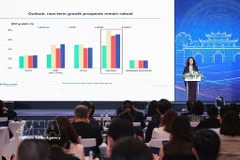
Tehmina Khan, the World Bank's Lead Economist for Vietnam, Cambodia and Laos, speaks at the event (Photo: VNA)

Vietnam develops capital market to support double-digit growth

At a special session on Vietnam themed “Investing in Vietnam – Rising to a new era,” Chairwoman of the State Securities Commission (SSC) Vu Thi Chan Phuong said Vietnam is entering a new development period with strong demand for capital for growth, infrastructure development, energy transition, high technology and new industries.

The Vietnam Sea Forum 2026 wraps up in Hanoi on October 2 (Photo: VNA)

Vietnam Maritime Forum 2026 concludes in Hanoi

The forum focused on mobilising resources and strengthening international connectivity for sustainable marine development, science, technology and marine governance in the new era, and enhancing international cooperation to protect the environment and promote the values of coastal communities.

Nguyen Duy Hung, Deputy Head of the Party Central Committee's Commission for Policy and Strategy, speaks at the event. (Photo: VNA)

2026 forum seeks to turn Vietnam into strong maritime nation

The Politburo’s Resolution 20-NQ/TW marks a strategic shift in how Vietnam views the sea, casting it as a pillar of national strength. Building a strong maritime nation is a long-term strategy tied to the country’s drive to rise and prosper.

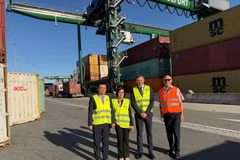
Vietnamese and Korean officials pose for a group photo at the Busan Port Authority. (Photo: baoquocte.vn)

Vietnam, RoK share experience in budget management, regional connectivity

At a meeting with Busan Vice Mayor for Administrative Affairs Kim Kyung Duk, the two sides exchanged experience in budget management, the decentralisation of local budgets, mechanisms for support from the central budget, policies to attract private-sector investment in technical infrastructure, and governance and financial mechanisms serving regional connectivity.

Nestlé Vietnam is a Swiss-invested enterprise that has continuously increased its investment and expanded operations in Hung Yen province since 2017. (Photo: VNA)

Vietnam remains growth bright spot in Southeast Asia

A report jointly released by US global management consulting firm Bain & Company, Singaporean financial services group DBS and Singapore-based strategic consultancy Vriens & Partners said Vietnam remained a leading growth market in Southeast Asia, with baseline growth projected at 6.2%.

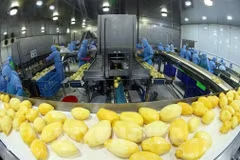
A modern production line processing frozen mango products for export at ANTESCO, Chau Phu commune, An Giang province. (Photo: VNA)

Vietnam’s agro-forestry-fishery exports rise 7.8% in nine months

Vietnam’s agro-forestry-fishery exports maintained growth momentum in the first nine months of 2026 despite continued volatility in global markets, reaching 56.3 billion USD, up 7.8% year on year. The sector posted a trade surplus of 16.9 billion USD, an increase of 7.4%.

Illustrative image (Photo: VNA)

New investor demands spur overhaul of Hai Phong’s industrial ecosystem

Foreign direct investment into Hai Phong remained among the strongest in Vietnam in the first nine months of 2026. Registered capital is estimated at more than 3.638 billion USD, or 93.3% of the full-year target of 3.9 billion USD. The inflow is helping the city pursue double-digit economic growth for the year.