Hanoi (VNA) – As traditional growth drivers reach their limits, transforming the growth model is no longer an option but an imperative of the times. The Asian Development Bank (ADB) said Vietnam has made significant progress in shifting its growth model.
However, experts held that to sustain long-term development, the transition remains unfinished and major challenges still need to be addressed.
Significant strides
In an interview with the Vietnam News Agency, Bui Minh Giap, ADB's principal economist in Vietnam, said that by consistently pursuing an open-door policy, attracting foreign direct investment (FDI), investing heavily in infrastructure and capitalising on its competitive labour force, Vietnam has made significant strides from a low-income economy to an important regional manufacturing and export hub.
Commenting on this journey, Giap noted that Vietnam has become an upper-middle-income economy earlier than its 2030 target.
According to the World Bank Group’s annual country classification, Vietnam’s gross national income (GNI) per capita rose from 4,490 USD in 2024 to 4,970 USD in 2025, officially surpassing the 4,636 USD threshold for upper-middle-income economies under the WB’s revised classification. The milestone came after 17 consecutive years in the lower-middle-income group since 2009.
At a press conference to release the September Asian Development Outlook (ADO), ADB Country Director for Vietnam Shantanu Chakraborty praised the Vietnamese economy’s strong performance in the first half of the year despite continued global volatility. Vietnam’s GDP grew an impressive 8.2% in the first half of 2026, significantly higher than the 7.5% recorded in the same period last year.
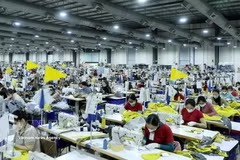
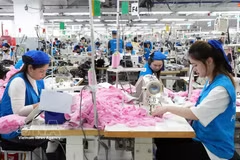
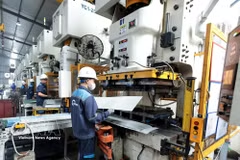
Chakraborty noted that growth was broad-based, driven by continued expansion in manufacturing and processing, a recovery in domestic consumption, stable FDI inflows and timely policy support.
Giap shared the assessment, stressing that a notable feature of Vietnam’s recent growth is that it has not been driven by a single sector but spread across industry, construction, services, agriculture, consumption, investment and trade.
He identified investment and production as two particularly important growth drivers. FDI has been a bright spot, with both registered and disbursed capital increasing in the first six, seven and eight months of the year, indicating that Vietnam remains an important destination in regional production chains.
On the production side, the Purchasing Managers’ Index (PMI) for manufacturing remained above the 50-point threshold for 14 consecutive months, signalling continued expansion in the sector and supporting growth in other parts of the economy.
Against these stronger-than-expected signals, the September ADO continued to project Vietnam as one of the fastest-growing economies among developing economies in the Asia-Pacific region in 2026, with the region’s largest upward growth revision. ADB raised its 2026 growth forecast for Vietnam to 7.8%, significantly higher than the 7.2% projection made in July. Growth in 2027 is forecast to ease slightly to 7.6%, still above the 7.0% forecast issued in July.
Domestic bottlenecks
Despite the positive progress, ADB cautioned that Vietnam’s growth model transition remains incomplete. The economy still relies heavily on capital accumulation, bank credit, low-cost labour, FDI and imported production inputs.
According to ADB, the first challenge is the economy’s heavy dependence on bank credit. By the end of 2025, outstanding bank loans were equivalent to 145% of GDP, while the corporate bond market remained relatively shallow at around 10% of GDP.
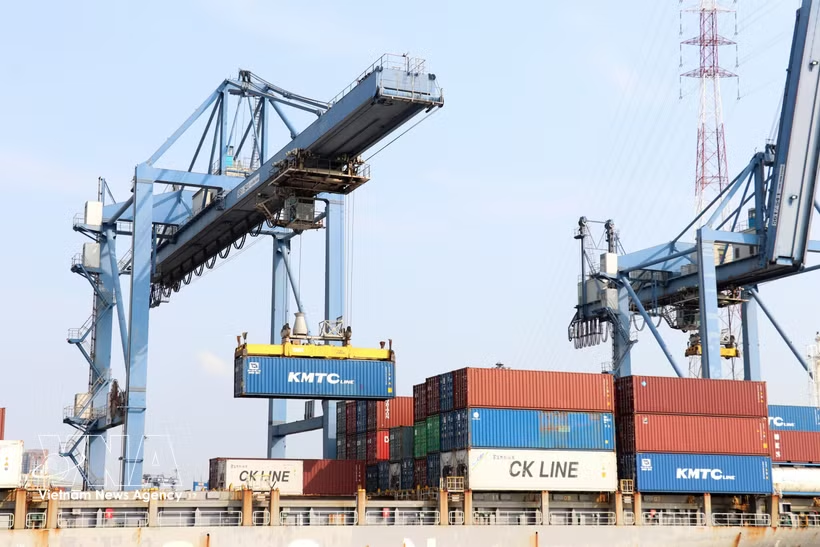
Giap also highlighted the trade deficit as imports have grown faster than exports. From January to July 2026, exports rose 21.7%, driven by key products such as electronics and manufactured goods. Imports, however, surged 34.8%, widening the merchandise trade deficit to 20.5 billion USD.
A closer look shows that the trade deficit is not entirely negative, Giap said, as it reflects expanding production and stronger imports of machinery, equipment, raw materials and components to meet manufacturing demand. However, he stressed that the downside is that the domestic economy remains heavily dependent on imported inputs.
Another strategic challenge raised by Chakraborty is the need to strengthen the role of the domestic private sector. The ADB representative stressed that strengthening the role of the domestic private sector does not mean diminishing the importance of FDI. FDI remains crucial to growth, exports, technology and employment. The key is to strengthen the capacity of domestic businesses to better absorb the benefits of FDI and participate more deeply in value chains, particularly as small and medium-sized enterprises account for 95% of all businesses.
Alongside strengthening domestic enterprises, Giap said a key reform priority is to shift from the mindset of “attracting FDI projects” to “building a strong investment ecosystem around the FDI sector”.
Investment screening and incentives should place greater emphasis on domestic value added, technology transfer, research and development (R&D), local sourcing, workforce skills, environmental performance and linkages with Vietnamese businesses, he said. This would enable high-quality FDI to become a stronger driver of domestic business growth and improve national competitiveness over the long term.
Chakraborty stressed that behind the impressive growth figures achieved so far, the key challenge now is how Vietnam can maintain high growth while improving its quality.
To achieve this, transforming the growth model is no longer an option but a necessity if Vietnam is to avoid the middle-income trap and pursue its goal of becoming a high-income country by 2045, he said./.