Vietnam’s pepper exports top 1.3 billion USD, maintain growth momentum

The outlook for the pepper industry remains positive, but greater efforts are needed to standardise growing areas, improve product value and strengthen competitiveness.

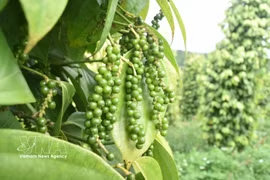
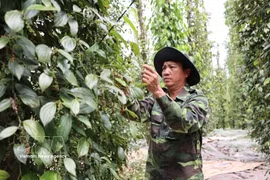
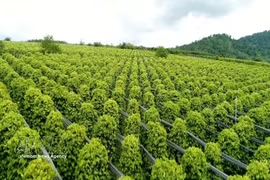
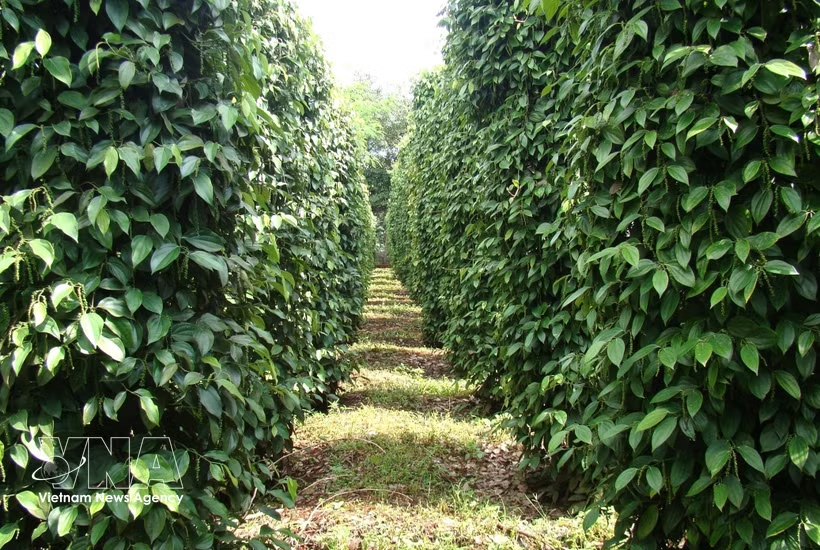
Vietnam ships abroad 10,915 tonnes of pepper worth 70 million USD in the first half of September alone. (Photo: VNA)

Hanoi (VNA) – Vietnam exported 202,414 tonnes of pepper from the beginning of this year to September 15, earning 1.32 billion USD in revenue, up 15.2% in volume and 10.3% in value year-on-year.

The outlook for the pepper industry remains positive, but greater efforts are needed to standardise growing areas, improve product value and strengthen competitiveness.

During the reviewed period, the US remained Vietnam’s largest pepper export market, purchasing 47,254 tonnes, or 23.5% of the total. It was followed by China with 22,620 tonnes and the UAE with 13,486 tonnes.

According to the Vietnam Pepper and Spice Association (VPSA), the country shipped abroad 10,915 tonnes of pepper worth 70 million USD in the first half of September alone.​

Meanwhile, Vietnam imported 959 tonnes of pepper worth 5.3 million USD in the first half of September. During the period through September 15, imports reached 47,961 tonnes, up about 35% year-on-year.

Despite strong export growth amid shrinking domestic production, domestic pepper prices have yet to recover as expected. The main reasons include additional supplies from imports and market uncertainties caused by conflicts in the Middle East and US tariff policies.

As of September 29, pepper prices in major growing areas ranged from 136,000-140,000 VND (5.24- 5.29 USD) per kg, up 1,000-3,000 VND per kg from the end of August but still 10,000-12,000 VND lower than a year earlier.

Building transparent supply chains

VPSA said global pepper production in 2026 is forecast to remain below earlier estimates, as output in Vietnam, Indonesia and India has fallen due to adverse weather and lower yields. Although Brazil has recorded higher production, the increase is not enough to offset shortages in other major producing countries.

The industry also faces increasingly stringent quality requirements. Notably, the European Food Safety Authority (EFSA) is moving towards cumulative risk assessment for multiple pesticide active substances, a trend expected to tighten controls on spice products.

Therefore, businesses need to strengthen control over raw-material areas, establish transparent traceability systems, regularly test products and proactively update themselves on new regulations in import markets.

Assessing the outlook, Le Viet Anh, Secretary General of VPSA, said several positive factors continue to support Vietnam’s pepper industry.

Global carry-over stocks from 2025 to 2026 are forecast at only around 170,000 tonnes, including nearly 60,000 tonnes in Vietnam. With supplies no longer abundant, recovering demand in the US and China is helping keep pepper prices relatively high.

However, businesses continue to face pressure from tariff policies, logistics costs and increasingly stringent technical standards. They therefore need to strengthen competitiveness to maintain growth momentum in the final months of the year.

Nguyen Do Anh Tuan, Director of the International Cooperation Department under the Ministry of Agriculture and Environment, said limited global supply, together with a gradual recovery in import demand in major markets, has helped maintain relatively high pepper prices, creating favourable conditions for exports and improving the value of the sector.

In this context, developing standardised raw-material areas, building an industry database, standardising growing-area codes and establishing transparent supply chains have become essential to maintaining the competitiveness of Vietnam’s pepper industry./.​

VNA

See more

Illustrative image (Photo: VNA)

New investor demands spur overhaul of Hai Phong’s industrial ecosystem

Foreign direct investment into Hai Phong remained among the strongest in Vietnam in the first nine months of 2026. Registered capital is estimated at more than 3.638 billion USD, or 93.3% of the full-year target of 3.9 billion USD. The inflow is helping the city pursue double-digit economic growth for the year.

Illustrative image (Photo: VNA)

Policy push opens new space for private sector growth

Tran Thanh Huong, Deputy Head of the Policy, Business Environment and International Cooperation Division at the Ministry of Finance (MoF)'s Department of Private Enterprise and Collective Economy Development, said business formation has jumped since the Politburo issued Resolution 68-NQ/TW on private sector development on May 1, 2025. About 297,500 firms were newly established or resumed operations in 2025, and nearly 206,400 did so in the first eight months of 2026.

Producing components for office equipment at SWCC Showa Vietnam Co., Ltd. in Bac Thang Long Industrial Park. Hanoi (Photo: hanoimoi.vn)

Hanoi sees strong growth in nine-month FDI attraction

The Hanoi Department of Finance reported that foreign-invested enterprises in Hanoi generally maintained stable production and business operations in September, with many continuing to expand investment, increase capital and develop markets. Investment activity was concentrated mainly in real estate, wholesale and retail trade, information and communications, professional, scientific and technical activities, and business support services.

Foreign direct investment (FDI) flows into Ho Chi Minh City are ramping up fast. (Illustrative photo: VNA)

Ho Chi Minh City seeks high-quality FDI inflows

In the competition to attract high-quality FDI, Ho Chi Minh City's advantages lay not only in its market size, infrastructure and incentives, but also in its ability to build a living and working environment attractive enough to draw and retain international experts.

The meeting between Chairwoman of the State Securities Commission of Vietnam (SSC) Vu Thi Chan Phuong and Lim Tuang Lee, Assistant Managing Director of the Capital Markets Group under the Monetary Authority of Singapore (MAS), in Hanoi on September 30 (Photo: SSC)

Vietnam, Singapore step up capital market connectivity

A Vietnamese official suggested exchanges, businesses and intermediaries from the two countries strengthen connections and gradually establish an ecosystem supporting the issuance and listing of depositary receipt (DR) products.

Vietnam’s commodity derivatives market has gradually taken shape and become a tool helping businesses manage risks arising from price fluctuations. (Photo: doanhnghiephoinhap.vn)

New development space opens for commodity derivatives market

The project aims to establish and develop the commodity derivatives market based on market principles and in a transparent, safe and efficient manner, in line with international practices. It seeks to strengthen links with the physical commodities market and better meet the needs of production, business, import – export activities and price risk hedging.

Asahi Mutual Life Insurance aims hire 1,000 staff in Vietnam

Asahi Mutual Life Insurance aims hire 1,000 staff in Vietnam

The recruitment drive will take place alongside the completion of Asahi Mutual Life Insurance’s acquisition of Vietnam’s MVI Life, announced in December 2025. The deal will be the Japanese insurer’s first overseas acquisition in its history and is subject to approval by Vietnamese regulators.

The conference is jointly organised by the Ho Chi Minh City Investment and Trade Promotion Centre (ITPC), the Australian Consulate General in Ho Chi Minh City, the Vietnam Trade Office in Australia and the Australian Chamber of Commerce Vietnam (AusCham) on September 30. (Photo: VNA)

Vietnamese businesses advised to compete on quality in Australian market

Australia has strong purchasing power and diverse demand for Vietnamese products, from industrial goods, machinery and equipment, textiles and footwear to wood products, agricultural and aquatic products and processed food. Two-way trade reached 9.79 billion USD in the first seven months of 2026, up 20% year-on-year, while Vietnam’s exports to Australia surged 30%.