Ho Chi Minh City seeks high-quality FDI inflows

In the competition to attract high-quality FDI, Ho Chi Minh City's advantages lay not only in its market size, infrastructure and incentives, but also in its ability to build a living and working environment attractive enough to draw and retain international experts.

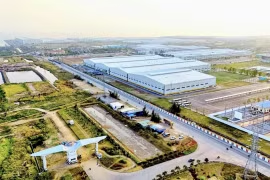
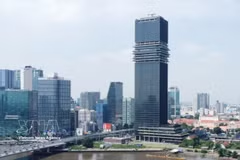
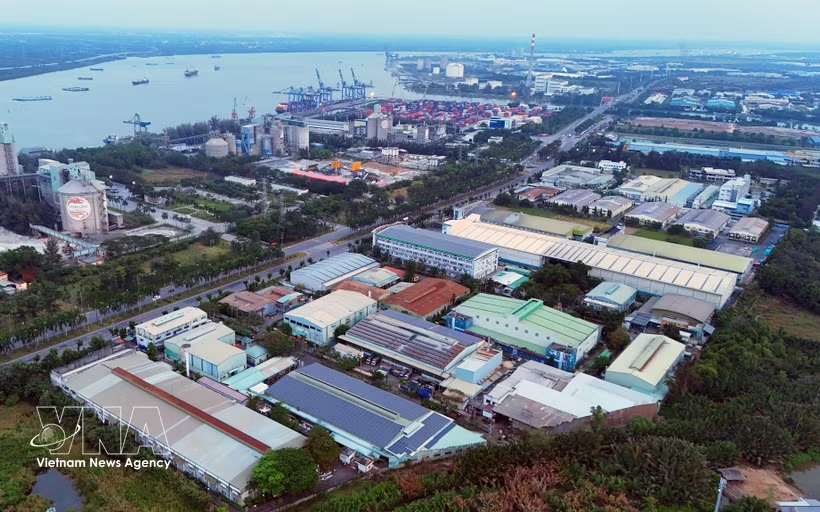
Foreign direct investment (FDI) flows into Ho Chi Minh City are ramping up fast. (Illustrative photo: VNA)

Ho Chi Minh City (VNA) – Ho Chi Minh City is expanding its development space, forming new growth poles and attracting investment into technology- and knowledge-intensive sectors.

Alongside efforts to improve the quality of FDI inflows, the city faces the challenge of attracting and retaining high-quality human resources.

Speaking at a seminar entitled “Ho Chi Minh City: Attracting International Talent for a New Era of Growth” on September 30, Deputy Director of the Ho Chi Minh City Department of Finance Quach Ngoc Tuan said that under Resolution No. 10-NQ/TW of the Politburo on developing the foreign-invested economic sector, the city’s development space is being organised around three growth poles.

The central area, comprising the traditional inner-city area, will focus on developing an international financial centre, commerce, professional services, education, research and innovation.

The northern growth pole, covering the former Thu Duc city and Binh Duong areas, is shifting from traditional manufacturing towards ecological and smart industries and innovation. It is expected to attract investment in semiconductor manufacturing, artificial intelligence (AI), data centres and other high-tech sectors.

Meanwhile, the southeastern growth pole, covering the former Ba Ria-Vung Tau and Can Gio areas, will capitalise on the potential of the marine economy, next-generation logistics and clean energy.

The formation of new growth poles is also creating greater demand for highly skilled workers.

Tuan said competition for FDI was no longer based mainly on cheap labour or tax incentives, but increasingly depended on institutional quality, innovation capacity, human resources, infrastructure and the strength of domestic enterprises.

“The key task is not only to screen projects, but also to create a human-resource ecosystem capable of absorbing high-quality investment,” he said.
vnanet_potal-tp-ho-chi-minh-khang-dinh-vi-the-thu-phu-cong-nghiep-hien-dai-8541479.jpg
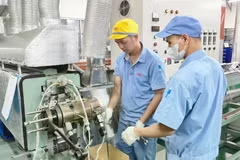
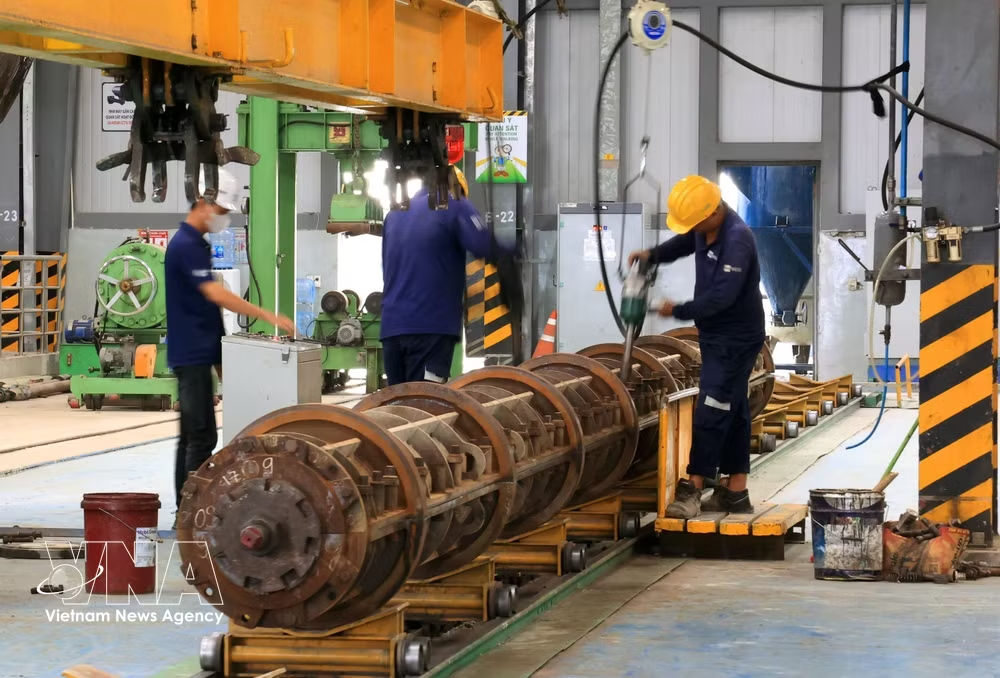
Centrifugal pressure pipe production at a factory in Phu My 3 specialised industrial park, Tan Phuoc ward, Ho Chi Minh City. (Photo: VNA)

From a business perspective, Vo Nguyen Hung, Country Head of HR at Ipsos Vietnam, said companies could provide jobs, incomes and social welfare, and assist foreign experts with housing and schools for their children. However, other factors beyond businesses’ control determine whether experts decide to stay long term.

Foreign experts coming to Ho Chi Minh City also look for a “second home”, he said, noting that education for children, entertainment and international connectivity are important factors in retaining them.

Building a comprehensive ecosystem

While human resources are essential for FDI enterprises to operate and expand, urban quality also affects the city’s ability to attract and retain such talent.

Vo Huynh Tuan Kiet, Director and National Head of Residential Project Marketing at CBRE Vietnam, said housing prices in central areas have risen significantly in recent years, while improved transport infrastructure has shortened travel times between satellite urban areas and the city centre.

For experts, areas offering comprehensive housing and services, together with convenient connections to workplaces, could therefore become more attractive options, he said.

Angus Liew, Chairman of Operations at Gamuda Land Vietnam, said talented professionals also seek communities and surrounding amenities, in addition to quality housing. Transport links, infrastructure, quality education and healthcare should therefore be taken into account in policies to attract international talent.

He said the "integrated urban area” model is an optimal solution for providing comprehensive amenities for high-quality personnel who come to live and work for the long term. Attracting high-quality personnel should not focus solely on individual talent but also take into account their families, including educational opportunities for their children and elderly care services amid population ageing.

Pham Binh An, Deputy Director of the Ho Chi Minh City Institute for Development Studies (HIDS), said the model is also part of the city’s development orientation, with comprehensive consideration given to the needs of high-quality human resources.

Experts at the seminar said that in the competition to attract high-quality FDI, the city’s advantages lay not only in its market size, infrastructure and incentives, but also in its ability to build a living and working environment attractive enough to draw and retain international experts.

This will be an important condition for improving the quality of FDI inflows, enhancing technology absorption and promoting high-value-added sectors, thereby contributing to the city’s growth in the coming period./.
VNA

See more

Illustrative image (Photo: VNA)

Policy push opens new space for private sector growth

Tran Thanh Huong, Deputy Head of the Policy, Business Environment and International Cooperation Division at the Ministry of Finance (MoF)'s Department of Private Enterprise and Collective Economy Development, said business formation has jumped since the Politburo issued Resolution 68-NQ/TW on private sector development on May 1, 2025. About 297,500 firms were newly established or resumed operations in 2025, and nearly 206,400 did so in the first eight months of 2026.

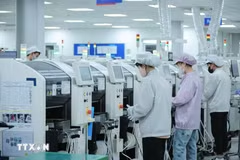
Producing components for office equipment at SWCC Showa Vietnam Co., Ltd. in Bac Thang Long Industrial Park. Hanoi (Photo: hanoimoi.vn)

Hanoi sees strong growth in nine-month FDI attraction

The Hanoi Department of Finance reported that foreign-invested enterprises in Hanoi generally maintained stable production and business operations in September, with many continuing to expand investment, increase capital and develop markets. Investment activity was concentrated mainly in real estate, wholesale and retail trade, information and communications, professional, scientific and technical activities, and business support services.

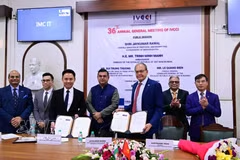
The meeting between Chairwoman of the State Securities Commission of Vietnam (SSC) Vu Thi Chan Phuong and Lim Tuang Lee, Assistant Managing Director of the Capital Markets Group under the Monetary Authority of Singapore (MAS), in Hanoi on September 30 (Photo: SSC)

Vietnam, Singapore step up capital market connectivity

A Vietnamese official suggested exchanges, businesses and intermediaries from the two countries strengthen connections and gradually establish an ecosystem supporting the issuance and listing of depositary receipt (DR) products.

Vietnam’s commodity derivatives market has gradually taken shape and become a tool helping businesses manage risks arising from price fluctuations. (Photo: doanhnghiephoinhap.vn)

New development space opens for commodity derivatives market

The project aims to establish and develop the commodity derivatives market based on market principles and in a transparent, safe and efficient manner, in line with international practices. It seeks to strengthen links with the physical commodities market and better meet the needs of production, business, import – export activities and price risk hedging.

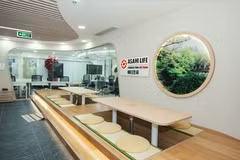
Asahi Mutual Life Insurance aims hire 1,000 staff in Vietnam

Asahi Mutual Life Insurance aims hire 1,000 staff in Vietnam

The recruitment drive will take place alongside the completion of Asahi Mutual Life Insurance’s acquisition of Vietnam’s MVI Life, announced in December 2025. The deal will be the Japanese insurer’s first overseas acquisition in its history and is subject to approval by Vietnamese regulators.

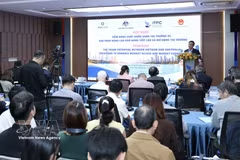
The conference is jointly organised by the Ho Chi Minh City Investment and Trade Promotion Centre (ITPC), the Australian Consulate General in Ho Chi Minh City, the Vietnam Trade Office in Australia and the Australian Chamber of Commerce Vietnam (AusCham) on September 30. (Photo: VNA)

Vietnamese businesses advised to compete on quality in Australian market

Australia has strong purchasing power and diverse demand for Vietnamese products, from industrial goods, machinery and equipment, textiles and footwear to wood products, agricultural and aquatic products and processed food. Two-way trade reached 9.79 billion USD in the first seven months of 2026, up 20% year-on-year, while Vietnam’s exports to Australia surged 30%.

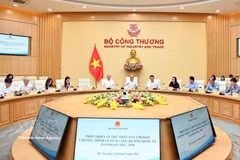
The Ministry of Industry and Trade holds the first meeting of the GoGlobal Steering Committee in Hanoi on September 30 to review implementation and set key tasks for the programme. (Photo: VNA)

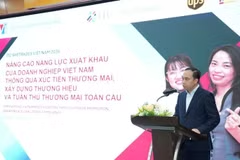
Vietnam sets roadmap to take businesses global

GoGlobal aims to support the private sector in establishing a stronger, more effective and sustainable presence in foreign markets. By 2030, the programme targets training at least 10,000 businesses, providing internationalisation consulting to 1,000, supporting 100 firms in overseas investment, and helping 100 businesses join regional or global value chains.

Content creators help farmers sell longan and OCOP products on TikTok. (Photo: VNA)

Tighter livestream controls to curb counterfeit goods online

Under the stricter process, checks now cover not only products but also sellers, businesses, promotional content and livestream participants. Content creator and affiliate marketer Vo Truong Duy said that sellers are required to provide products and relevant documents for verification before livestreams. Information on distributors, product declarations, labels and ingredients must be consistent.

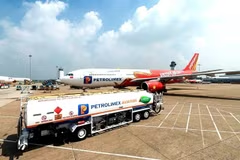
Petrolimex Aviation supplies SAF for Vietjet flights (Photo: baochinhphu.vn)

Vietnam studies ways to broaden use of sustainable aviation fuel

The proposed SAF roadmap will take into account Vietnam's international commitments, the Carbon Offsetting and Reduction Scheme for International Aviation (CORSIA) and the country's ability to develop a domestic SAF supply while avoiding shocks to domestic airlines and the air transport market.