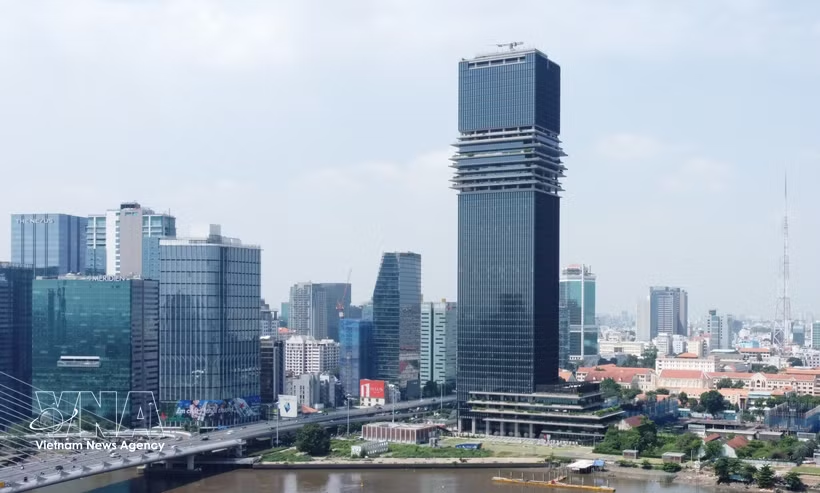
Ho Chi Minh City (VNA) – Ho Chi Minh City climbed again in the 40th Global Financial Centres Index (GFCI 40), scoring 692 points to rank 67th among the financial centres assessed.
The city rose 17 places and added 27 points from GFCI 39, published in March.
Second-biggest mover
Only Copenhagen, which gained 19 places, improved more than Ho Chi Minh City in the latest edition. It is the second straight edition in which the city has made a sizeable jump.
In GFCI 39, the city rose 11 places, from 95th to 84th. Across the two 2026 editions, it has gained 28 places, from 95th to 67th.
Survey respondents also named the city among 15 financial centres they expect to grow in importance over the next two to three years. It received 34 mentions over a 24-month period, adding a forward-looking signal to its improved score and ranking.
In fintech, the city rose 12 places, from 83rd to 71st, with 645 points, up 11 from the prior edition. Its overall score rose about 4.1%, well ahead of the 0.8% global average gain and the 1.48% Asia-Pacific average. The figures point to stronger local competitiveness and prospects within the international financial network.
Notably, Da Nang entered the GFCI for the first time, placing 71st among 117 centres in the official rankings. With both cities now listed, Vietnam has a larger presence on the map of international financial centres. It also lays groundwork for a complementary network in which each centre draws on its own strengths to connect with international markets and capital flows.
The GFCI is compiled by UK-based Z/Yen Partners and the China Development Institute and published twice a year, in March and September. GFCI 40 assessed 139 financial centres worldwide, 117 of which made the official rankings.
The index blends quantitative data with views from the international financial community. GFCI 40 draws on 144 quantitative factors from third-party sources, including the World Bank, OECD and United Nations, plus 39,531 assessments from 6,147 survey respondents.
Its criteria cover the fundamentals of a financial centre's competitiveness, such as business environment, human capital, infrastructure, financial sector development and reputation.
The simultaneous gain in score and rank marks a marked shift in Ho Chi Minh City's standing against peers. For a centre still taking shape, institutional quality, business environment, workforce, infrastructure and the ability to connect with international capital flows will shape long-term competitiveness.
From rankings to capital flows
Richard D. McClellan, Executive Director of the Vietnam International Financial Centre in Ho Chi Minh City (VIFC-HCMC), called the GFCI 40 results an important milestone but not the end point.
What matters more, he said, is the foundation being built, the quality of the financial ecosystem and its ability to channel real capital flows in the years ahead, rather than a single ranking edition.
McClellan said VIFC-HCMC is being developed as a financial growth engine for Vietnam's next growth stage. It aims to bring the capital market, banking and asset management closer to international standards at home, so that more of the value created by the country's economic growth stays in Vietnam.
Marc Knapper, member of the VIFC-HCMC strategic advisory group and former US Ambassador to Vietnam, called the 17-place, 27-point gain notable. He said the city entered the ranking in 2022 at 102nd and has risen in three straight editions since.
Bhaskar Dasgupta, also on the advisory group and former head of market infrastructure at Abu Dhabi Global Market (ADGM), noted that the VIFC was set up less than nine months ago and VIFC-HCMC about seven months ago. In that time, he said, progress has come in the institutional framework, leadership structure, international partnerships and operations.
The higher ranking and score reflect that momentum and signal that international markets are starting to take notice, Dasgupta said./.