FTSE upgrade broadens capital options for property firms

Over the longer term, deeper connections with international capital could provide additional room for property companies with sound fundamentals and appropriate financial structures.

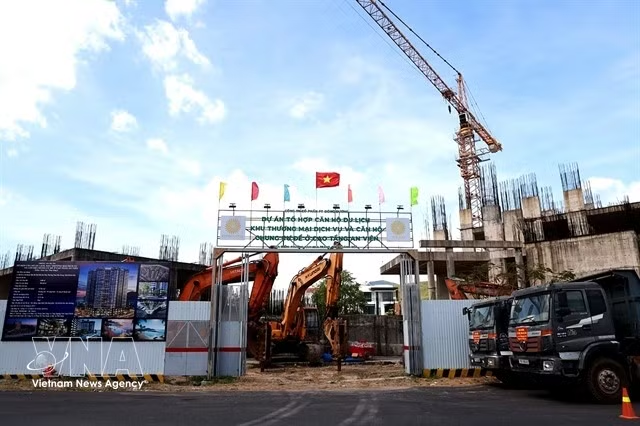
A construction site of a housing project in Nha Trang (Photo: VNA)

Hanoi (VNS/VNA) - The market upgrade by FTSE Russell to secondary emerging market status could broaden access to international capital for listed property companies, creating additional options for equity fundraising, investment structures and share-related transactions rather than directly channelling new funds into real estate projects.

Effective September 21, Vietnamese stocks will be included in the FTSE Global Equity Index Series and related indices in stages through 2027.

The upgrade is expected to potentially attract up to 6 billion USD into Vietnam's stock market. However, the potential capital inflow relates to the equity market and should not be viewed as a forecast of direct investment into the property sector.

For real estate companies, the relationship between the market upgrade and the property market is therefore indirect.

International investors may allocate capital to shares of listed property developers, but such investment does not mean that the money will immediately become funding for project development.

Capital flowing into shares initially affects companies' access to capital and the liquidity of their investments. To turn that capital into resources for real estate operations, companies still need the ability to absorb capital, suitable projects, financial structures that meet investor requirements and the capacity to generate cash flow.

The impact of the upgrade, therefore, needs to be considered in the broader development of the capital market. For property companies, a capital market with wider access could provide additional options for raising equity and conducting share-related transactions.

For institutional investors, a more liquid capital market could also provide another way to gain exposure through companies rather than investing directly in individual properties or projects.

Experts from Savills Vietnam said it was important to distinguish between capital-market liquidity and real estate asset liquidity.

A stock can be traded on the market within a relatively short period, while transferring a property remains dependent on its location, quality, legal status, cash flow, market demand and price. As a result, improved liquidity in the stock market does not automatically make real estate assets easier to buy or sell.

Thomas Jacobs, country manager of the International Finance Corporation (IFC) in Vietnam, said the upgrade would enable Vietnam's capital market to access a broader and more diverse group of global investors, thereby increasing liquidity and creating conditions for domestic companies to access longer-term capital for growth.

From this perspective, the upgrade could be viewed as an expansion of the capital ecosystem available to the property sector rather than a mechanism for directly transferring stock-market capital into real estate projects.

Selective recovery in capital flows

The upgrade comes as the Asia-Pacific real estate market is recovering.

According to Savills Global Capital Markets, in the second quarter of 2026, total real estate investment in the region reached about $46 billion, up 18 per cent year-on-year in the second quarter.

Cross-border capital flows remained an important driver, alongside transactions involving the acquisition of partners’ stakes, minority share sales and recapitalisation. However, the pace of recovery varied across markets.

Globally, Savills said investment opportunities were becoming increasingly selective, with investors focusing on fundamentals and segments with clear income-growth drivers.

The recovery in regional capital flows therefore does not mean capital will automatically move into Vietnam, according to Savills. The ability to turn investor interest into actual transactions remains dependent on the quality of individual opportunities and their ability to meet the requirements of different sources of capital.

For listed property companies, broader access to the capital market can change the way they approach investors. Fundraising will then involve not only borrowing or issuance but also capital structure, asset quality and the ability to create value for shareholders.

A more open and liquid market can also give companies access to a broader pool of institutional investors. At the same time, investors will have another way to participate in the property market through company shares without directly owning a specific property.

The mechanism, however, also places risks at the corporate level. Investors need to assess financial leverage, project progress, cash flows, debt obligations and the ability to implement business strategies.

The value of the FTSE upgrade for the property sector, therefore, may lie less in the immediate amount of new capital and more in expanding options for fundraising, investment structures and exits./.

VNA
See more

The conference is jointly organised by the Ho Chi Minh City Investment and Trade Promotion Centre (ITPC), the Australian Consulate General in Ho Chi Minh City, the Vietnam Trade Office in Australia and the Australian Chamber of Commerce Vietnam (AusCham) on September 30. (Photo: VNA)

Vietnamese businesses advised to compete on quality in Australian market

Australia has strong purchasing power and diverse demand for Vietnamese products, from industrial goods, machinery and equipment, textiles and footwear to wood products, agricultural and aquatic products and processed food. Two-way trade reached 9.79 billion USD in the first seven months of 2026, up 20% year-on-year, while Vietnam’s exports to Australia surged 30%.

The Ministry of Industry and Trade holds the first meeting of the GoGlobal Steering Committee in Hanoi on September 30 to review implementation and set key tasks for the programme. (Photo: VNA)

Vietnam sets roadmap to take businesses global

GoGlobal aims to support the private sector in establishing a stronger, more effective and sustainable presence in foreign markets. By 2030, the programme targets training at least 10,000 businesses, providing internationalisation consulting to 1,000, supporting 100 firms in overseas investment, and helping 100 businesses join regional or global value chains.

Content creators help farmers sell longan and OCOP products on TikTok. (Photo: VNA)

Tighter livestream controls to curb counterfeit goods online

Under the stricter process, checks now cover not only products but also sellers, businesses, promotional content and livestream participants. Content creator and affiliate marketer Vo Truong Duy said that sellers are required to provide products and relevant documents for verification before livestreams. Information on distributors, product declarations, labels and ingredients must be consistent.

Petrolimex Aviation supplies SAF for Vietjet flights (Photo: baochinhphu.vn)

Vietnam studies ways to broaden use of sustainable aviation fuel

The proposed SAF roadmap will take into account Vietnam's international commitments, the Carbon Offsetting and Reduction Scheme for International Aviation (CORSIA) and the country's ability to develop a domestic SAF supply while avoiding shocks to domestic airlines and the air transport market.

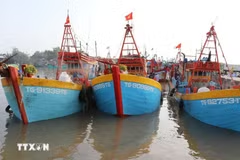
Fishing boats anchor before heading out to the sea. (Illustrative photo: VNA)

An Giang tightens management of high-risk violators to combat IUU fishing

Vice Chairman of the People’s Committee of An Giang province Ngo Cong Thuc asked relevant departments, agencies, forces and local authorities to manage all fishing vessels ineligible for operation, regularly update their status and anchorage locations, and ensure that no such vessels engage in fishing activities.

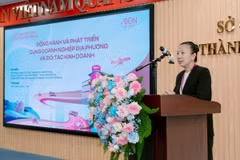
Nguyen Thi Ngoc Hue, Senior Director of Human Resources Strategy and Brand at Aeon Vietnam, speaks at an event. (Photo: Aeon Vietnam)

Japan's retail giant Aeon Corporation bets big on Vietnamese market

Under its medium-term business plan through March 2031, Aeon aims to generate more than 300 billion JPY (1.9 billion USD) in operating revenue in Vietnam, 2.5 times higher than its fiscal year 2026 forecast. The group plans to increase its supermarket network, including MaxValu, from about 60 stores to 300, while allocating about 60% of its Southeast Asian investment to Vietnam.

At a working session between Phu Tho's leaders and the Opora Rossii delegation. (Photo: VNA)

Phu Tho courts Russian investors in vocational training, trade

Vice Chairman of the Phu Tho provincial People’s Committee Nguyen Khac Hieu has expressed a desire to strengthen connections with Russian partners in areas such as education, industrial growth, agro-forestry processing, technology, and trade.

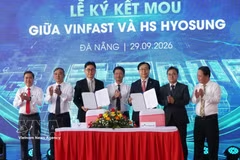
At the signing ceremony of a memorandum of understanding on cooperation between VinFast and HS Hyosung. (Photo: VNA)

RoK group adds 100 million USD investment in Da Nang

Covering about 11 hectares, the project will manufacture BCF yarn, commercial carpets and automotive floor carpets, with an annual capacity of 16,800 tonnes of BCF yarn and approximately 7.8 million sq.m of carpets.

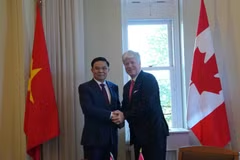
Vietnamese Minister of Industry and Trade Le Manh Hung (left) and Canadian Minister of Energy and Natural Resources Tim Hodgson at their talks. (Photo published by VNA)

Vietnam, Canada open new avenues for energy cooperation

Minister of Industry and Trade Le Manh Hung recently held talks with Canadian Minister of Energy and Natural Resources Tim Hodgson, focusing on implementing the newly signed memorandum of understanding on energy and clean energy transition cooperation.