Vietnam uses GIS for priority setting in post-war bomb, mine clearance

The study in Quang Ngai combines wartime bombing data, field survey results, population density, land-use planning and other socio-economic factors to develop priority maps. It demonstrates the potential of GIS to improve the efficiency of efforts to address the consequences of bombs, landmines and unexploded ordnance (UXO) in Vietnam.

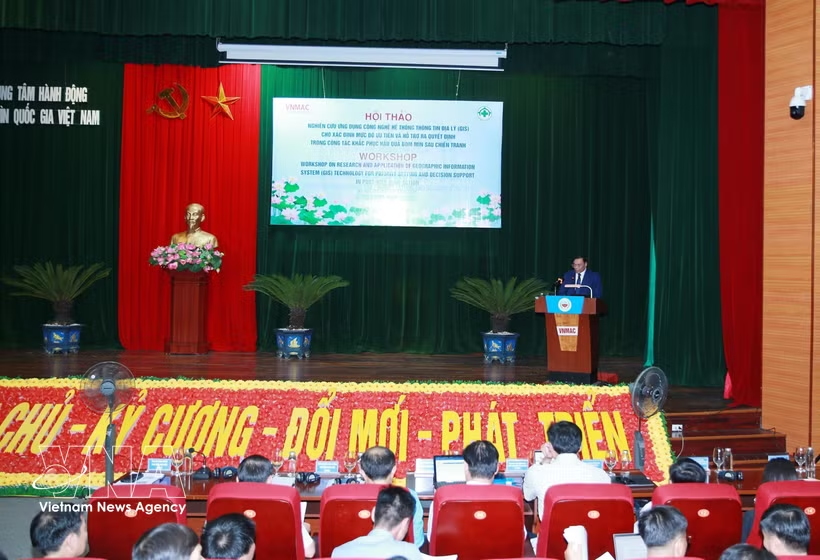
Ha Dinh Huong, Standing Deputy Director General of VNMAC, speaks at the workshop in Hanoi on September 30. (Photo: VNA)

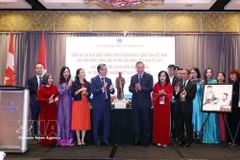
Hanoi (VNA) – A workshop on applying geographic information system (GIS) technology for priority setting and decision support in post-war mine action was held in Hanoi on September 30, aiming to share initial results of a pilot study in central Quang Ngai province.

The workshop was co-organised by the Vietnam National Mine Action Centre (VNMAC) and Norwegian People’s Aid (NPA).

The study combines wartime bombing data, field survey results, population density, land-use planning and other socio-economic factors to develop priority maps. It demonstrates the potential of GIS to improve the efficiency of efforts to address the consequences of bombs, landmines and unexploded ordnance (UXO) in Vietnam.

Ha Dinh Huong, Standing Deputy Director General of VNMAC, said that although the war ended decades ago, remnants of bombs, mines and other explosive materials remain a major challenge to public safety and sustainable socio-economic development in many localities.

The Party and State, particularly the Ministry of National Defence, have paid close attention to the issue, maximising resources and working closely with international organisations to accelerate the clearance of contaminated land, he said.

Huong noted that the identification of areas requiring UXO clearance previously relied mainly on maps of suspected contaminated areas (BMA) produced through broad-area surveys. However, the suspected contaminated area is vast while financial, human and equipment resources remain limited.

Therefore, relying solely on contamination data may not ensure that resources are allocated in line with the urgent development needs of individual localities. Mine-action managers need scientific tools to convert technical data into practical decisions, he said.

Facing that fact, VNMAC, in coordination with NPA and with funding from the US Government, launched a pilot study in Quang Ngai to develop a GIS-based prioritisation and decision-support method.

The study adopts an approach that integrates multiple data layers instead of assessing only the risks posed by bombs and mines. The five core criteria consist of bomb and mine density, suspected contaminated areas, population density based on address data, accident-risk hotspots, and land-use changes under the province’s 2021–2030 development plan.

The model then provides visual rankings of risk levels – low, medium and high – through colour-coded maps for each commune and each 500m-by-500m grid cell.

According to the organisers, the model could provide a scientific basis for central and local agencies to make more accurate and effective decisions on prioritising resources for UXO clearance.

Participants at the workshop discussed ways to improve the priority index to ensure its scientific validity and feasibility under the diverse conditions of different localities. A roadmap was also considered for developing a shared GIS data platform to support management and decision-making at different levels.

They reviewed the pilot study’s methodology and results in Quang Ngai and received feedback from provincial departments, local authorities and international organisations to refine the indicators and weighting system in line with Vietnam’s practical needs.

They also discussed the potential for applying the research findings in practice and expanding priority risk mapping to other localities nationwide.

Representatives from Quang Ngai said several issues need to be addressed to turn the results into an effective management tool, including establishing a continuous two-way data-updating mechanism to ensure accurate and up-to-date information, developing a shared WebGIS platform, and strengthening training and technique transfer for grassroots officials./.
​

VNA

See more

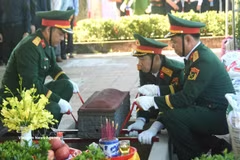
Soldiers prepare to conduct the burial ceremony for the remains of a martyr at the Quang Tri Martyrs' Cemetery. (Photo: VNA)

Quang Tri holds solemn memorial service for 30 martyrs

At the ceremony, delegates laid wreaths, offered incense, and observed a minute of silence in tribute to the fallen soldiers who sacrificed their youth and lives for national independence and freedom and the people’s happiness.

A view of Ben Luc–Long Thanh Expressway section passing through the mangrove forest in Dong Nai province (Photo: VNA)

Corridor expressway links Mekong Delta with Long Thanh int’l airport

The 57.8-km expressway, invested in by Vietnam Expressway Corporation (VEC), runs through the Mekong Delta province of Long An, Ho Chi Minh City and Dong Nai. Its endpoint connects with National Highway 51 and the Bien Hoa-Vung Tau Expressway, about 10 km from Long Thanh International Airport.

People have access to appropriate care, rehabilitation and support services within their communities (Photo: VNA)

Vietnam moves to adapt to rapid population ageing, expand silver economy

The International Day of Older Persons 2026, themed “The Age of Longevity: Rethinking Systems for Longer Lives,” highlights the need to develop healthcare, social security, labour-market and social-service systems in response to increasing life expectancy. For Vietnam, rapid population ageing is not only a demographic issue but also a development challenge.

Border Guard forces, in coordination with competent authorities, conduct outreach activities for fishermen at Hon Ro Port in Nam Nha Trang ward, Khanh Hoa province. (Photo: VNA)

Khanh Hoa mobilises resources to address IUU fishing

In Nam Nha Trang ward, task forces are closely watching fishing vessels, tracking their routes, overseeing arrival and departure procedures, and tracing the origins of seafood. Meanwhile, fishermen’s understanding and adherence to regulation against unreported and unregulated (IUU) fishing have steadily improved, reducing the likelihood of vessels entering foreign waters illegally.

An overview of the meeting (Photo: VNA)

Vietnamese experts in Switzerland urged to contribute to national science, technology development

Ambassador Mai Phan Dung expressed hope that Vietnamese experts and intellectuals in Switzerland will continue contributing through various forms, including policy consultations and recommendations, participation in research and training, technology transfer, and connections between universities, research institutes, businesses and international organisations and their Vietnamese counterparts.

The meeting between representatives of the Communist Review and Yonhap TV in Seoul on September 28, 2026 (Photo: VNA)

Vietnam, RoK promote cooperation in policy communications

The Communist Review is enhancing ties with Korean media agencies and working on plans to launch a Korean-language version of its website to enhance external communications and contribute to Vietnam’s economic development goals.

At the talks between the Vietnam Fatherland Front Committee of Quang Ngai province and the Lao Front for National Construction Committee of Champasak province (Photo: VNA)

Vietnamese, Lao localities bolster Front cooperation

Both sides agreed to keep educating officials, Party members, youth union groups and the broader public, especially young people in both provinces, on the great friendship, special solidarity, comprehensive cooperation and strategic cohesion between Vietnam and Laos.

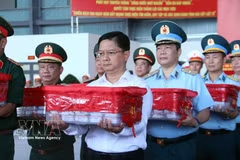
Vice Chairman of the Ho Chi Minh City People’s Committee Nguyen Manh Cuong at the handover ceremony of biological samples for identifying unknown martyrs at the city’s martyrs’ cemeteries. (Photo: VNA)

Ho Chi Minh City steps up search for fallen soldiers

A major result has been the completion of biological sampling from remains at all 18 martyrs' cemeteries in the city, with 9,854 samples collected ahead of schedule. Of these, 7,104 samples were assessed as suitable for DNA testing.

At the meeting of the Vietnam Association for Promoting Education in Hanoi on September 25 (Photo: VNA)

Lifelong learning programme to be expanded to overseas Vietnamese

In the new period, the Vietnam Association for Promoting Education (VAPE) will focus on improving the quality of its activities on digital platforms, while renewing learning models towards digitalisation and green transformation to meet the country’s development requirements, according to APE President Nguyen Thi Doan.