Ho Chi Minh City (VNA) – To strengthen their foothold in the Australian market, Vietnamese businesses need to move beyond price-based competition by improving product quality, meeting standards, ensuring origin transparency and optimising supply chains, experts said.
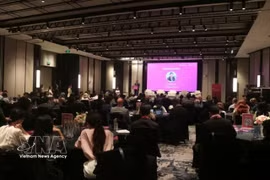
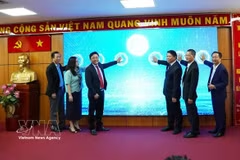
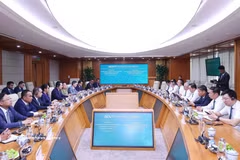
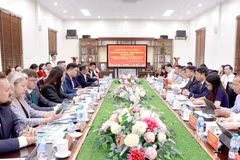
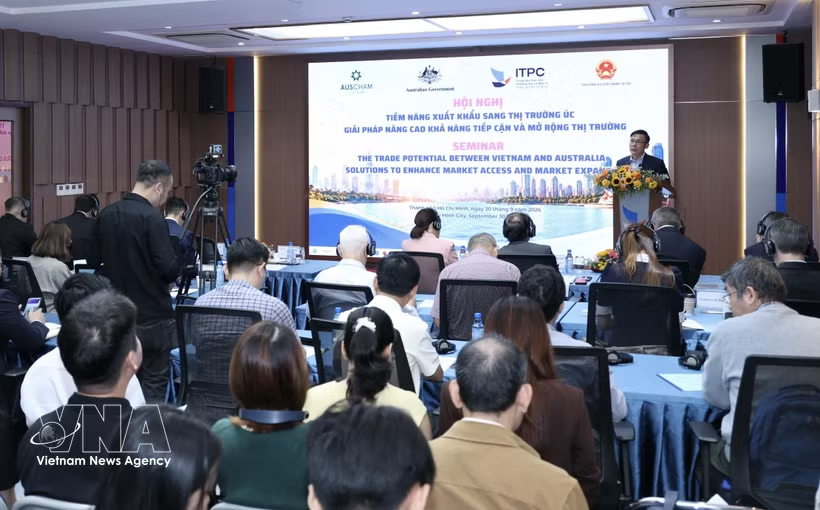
The recommendation was made at a conference on export potential in the Australian market and solutions to improve market access and expansion, jointly organised by the Ho Chi Minh City Investment and Trade Promotion Centre (ITPC), the Australian Consulate General in Ho Chi Minh City, the Vietnam Trade Office in Australia and the Australian Chamber of Commerce Vietnam (AusCham), on September 30.
ITPC Deputy Director Le Anh Hoang said the upgrade of Vietnam-Australia ties to a Comprehensive Strategic Partnership in 2024, together with cooperation agreements between Ho Chi Minh City and the Australian states of Queensland, New South Wales and Victoria and the Northern Territory, has created huge room for cooperation.
Two-way trade reached 9.79 billion USD in the first seven months of 2026, up 20% year-on-year, while Vietnam’s exports to Australia surged 30%, he said.
Australia has strong purchasing power and diverse demand for Vietnamese products, from industrial goods, machinery and equipment, textiles and footwear to wood products, agricultural and aquatic products and processed food. At the same time, the market has stringent technical requirements, particularly on food safety, biosecurity, traceability and sustainable development.
Businesses therefore need to closely study legal regulations, consumer trends and local distribution systems to improve their access to the market, Hoang said.
Nguyen Manh Hiep, Trade Consul of the Vietnam Trade Office in Australia, highlighted the need to make effective use of three free trade agreements to which both Vietnam and Australia are parties, including the ASEAN-Australia-New Zealand Free Trade Area (AANZFTA), the Comprehensive and Progressive Agreement for Trans-Pacific Partnership (CPTPP) and the Regional Comprehensive Economic Partnership (RCEP).
Amid rising trade protectionism, these FTAs, which eliminate tariffs on most import lines, provide opportunities for Vietnamese businesses to reduce costs and improve competitiveness, Hiep said, suggesting businesses master the use of FTAs, particularly AANZFTA, by restructuring supply chains, clearly understanding product-specific rules of origin and ensuring transparent input-material records to meet Australian customs’ verification and post-clearance inspection requirements.
Sam Conroy, President of AusCham Vietnam, said Australia, with a population of about 28 million and GDP per capita of approximately 105,000 AUD, has strong purchasing power. Its multicultural population, with 32% of residents born overseas, or about 8.8 million people, also creates diverse consumer demand and openness to Asian products.
Although its exports to Australia rose 88% from 2020 to 2025, Vietnam accounted for only about 2.7% of Australia’s total imports worth more than 308 billion USD in 2025, he said.
Vietnamese toys and sporting goods, coffee, fruit and vegetables are performing well in this market, while opportunities are emerging for value-added food, environmentally friendly construction materials and furniture, he noted.
From a supply-chain perspective, Chandler So, Managing Director of GEODIS Vietnam Co., Ltd., said logistics costs account for 15-30% of retail prices in Australia. Businesses should consider annual sea-freight contracts instead of relying on spot rates, use regular weekly less-than-container-load services, and explore bonded warehouses to optimise transport and financial costs./.