Hanoi (VNS/VNA) – Vietnam emerged as Southeast Asia’s largest electric-car market in 2025, with electric vehicles (EVs) accounting for nearly 40% of new-car sales as adoption more than doubled, putting the country among the world’s leading markets for electric mobility, according to the International Energy Agency (IEA).
The rapid adoption put Vietnam ahead of Thailand and Indonesia and above the global average of about 25%, highlighting the speed at which EVs have gained ground in a market close to zero in 2020.
In its Global EV Outlook 2026, the IEA said electric-car sales in Southeast Asia more than doubled in 2025 to over 500,000 vehicles, with EVs accounting for nearly one in five new cars sold.
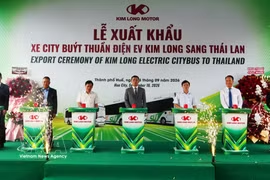
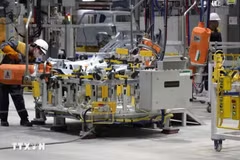
Vietnam, Indonesia and Thailand led the regional growth, supported by policy incentives, expanding domestic production and imports, particularly from China, the IEA said.
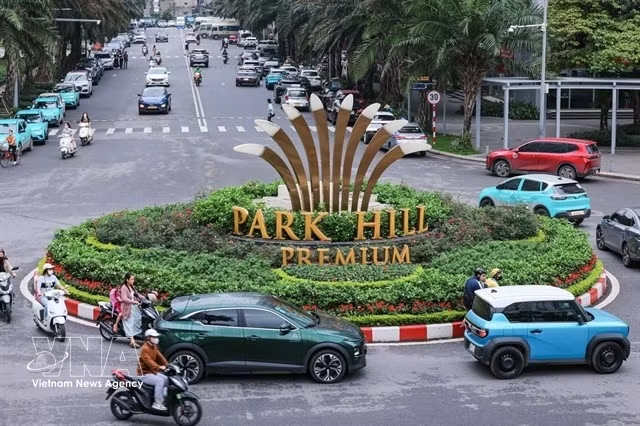
In Vietnam, electric car sales more than doubled in 2025, lifting the EV share of new car sales to around 40%, above levels recorded in most European countries, the report said.
The transformation has been particularly striking given the market’s starting point. Electric cars had only a marginal presence in Vietnam in 2020 before sales began accelerating rapidly.
Thailand was the region’s second-largest electric-car market in 2025, with sales rising 70% to about 140,000 vehicles, nearly one-quarter of new-car sales.
Globally, electric-car sales exceeded 20 million in 2025, up 20% from the previous year, with EVs accounting for 25% of all new-car sales, or one in every four vehicles sold.
China remained the world's largest EV market, with more than 13 million electric cars sold and an EV sales share of nearly 55%. Europe recorded 4.2 million EV sales, representing 28% of new-car sales, while the US remained at around 10%.
The IEA said the growth in Southeast Asia was supported by a combination of government incentives and growing local production and imports.
Vietnam has supported EV purchases through exemptions from registration fees for battery-electric vehicles since 2022, while VinFast’s expansion of affordable models has helped broaden the market, the IEA said.
The carmaker said it delivered 175,099 electric cars in Vietnam in 2025 and 137,697 units in the first seven months of this year. It aimed to sell 300,000 electric cars this year.
The IEA expects the trend to continue, projecting that Vietnam could reach an electric-car sales share of more than 80% by 2035, the highest among Southeast Asian countries.
Market research company Statista said Vietnam’s electric-car market is gaining momentum as rising fuel costs and growing environmental awareness together with Government incentives encouraged consumers to consider switching to EVs.
Domestic industry data showed that nearly 29% of newly registered vehicles in the first half of this year were new-energy vehicles, including battery-electric and hybrid models.
The Vietnam Automobile Manufacturers’ Association projected that electric cars on Vietnam’s roads would reach around 1 million by 2028 and 3.5 million by 2040.
Charging infrastructure getting ready
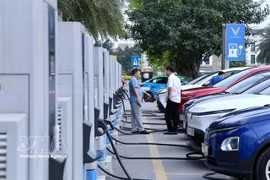
The rapid shift towards electric mobility is prompting the charging infrastructure needed to support a growing EVs on road.
VinFast currently has the largest charging network in Vietnam through V-Green with more than 150,000 charging ports nationwide and planned to focus on larger charging hubs to support long-distance travel, while expanding battery-swapping infrastructure for electric motorbikes. VinFast has also worked with Petrolimex and PVOIL to install EV charging facilities at petrol stations.
PV Power, a unit of PetroVietnam, has also moved into the sector with the signing of a cooperation agreement with the Republic of Korea’s EN Technologies Inc. to study and develop EV charging systems in Vietnam.
The Government also aimed to make charging infrastructure a key part of its broader green-transport strategy.
Under the programme to shift the transport sector towards green energy with the long-term goal of achieving net-zero greenhouse gas emissions by 2050, Vietnam calls for promoting the production, assembly and import of EVs and developing charging infrastructure.
The Government has also instructed ministries to review regulations on the installation of charging stations at petrol stations and develop standards for charging facilities in apartment buildings, commercial centres and roadside rest areas./.