Hanoi (VNA) – Vietnamese electronics companies are increasingly required to meet standards on ESG, carbon emissions, traceability, clean energy and sustainable packaging, alongside quality, pricing and production capacity, to maintain their position in global supply chains.
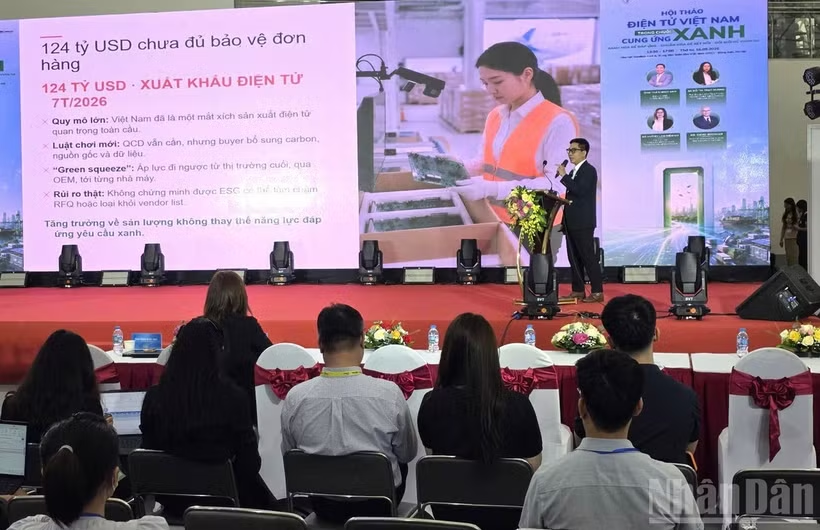
As part of the international manufacturing business matching event FBC ASEAN 2026, held from September 16-18, the Vietnam Electronic Industries Association (VEIA), in collaboration with the testing, inspection and certification company SGS, organised a seminar on the electronics industry in green supply chains, covering environmental, social and governance (ESG), sustainable packaging, and global market requirements.
Speakers at the event said the way international corporations select suppliers is changing. While quality, price, production capacity and delivery schedules were previously the key criteria, sustainability, emissions reduction, data transparency and supply chain controls are increasingly becoming important requirements.
ESG becomes a condition for joining supply chains
Do Thi Thuy Huong, VEIA Vice President and General Secretary, said ESG standards and frameworks for assessing a company’s sustainability and responsibility towards the community and society are no longer simply a future-oriented goal, but are becoming a condition for companies to be included on supplier lists.
The green transition needs to begin with factory management, operating processes, energy and raw-material management, while being closely linked to digital transformation, she said.
Pressure to green supply chains is also spreading throughout the entire supply network. Requirements on recycled packaging, labelling and chemical management mean companies need to prepare from the design stage. Slow adaptation could increase remediation costs and the risk of losing orders.
Tran Nhat Anh, ESG project manager and SGS representative, said Vietnam has become an important link in the global electronics industry, driven by investment from international corporations. However, alongside the opportunities comes pressure as brands and original equipment manufacturers (OEMs) shift towards net zero models. According to the SGS representative, the four main bottlenecks currently facing Vietnamese factories are energy, data, the circular economy and green finance.
Companies still face difficulties in accessing 100% clean electricity, lack systems for collecting quantitative data, have an incomplete understanding of recycled-material content and face challenges in accessing green credit, he said.
Rather than undertaking a full-scale transformation at once, Nhat Anh suggested that companies could begin with a key product line to calculate its carbon footprint and establishing a standardised reporting database before gradually expanding the process across the entire factory.
Proactive transition key to maintaining supply-chain position
Huynh Lam Diem Mi, head of the technical division at SGS’s chemical testing centre, said sustainability is becoming a technical requirement for companies seeking access to international markets.
Electronic products exported to the EU will be subject to the European Commission’s Ecodesign for Sustainable Products Regulation (ESPR), as well as the Packaging and Packaging Waste Regulation (PPWR), under EU Regulation 2025/40, concerning packaging and packaging waste. The PPWR regulates three levels of packaging – sales packaging, grouped packaging and transport packaging, while also setting requirements on hazardous chemicals, recyclability, excessive packaging and labelling.
From September, controls on heavy metals and compliance documentation officially came into effect. By 2030, packaging with a recyclability rate of below 70% will be prohibited from being circulated in the market.
Therefore, companies preparing to export to the EU need to develop technical documentation, declarations of conformity and register for extended producer responsibility (EPR) fees.
Experts at the seminar said companies did not necessarily have to begin with a large-scale transformation programme. For businesses exporting to the EU, material analysis, controls on four heavy metals, packaging design in line with PPWR requirements, and preparation of technical documentation and declarations of conformity should be incorporated into their export preparations.
The green transition is therefore not simply about meeting a set of standards, but is directly linked to the ability of Vietnamese electronics companies to enter and maintain their position in global supply chains./.
See more
Overseas Vietnamese entrepreneurs seen as bridge for Vietnam–US business ties
If properly connected through appropriate mechanisms, OV entrepreneurs could provide a valuable source of knowledge, science – technology, management expertise, finance, investment and international relations to contribute to the homeland's development.
Vietnam's An Giang picked for CAEXPO “Charming Cities” showcase
An Giang's presentation will highlight urban development, key industries and investment prospects. At the expo, the province plans to showcase signature agricultural and forestry products while promoting its industrial parks, investment incentives and tourism resources.
OCTF 2026 links Vietnam-China supply chains
The opening ceremony's highlight was a strategic Memorandum of Understanding signed by the Vietnam Industrial Park Supply Enterprises Association and the Korea-Vietnam Association of Science and Technology, aimed at helping thousands of firms expand globally.
Gia Lai courts German investors in energy, agriculture push
During a working session with GEO Group, which is developing a project in Gia Lai, Vice Secretary of the Party Committee and Chairman of the People’s Committee of Gia Lai province Pham Anh Tuan pledged full support to ensure the venture breaks ground on schedule in October.
Dien Bien conference promotes digital, green transformation in border trade
Once external transport routes, particularly the Son La-Dien Bien-Tay Trang Border Gate expressway, are completed, they are expected to reduce cargo transport costs and time and attract investment in warehousing, logistics, processing and distribution.
Vietnam promotes green, smart seaports linked to modern logistics
To develop green ports, the Vietnam Seaports Association planned to promote energy management, emission reduction, electrification, onshore power, renewable energy, measurement systems, reporting and verification of emissions (MRV), along with green financial solutions.
Kim Long Motor exports first batch of electric buses to Thailand
This is the first batch of finished buses manufactured by Kim Long Motor to be transported to an international market via a dedicated roll-on/roll-off (Ro-Ro) vessel, marking a new development in logistics capacity and port connectivity in the central region.
VinFast announces new step in development strategy in US
In the next phase of growth, VinFast said it will continue to put customers at the centre of its operations while investing in and expanding service capacity in key markets.
Norwegian Seafood Council tells stories of salmon to appeal to Vietnamese consumers
As Vietnam’s economy has grown, so has its appetite for Norwegian salmon. Fresh Norwegian salmon exports to Vietnam reached approximately 7,900 tonnes in 2025, an increase of 40% from the previous year.
Vietnam moves to fast-track foreign investment through institutional reforms
Under the draft Law, the Government will periodically adjust market access restrictions for foreign investors based on socio-economic conditions and management requirements. This approach could shorten policy lags amid rapid changes in international capital flows, technology and supply chains, while Vietnam is shifting its investment attraction focus from quantity to quality and efficiency.
Vietnamese goods see great opportunity to gain deeper access to Thai retail market
Thailand is a major trading partner of Vietnam in ASEAN. Bilateral trade reached more than 22 billion USD in 2025 and continued to grow strongly this year, reaching 18.5 billion USD in the first eight months, up 30.6% year-on-year.
Vietnam, Cambodia seek deeper, practical investment cooperation
Potential only becomes meaningful when it is translated into investment projects, trade contracts and concrete cooperative ties, said Vietnamese Consul General in Battambang Tran Tuan Anh.
Vietnam targets 48 billion USD in textile-garment exports
Experts said the 48-billion-USD target should also be viewed as an opportunity for Vietnam's garment and textile industry to improve productivity and increase value added for more sustainable competitiveness.
128 companies from 31 countries register for Vietnam Defence Expo 2026
Vietnam Defence Expo 2026 will cover about 123,800 sq.m and feature seven main areas, including indoor and outdoor exhibition spaces, a defence experience and military games area, a space showcasing defence-economic products and the cultural heritage of Vietnam’s three regions, a VIP reception area, grandstand and performance areas, and common facilities.
Reference exchange rate continues to climb on September 18
With the current trading band of +/- 5%, the ceiling rate applicable for commercial banks during the day is 26,919 VND/USD, and the floor rate 24,355 VND/USD.
Lai Chau ginseng targeting international markets
To reach global markets, Lai Chau ginseng needs a clear roadmap: standardising growing areas, ensuring transparent traceability, promoting deep processing and building a national brand.
Malaysia-Vietnam cooperation potential under NAP 2.0: expert
By leveraging their complementary strengths under the NAP 2.0 framework, Malaysia and Vietnam have considerable potential to deepen cooperation to build a more technology-driven, sustainable, and resilient agricultural sector in Southeast Asia.
Can Tho seeks to improve FDI quality, create new growth momentum
Can Tho is now facing a “window of opportunity” to upgrade the quality of FDI, but needs to shift from a mindset of attracting capital to one focused on selecting, absorbing and spreading investment value.
National credibility – investment advantage for ASEAN’s Fabulous Five: expert
Investors are drawing a clearer distinction between economies driven by cyclical growth and those capable of converting growth momentum into sustainable, risk-adjusted returns.
Vietnam Airlines pilots green solutions on Hanoi–London route
The initiatives included incentives for passengers to use electric Green SM vehicles to travel to the airport, fuel and emissions optimisation, adjustments to onboard products, and encouraging more responsible tavel choices.