Hanoi (VNA) – As Vietnam is shifting towards a green and circular economy to maintain competitiveness and participate effectively and sustainably in global value chains, experts emphasised that a sufficiently clear and efficient legal environment is needed to create momentum for businesses to make the transition.
Legal gaps remain on the path to transition
Thang Long Plastics JSC is one of the partners of Mainetti, a group specialising in hanger solutions for the textile and garment industry. The company exports hangers to the US and Europe and then imports them back into Vietnam under a reuse model, limiting the recycling of waste that could harm the environment.
Although the materials used to manufacture the hangers are 100% Vietnamese, the company faces difficulties when importing them back due to a lack of appropriate mechanisms.
If they are classified as used plastic products, their import is prohibited. If they are classified as scrap, an environmental licence is required. This will certainly affect not only this industry but many others as well. The question is how the State can introduce policies to remove legal barriers and enable businesses to carry out such activities, said Le Hoang Long of Thang Long Plastics JSC.
Without clear criteria for by-products, secondary raw materials and when waste ceases to be classified as waste, regulators fear the risks while businesses are reluctant to invest.
Nguyen Huu Thap, Vice Chairman of the Vietnam Association of Business Legal Affairs, said this demonstrates how the circular loop is broken at the boundary between “waste” and “resource”.
There is also a risk that procedures will become “greener” on paper rather than the economy itself becoming greener. EPR, greenhouse gas inventories, the carbon market, ESG, supply-chain standards and export requirements all require data. If each agency requires a separate form, platform and inspection, the green transition will become another layer of compliance costs, he pointed out.
For businesses, Thap said, time is a cost, procedures are a cost, and a lack of clarity is an investment risk. If going green means having to obtain more permits, borrow at higher costs and bear greater legal risks, institutions are sending the opposite signal to the one needed for the transition.
Building coherent institutional ecosystem for the green economy
Vietnam has introduced the Law on Environmental Protection, the Green Growth Strategy, schemes on the circular economy, the Just Energy Transition Partnership (JETP), green taxonomy, green credit and a carbon market.
The year 2026 marks a shift towards putting green economic models into practical operation. Meanwhile, the carbon exchange has begun operating, while outstanding green credit stands at around 828.8 trillion VND (31.87 billion USD). The European Union’s Carbon Border Adjustment Mechanism (CBAM) has also entered its definitive phase.
However, many experts say legal provisions on the green economy and circular economy remain fragmented. The lack of links between environmental regulations and those governing investment, land, construction, energy, taxation, technical standards and contracts makes it difficult for businesses to identify appropriate solutions.
Provisions on tax, land and credit incentives for circular-economy projects largely refer to specialised legislation, but the corresponding regulations needed to put such incentives into practice remain incomplete. As a result, the number of projects actually receiving meaningful incentives that are attractive enough to alter businesses’ investment behaviour remains limited.
Meanwhile, the carbon market requires further legal development regarding the legal status of carbon credits and emissions allowances, as well as their ownership, transfer, use of collateral and the settlement of disputes.
Assoc. Prof. and Dr Ngo Tri Long of the Vietnam Financial Consulting Association proposed reviewing legislation across the entire chain of economic activities to identify and address key points of intersection in support of the green and circular transition in a consistent manner, preventing legal gaps and enabling waste to genuinely become a resource.
This should be accompanied by an “audit of green administrative procedures”, he added.
The Vietnam Association of Business Legal Affairs proposed establishing the principle of “one green project, one data set, one focal point and one inspection plan”; creating a legal framework for qualified materials to re-enter production; turning green taxonomy into a “passport” for accessing resources; and building a national green data platform based on the principle that businesses report information only once.
Dr Nguyen Van Cuong, Director of the Institute of Legal Strategy and Science under the Ministry of Justice, said institutions must make green choices economically beneficial. Businesses cannot sustain the green transition through appeals alone.
The law must gradually give effect to the principle of internalising environmental costs while harmonising administrative and economic instruments with market-based mechanisms. The national green taxonomy should truly become a “common language” for the State, banks, investors and businesses to determine what constitutes a green economic activity, thereby directing capital to the right areas while limiting greenwashing./.
See more
Vietnam moves to fast-track foreign investment through institutional reforms
Under the draft Law, the Government will periodically adjust market access restrictions for foreign investors based on socio-economic conditions and management requirements. This approach could shorten policy lags amid rapid changes in international capital flows, technology and supply chains, while Vietnam is shifting its investment attraction focus from quantity to quality and efficiency.
Vietnamese goods see great opportunity to gain deeper access to Thai retail market
Thailand is a major trading partner of Vietnam in ASEAN. Bilateral trade reached more than 22 billion USD in 2025 and continued to grow strongly this year, reaching 18.5 billion USD in the first eight months, up 30.6% year-on-year.
Vietnam, Cambodia seek deeper, practical investment cooperation
Potential only becomes meaningful when it is translated into investment projects, trade contracts and concrete cooperative ties, said Vietnamese Consul General in Battambang Tran Tuan Anh.
Vietnam targets 48 billion USD in textile-garment exports
Experts said the 48-billion-USD target should also be viewed as an opportunity for Vietnam's garment and textile industry to improve productivity and increase value added for more sustainable competitiveness.
128 companies from 31 countries register for Vietnam Defence Expo 2026
Vietnam Defence Expo 2026 will cover about 123,800 sq.m and feature seven main areas, including indoor and outdoor exhibition spaces, a defence experience and military games area, a space showcasing defence-economic products and the cultural heritage of Vietnam’s three regions, a VIP reception area, grandstand and performance areas, and common facilities.
Reference exchange rate continues to climb on September 18
With the current trading band of +/- 5%, the ceiling rate applicable for commercial banks during the day is 26,919 VND/USD, and the floor rate 24,355 VND/USD.
Lai Chau ginseng targeting international markets
To reach global markets, Lai Chau ginseng needs a clear roadmap: standardising growing areas, ensuring transparent traceability, promoting deep processing and building a national brand.
Malaysia-Vietnam cooperation potential under NAP 2.0: expert
By leveraging their complementary strengths under the NAP 2.0 framework, Malaysia and Vietnam have considerable potential to deepen cooperation to build a more technology-driven, sustainable, and resilient agricultural sector in Southeast Asia.
Can Tho seeks to improve FDI quality, create new growth momentum
Can Tho is now facing a “window of opportunity” to upgrade the quality of FDI, but needs to shift from a mindset of attracting capital to one focused on selecting, absorbing and spreading investment value.
National credibility – investment advantage for ASEAN’s Fabulous Five: expert
Investors are drawing a clearer distinction between economies driven by cyclical growth and those capable of converting growth momentum into sustainable, risk-adjusted returns.
Vietnam Airlines pilots green solutions on Hanoi–London route
The initiatives included incentives for passengers to use electric Green SM vehicles to travel to the airport, fuel and emissions optimisation, adjustments to onboard products, and encouraging more responsible tavel choices.
FTSE Russell pledges comprehensive support for Vietnam’s capital market development
FTSE Russell views Vietnam as a remarkable growth story in Asia and a long-term partner, adding it wishes to further deepen cooperation with the Vietnamese Government and market participants, said its CEO Fiona Bassett.
Meey Global Corp announces public filing of registration statement for proposed initial public offering
Meey Global is a holding company primarily conducting its operations through its main subsidiary, Meey Land Group Joint Stock Company ("Meey Land"), a data and technology-driven property technology (PropTech) company founded in 2019 in Vietnam.
Going global: The competition challenge for "Made in Vietnam" cars
The growing number of exporters shows that Vietnam’s automobile industry is entering a new stage of development. However, international markets also present major challenges related to localisation, supporting industries, technological capabilities, human resources and country-specific technical standards.
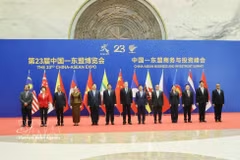
Vietnam always an active contributor to CAEXPO, CABIS: Deputy PM
Within the broader ASEAN-China relationship, Vietnam-China trade and investment cooperation has provided strong momentum and played a key role in connecting markets and production chains, with substantive cooperation advancing across multiple areas.
Ho Chi Minh City helps businesses effectively leverage FTAs
Ho Chi Minh City will implement a range of tasks and solutions to enhance business competitiveness, promote sustainable exports, expand markets, and enable local businesses to engage more deeply in global value and supply chains. The move is also expected to contribute to the development of Ho Chi Minh City as a regional hub for trade, logistics and international economic integration.
Livestreaming helps Vietnamese goods break past local markets
Once a product goes digital, it can transcend geography entirely. Consumers no longer need to visit a store or craft village in person to learn where a product comes from, how it's made, or whether it's worth buying. They can do all of that, and decide to buy, from a screen.
Vietnam to remain regional growth leader for 2026-2035: Report
Vietnam may remain the growth leader in Southeast Asia in the 2026-2035 period, according to a report released by the US’s Bain & Company and Singapore’s DBS Bank and Vriens & Partners on September 16.
Khanh Hoa approves industrial projects with investment of 10.8 trillion VND
The south-central province of Khanh Hoa on September 16 announced investment approval decisions and investment registration certificates for five projects worth nearly 10.82 trillion VND (415.96 million USD), including three industrial park infrastructure projects and two foreign-invested ones.
Removing bottlenecks to expand leasing finance for private healthcare
Financial leasing can provide medium- and long-term financing, cover up to 100% of equipment costs and use revenue generated from equipment operations to service lease payments.