Norwegian Seafood Council tells stories of salmon to appeal to Vietnamese consumers

As Vietnam’s economy has grown, so has its appetite for Norwegian salmon. Fresh Norwegian salmon exports to Vietnam reached approximately 7,900 tonnes in 2025, an increase of 40% from the previous year.

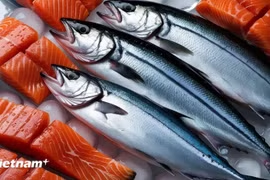
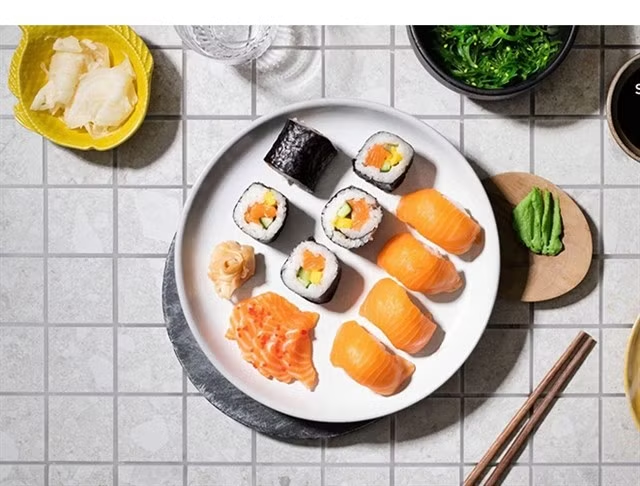
Sushi and sashimi, icons of Japanese cuisine, prepared using fresh Norwegian salmon. (Photos courtesy of NSC)

Ho Chi Minh City (VNS/VNA) – A recent initiative launched by the Norwegian Seafood Council has unveiled the stories of Norway's salmon, which is often used for sushi in Vietnam.

The initiative follows a finding from the council’s latest global consumer survey that 52% of Vietnamese respondents preferred Norwegian salmon, almost as many as those who preferred salmon from Japan.

“Norway’s cold, clear Atlantic waters produce distinctive, high-quality salmon that has become a much-loved ingredient in sushi and other popular Japanese dishes. Yet its Norwegian origin is not always apparent to diners,” said Åshild Nakken, Southeast Asia director at the Norwegian Seafood Council.

Leading retail and food service partners, including Lotte Mart, Mena Gourmet, Mega Market, Morico, Botejyu and Sushi BON have joined the initiative, making it the council’s largest campaign to date in Vietnam.

The campaign brings together industry partners, nutrition experts, chefs, media and culinary enthusiasts to celebrate the story of Norwegian salmon in sushi and other Japanese dishes.

During the campaign, participating outlets nationwide will offer special menus, retail promotions, salmon tastings and interactive activities. These will invite Vietnamese consumers to experience Norwegian salmon and discover its journey from Norway’s coast, through Japan’s celebrated culinary culture, to tables across the country.

At the heart of the initiative is the story of how Norwegian salmon found its place in Japanese cuisine. Sushi has been part of Japanese culture for centuries, but Norwegian salmon became a widely used ingredient through Project Japan, a collaboration launched in 1985 between Norwegian producers and Japanese importers, chefs and restaurants.

Over nearly a decade, the partnership helped establish the use of Norwegian salmon in sushi and contributed to a pairing now enjoyed by diners around the world.

Today, around 30% of Norwegian salmon is estimated to be consumed raw in sushi and similar dishes.

“Japanese cuisine is known for its close attention to freshness, texture and the depth of flavour of every ingredient. Norwegian salmon offers these qualities, which is why it has found such a natural place in sushi and other Japanese dishes,” said Nakken.

Norwegian salmon is produced under Norway’s rigorous food safety and quality management system. The Norwegian Food Safety Authority conducts official controls across the production chain, while the Institute of Marine Research independently tests market-ready farmed fish for illegal substances, veterinary medicines and environmental contaminants.

From processing and chilling in Norway to temperature-controlled transport and local distribution in Vietnam, careful handling helps retain its freshness and texture until it reaches retailers and restaurant kitchens.

“As Vietnamese families and diners enjoy salmon more often, understanding its origin becomes part of choosing well. Norwegian salmon has a distinctive story, one that explains why it is so widely valued in sushi and many other dishes,” said Nakken.

The campaign comes as Norway and Vietnam celebrate 55 years of diplomatic relations and move towards closer ties in bilateral trade.

As Vietnam’s economy has grown, so has its appetite for Norwegian salmon. Fresh Norwegian salmon exports to Vietnam reached approximately 7,900 tonnes in 2025, an increase of 40% from the previous year./.
VNA

See more

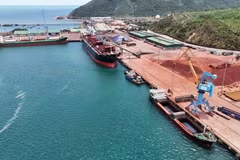
Vung Anh deep-water port in Ha Tinh province (Photo: VNA)

Vietnam promotes green, smart seaports linked to modern logistics

To develop green ports, the Vietnam Seaports Association planned to promote energy management, emission reduction, electrification, onshore power, renewable energy, measurement systems, reporting and verification of emissions (MRV), along with green financial solutions.

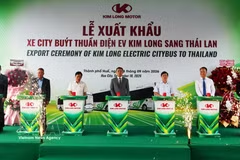
Delegates at the ceremony held at Chan May Port in Hue city for the export of first batch of Kim Long Motor electric buses to Thailand Photo: VNA)

Kim Long Motor exports first batch of electric buses to Thailand

This is the first batch of finished buses manufactured by Kim Long Motor to be transported to an international market via a dedicated roll-on/roll-off (Ro-Ro) vessel, marking a new development in logistics capacity and port connectivity in the central region.

The Can Gio mangrove forest, a vital "carbon sink" ecosystem, contributes to generating the credits needed to fuel Vietnam's carbon market. (Photo: VNA)

Institutions must provide strong economic incentives for green transition: experts

Assoc. Prof. and Dr Ngo Tri Long of the Vietnam Financial Consulting Association proposed reviewing legislation across the entire chain of economic activities to identify and address key points of intersection in support of the green and circular transition in a consistent manner, preventing legal gaps and enabling waste to genuinely become a resource.

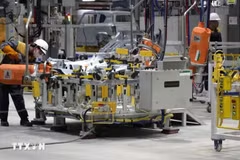
An automotive and motorcycle parts production line at Vietnam Precision Industrial Co., Ltd. No. 1 in Ba Thien 2 Industrial Park, Phu Tho province (Photo: VNA)

Vietnam moves to fast-track foreign investment through institutional reforms

Under the draft Law, the Government will periodically adjust market access restrictions for foreign investors based on socio-economic conditions and management requirements. This approach could shorten policy lags amid rapid changes in international capital flows, technology and supply chains, while Vietnam is shifting its investment attraction focus from quantity to quality and efficiency.

Helicopters perform a flypast at the opening ceremony of the Vietnam Defence Expo 2024. (Photo: VNA)

128 companies from 31 countries register for Vietnam Defence Expo 2026

Vietnam Defence Expo 2026 will cover about 123,800 sq.m and feature seven main areas, including indoor and outdoor exhibition spaces, a defence experience and military games area, a space showcasing defence-economic products and the cultural heritage of Vietnam’s three regions, a VIP reception area, grandstand and performance areas, and common facilities.

Professor Dato Dr Ahmad Ibrahim, an expert in technology, digital transformation and agricultural value chains at UCSI University (Photo published by VNA)

Malaysia-Vietnam cooperation potential under NAP 2.0: expert

By leveraging their complementary strengths under the NAP 2.0 framework, Malaysia and Vietnam have considerable potential to deepen cooperation to build a more technology-driven, sustainable, and resilient agricultural sector in Southeast Asia.

VinFast electric cars are gathered at Hai Phong Port, ready to be loaded onto a ship for export. (Photo: VNA)

Going global: The competition challenge for "Made in Vietnam" cars

The growing number of exporters shows that Vietnam’s automobile industry is entering a new stage of development. However, international markets also present major challenges related to localisation, supporting industries, technological capabilities, human resources and country-specific technical standards.

Ports in Ho Chi Minh City are always bustling with ships loading and unloading cargo (Photo: VNA)

Ho Chi Minh City helps businesses effectively leverage FTAs

Ho Chi Minh City will implement a range of tasks and solutions to enhance business competitiveness, promote sustainable exports, expand markets, and enable local businesses to engage more deeply in global value and supply chains. The move is also expected to contribute to the development of Ho Chi Minh City as a regional hub for trade, logistics and international economic integration.