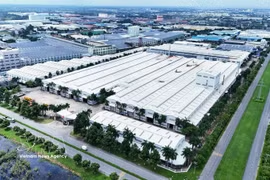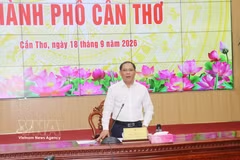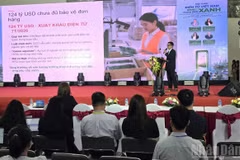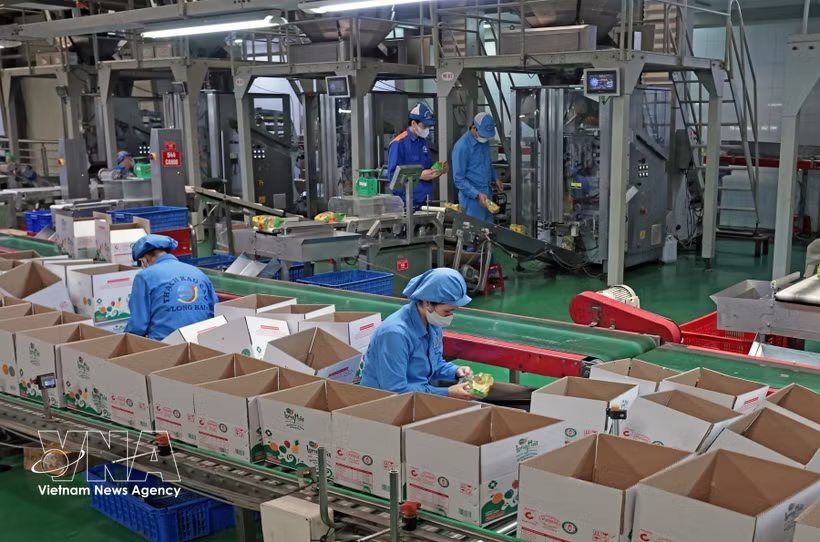
Hai Phong (VNA) – With around 2,000 foreign-invested enterprises and organisations contributing more than 20% of the city’s total domestic revenue, the FDI sector is playing a key role in the northern city of Hai Phong’s budget. This is a direct result of the city’s focused and targeted approach to investment attraction, with emphasis on quality and effectiveness.
Listening to every concern
In the first eight months of 2026, Hai Phong attracted over 3.47 billion USD in foreign investment, 1.8 times the figure recorded in the same period last year and above the target of 3.25 billion USD. Total State budget revenue reached 146.68 trillion VND (5.64 billion USD), equivalent to 75.3% of the assigned estimate.
Pham Van Thep, head of the Hai Phong Economic Zone Authority, said the city’s goal is not merely to attract businesses, but to accompany them so they can operate effectively and stably and pursue long-term development in Vietnam and Hai Phong in particular.
The organisation of consultations to address tax-related difficulties facing FDI enterprises is a typical example of the city’s “business-centred” approach, he said.
Rather than leaving businesses to navigate complex procedures on their own, Hai Phong’s departments and agencies proactively work with them to resolve problems and listen to even the smallest concerns arising from production activities.
The investment climate, he noted, should be assessed not only by land, infrastructure and incentives, but also by institutional quality, transparency, policy stability and predictability, the ease of administrative procedures and the quality of public services. More importantly, it should be measured by the ability to resolve difficulties arising during business operations quickly and substantively.
This also requires comprehensive improvements to the legal framework governing investment, enterprises, land, planning, construction, taxation, customs, trade and related areas, together with the timely removal of overlapping or contradictory provisions and implementation bottlenecks.
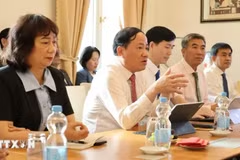
Highlighting Hai Phong’s potential, Ko Tae-yeon, Chairman of the Korean Chamber of Business in Vietnam (KOCHAM), said the city is one of the localities with the most dynamic Korean investment activity. Korean projects account for around 25% of the total in major industrial parks, while the Republic of Korea consistently ranks among the leading sources of registered investment.
Nguyen Tien Truong, Director of the Hai Phong taxation agency, said the city sees business development as the foundation of its own development, while stable and effective business operations ensure a sustainable source of budget revenue.
Providing best possible support to business community
Secretary of the municipal Party Committee Le Ngoc Chau has repeatedly stressed that with its strategic position, outstanding potential, favourable institutions and determination to act, Hai Phong is ready to welcome investors to accompany the city in long-term development.
The city is committed to building an enabling administration that acts decisively, dares to take the lead and assumes responsibility, while providing the best possible services to residents and the business community, he said.
The major orientations for developing the FDI sector in Hai Phong are rooted in the spirit of Resolution No. 10-NQ/TW on the development of the foreign-invested economic sector, which represents an important shift in Vietnam’s thinking and approach to FDI development. It calls for a strong shift from a mindset of “capital attraction” to that of “strategic investment foundation development”, with quality, effectiveness, technology, innovation, value added and linkages with domestic enterprises serving as key criteria.
Embracing this spirit, Hai Phong has been translating the resolution into practical mechanisms and policies.
Alongside practical regulations and administrative procedures, the Hai Phong People’s Committee has issued Decision No. 3661/QD-UBND on September 13, 2026, announcing a list of administrative procedures for which processing times will be reduced and approving internal procedures under a “green lane” mechanism for six investment-related procedures under the authority of the municipal Department of Finance.
From October 1, 2026, four procedures will have their processing time cut from 17 working days to eight.
For two other procedures, including the issuance and adjustment of investment registration certificates, the processing time will be reduced from 10 to 3.5 working days./.