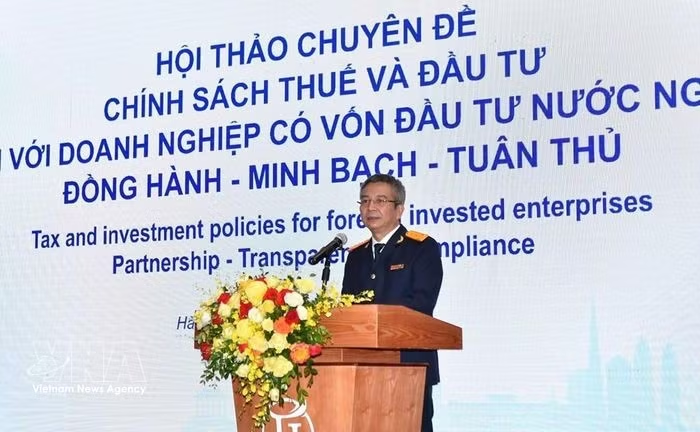
Hanoi (VNA) – The Tax Department on September 28 held a seminar providing foreign-invested enterprises with new tax policies, the global minimum tax, related-party transactions, double taxation agreements, and requirements for tax transparency and information exchange.
The event took place as Vietnam implements Politburo Resolution No. 10-NQ/TW, dated June 8, 2026, on developing the foreign-invested economic sector, alongside new provisions of the Law on Tax Administration and international standards on tax transparency and cooperation.
Speaking at the seminar, the department's Director Mai Xuan Thanh highlighted the important role of the foreign-invested economic sector. He stressed that in recent years, the tax policies and legal framework have continued to be reviewed and refined, while tax administration has shifted strongly towards a modern, data-driven and risk-based approach, with greater use of technology and stronger international cooperation. Vietnam has also proactively participated in and gradually implemented international tax standards, he said.
For the FDI sector, Thanh noted that business operations are no longer confined to a single country. A transaction may involve multiple entities, markets and tax systems. As a result, related-party transactions, double taxation avoidance agreements, the mutual agreement procedure (MAP), advance pricing agreements (APA), information exchange and data transparency are increasingly directly linked to companies’ tax management.
Thanh stressed that transparency is a requirement for both sides. On the part of businesses, tax authorities expect companies to proactively manage compliance and ensure that their records, data and information accurately reflect the nature of their operations and transactions, while engaging with tax authorities at an early stage when complex or unclear issues arise.
For tax authorities, policies, procedures and management requirements must be made public, clearly explained, implemented consistently and communicated in a timely manner.
Nguyen Thanh Hung, chief accountant of Scavi Joint Stock Company, said there are currently many new regulations, including significant changes to rules on related-party transactions that took effect on July 1.
Businesses remain concerned about selecting indicators and data that may be used by tax authorities for analysis. If a company selects data sources or analytical methods that differ from those used by tax authorities, discrepancies may arise between the business and the tax authority.
He said FDI firms hope to be provided with standard data sources or clearer guidance. Businesses also hope that the regulations will be made more specific and clearer.
Nguyen Anh Tuan, Deputy Director of the Foreign Investment Agency under the Ministry of Finance, said rather than attracting more capital or projects, Vietnam needs to improve the quality, efficiency and sustainability of investment flows, while strengthening links between the FDI sector and domestic capabilities and aligning them more closely with the country’s long-term development goals.
He said Resolution No. 10 calls for a strong shift from focusing on scale and quantity towards quality, efficiency and added value. It gives priority to projects featuring advanced technologies, modern management, innovation capacity and the ability to participate more deeply in global value chains.
From the perspective of international investors, Eloïse Roux, Project Manager at the Delegation of the European Union to Vietnam, said that Vietnam remains highly attractive thanks to its expanding domestic market, export-oriented logistics infrastructure and extensive network of free trade agreements. Foreign direct investment in Vietnam reached its highest level in five years in 2025 and during the first quarters of 2026. EU direct investment in Vietnam stood at around 30.5 billion USD as of the end of 2025.
The EU Delegation representative said there remains significant potential for investment cooperation between Vietnam and the EU, with efforts to attract higher-quality and more strategic investment needing to be supported by a favourable, stable and highly predictable investment environment.
At the seminar, the Tax Department also introduced the Vietnam Tax White Paper 2026 to the business community, providing information on the country’s tax policy system, tax administration reforms and investment environment, thereby helping businesses access comprehensive and consistent information./.
VNA