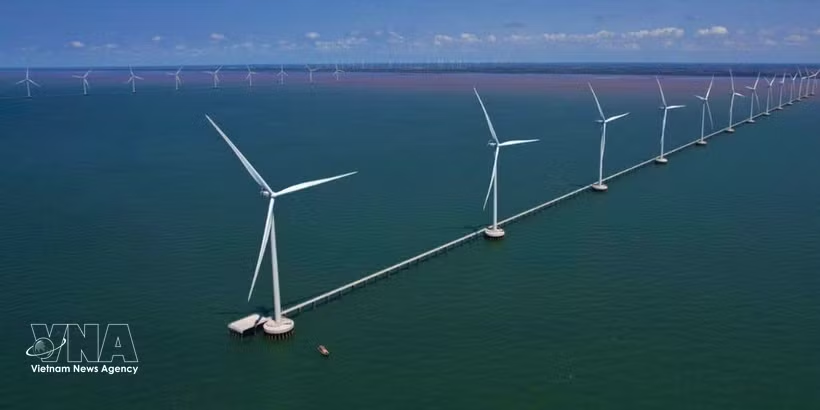
Hanoi (VNA) - Vietnam needs a comprehensive policy framework to remove legal and procedural bottlenecks and create conditions for offshore wind power projects to access long-term investment capital, helping to unlock the country’s substantial offshore wind potential, said insiders.
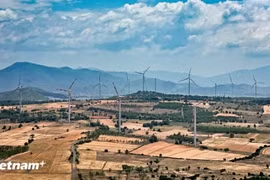
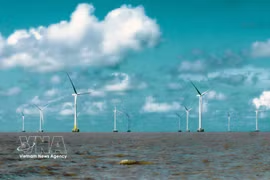
With a coastline of more than 3,260 km, an exclusive economic zone of nearly 1 million sq.km and favourable, stable wind conditions, Vietnam boasts significant offshore wind resources. The World Bank estimates the country’s technical potential at about 600 GW, while a recent study by the Vietnam Meteorological and Hydrological Administration under the Ministry of Agriculture and Environment, in cooperation with the United Nations Development Programme (UNDP), puts the figure at 1,068 GW.
Despite this potential, the sector continues to face significant regulatory hurdles.
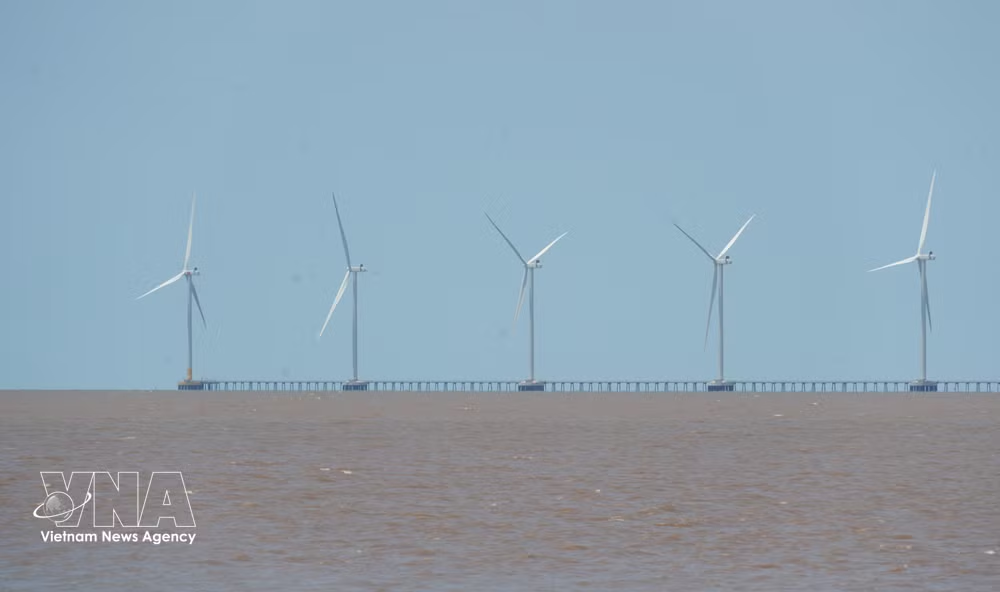
Dr Nguyen Hung Dung, Vice Chairman and Secretary General of the Vietnam Petroleum Association, identified an incomplete and inconsistent legal framework as a key obstacle, noting that energy projects are governed by multiple laws covering electricity, investment, land, environmental protection, and marine resources, as well as other guiding decrees.
Decree No. 272/2026/ND-CP, issued by the Government on July 4, 2026, provides regulations on offshore wind surveys and development. However, several critical issues, including electricity prices, power purchase agreements (PPAs), risk-sharing arrangements and payment guarantees, remain unclear. These are among the factors considered by international lenders when assessing project financing, Dung said.
Sharing Dung’s views, National Assembly Deputy Nguyen Hai Nam said inconsistencies between the power development plan, marine spatial planning and related plans mean that although offshore wind power has been identified as a development priority, there is still insufficient basis for projects to be implemented in practice.
Regulations governing the allocation and leasing of marine areas for surveys, research and construction remain incomplete, he said, adding that questions surrounding long-term electricity prices, investor selection and the authority to approve investment policies also need to be clarified.
With projects requiring billions of US dollars, lengthy preparations, costly surveys and coordination among multiple agencies, Nam called for a unified framework covering development areas, survey procedures, marine-area allocation, investor selection and approval authority.
He also proposed a stable and competitive electricity pricing mechanism incorporating risk-sharing provisions, which, he said, would help investors mobilise long-term financing.
Dr Du Van Toan from the Institute of Meteorology, Hydrology, Environment and Marine Sciences under the Ministry of Agriculture and Environment said offshore wind could serve purposes beyond grid-connected power generation, including producing green hydrogen through water electrolysis. The hydrogen could subsequently be used to make green ammonia and other clean fuels for export.
He noted that countries with strong offshore wind potential, including the Netherlands, Denmark, the UK, Australia and several Middle Eastern countries, are exploring and developing these applications.
Toan said the forthcoming revision of the Electricity Law should establish not only a comprehensive legal framework for offshore wind but also an institutional foundation for the broader offshore energy industry.
He warned that missing this opportunity could have implications beyond the development of offshore wind, potentially limiting Vietnam’s participation in rapidly expanding global value chains for green hydrogen, green ammonia and other emerging energy sectors./.