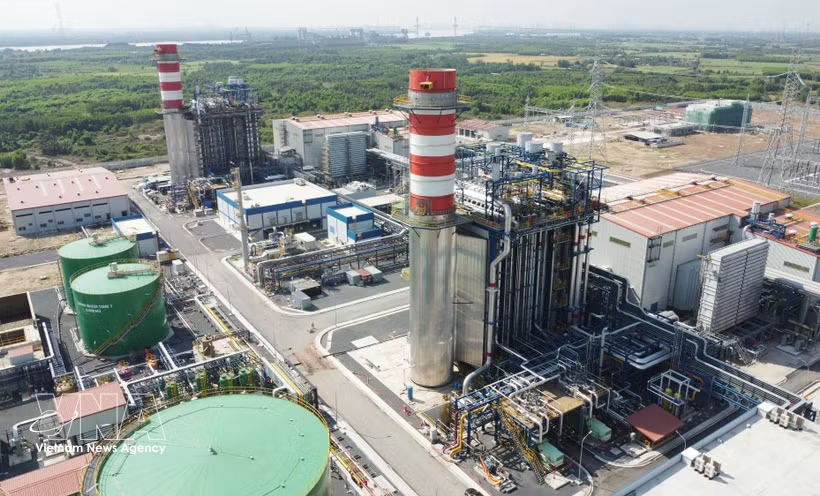
Hanoi (VNA) – As wind and solar power account for an increasing share of Vietnam’s electricity mix, the country faces a growing need for flexible power sources that can maintain grid stability when renewable generation fluctuates with weather conditions.
Natural gas-fired power plants using liquefied natural gas (LNG) are emerging as an important option during the energy transition, as they can adjust output quickly to compensate for changes in renewable power generation.
Flexible backbone for the national grid
Bui Quoc Hung, Deputy Director of the Electricity Authority under the Ministry of Industry and Trade, said that as electricity demand continues to rise, the power system requires greater reliability, stability and flexibility.
LNG-fired power has therefore been identified as a strategic transitional source for the coming period, he said. It can help balance electricity supply and demand while supporting the integration of large-scale renewable energy, improving grid stability and safety, and contributing to Vietnam’s international commitments on greenhouse gas emissions reduction.
The development of gas-fired power is also part of Vietnam’s broader national energy security strategy under Politburo Resolution No. 70-NQ/TW, issued on August 20, 2025, on national energy security through 2030 with a vision to 2045.
The resolution calls for a comprehensive and diversified energy system, with priority given to renewable, new and clean energy, while also promoting nuclear and gas-fired power and gradually reducing the share of coal-fired electricity.
Under the revised Power Development Plan VIII, total LNG-fired power capacity is targeted at 22,524MW by 2030, accounting for around 9.5-12.3% of total power capacity serving domestic demand. The plan also calls for developing around 2,000-3,000MW of flexible power sources capable of rapid start-up to help regulate the system as the share of renewable energy rises.
Removing barriers to LNG projects
Under the revised Power Development Plan VIII, it is expected that 22 LNG-fired power projects would be developed and put into operation during 2025-2035. Fifteen projects, with a combined capacity of 22,524MW, are planned for commercial operation by 2030.
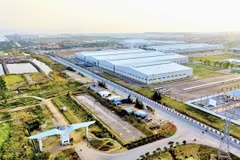
The Nhon Trach 3 and 4 LNG power plants have recently entered commercial operation, adding capacity to the national grid and contributing to more stable system operation.
However, many other LNG projects continue to face obstacles.
Le Ba Quy, Director of the Electricity Project Management Board under Petrovietnam Power Corporation (PV Power), identified transmission infrastructure and site clearance for shared infrastructure as two major bottlenecks.
While gas-fired power technology is relatively mature and equipment is widely available internationally, the greater challenge lies in the economic structure and financial viability of projects, he said.
LNG is fully imported, leaving fuel costs exposed to international prices, shipping costs, exchange-rate movements and geopolitical developments. At the same time, LNG projects require large upfront investment, have long operating lives and need long-term financing. Balancing fuel costs, electricity prices and investment recovery therefore remains a major challenge.
Assoc. Prof. Dr. Tran Dinh Thien said economic efficiency should be a key consideration. Energy planning covers a 20-30-year horizon, while investors must ensure the financial viability of individual projects. He said the legal framework, including regulations under the amended Electricity Law, should provide mechanisms that make LNG projects feasible.
Dr. Nguyen Quoc Thap, Chairman of the Vietnam Petroleum Association, proposed classifying LNG projects into three groups: those capable of reaching final investment decisions (FID) within six to 18 months; those requiring additional procedures; and those facing serious difficulties that need separate solutions.
He also suggested expanding the direct power purchase agreement (DPPA) mechanism to LNG projects, allowing buyers and sellers to negotiate long-term commitments for power offtake and explore suitable options for investing in or leasing transmission infrastructure.
Assoc. Prof. Dr. Ngo Tri Long said flexible power purchase agreements should also be considered for different stages, along with multi-component electricity pricing that includes capacity payments, helping balance regulatory requirements with investors’ need to recover costs.
Resolution No. 70-NQ/TW calls for urgent action to remove obstacles to gas and LNG projects, particularly those related to electricity purchase prices. It also calls for a competitive, transparent and efficient electricity market and stable, long-term PPAs that protect investors’ legitimate rights and interests.
Developing mechanisms for ancillary services could provide additional revenue and improve project economics.
For LNG-fired power to fulfill its role in Vietnam’s energy transition, bottlenecks in institutions, infrastructure, electricity pricing, PPAs, power dispatch and financing must be addressed together. A more complete framework would allow LNG-fired power, alongside other sources, to strengthen national energy security and support economic and social development and the country’s high-growth targets./.
VNA