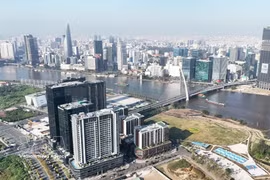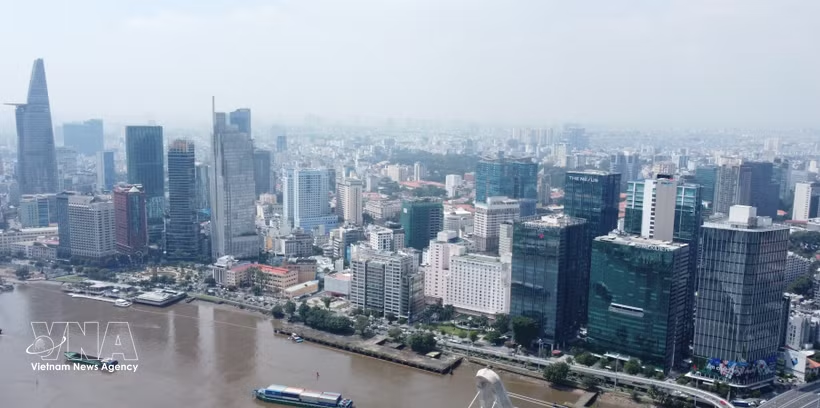
Ho Chi Minh City (VNA) – Ho Chi Minh City is entering a new development era after becoming Vietnam’s first mega-city, bringing major opportunities as well as challenges for the city and investors.
Infrastructure to drive mega-city development
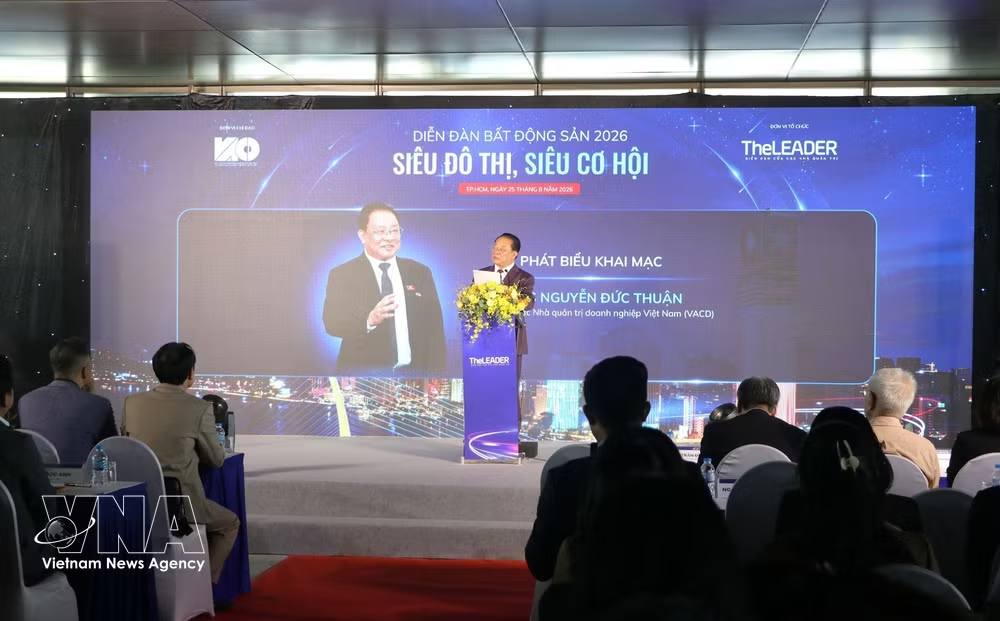
Speaking at the Real Estate Forum 2026, themed “Mega city, Mega opportunities,” held on August 25, Prof. Dr. Nguyen Duc Thuan, Chairman of the Vietnam Association of Corporate Directors (VACD), said the merger of Ho Chi Minh City with Binh Duong and Ba Ria-Vung Tau has created an urban space of about 6,700 sq. km with a population of more than 14 million.
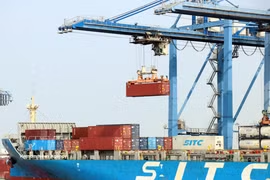
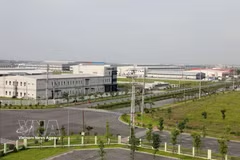
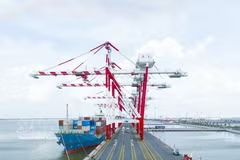
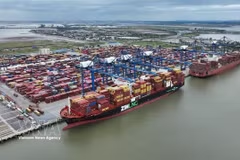
The new space combines strengths in high-tech industry and manufacturing, deep-water seaports, international logistics, finance and services, and high-quality human resources.
Thuan said a mega-city cannot be created simply by combining three localities but must connect their resources into an integrated whole that generates value greater than the sum of its parts.
He suggested developing Ho Chi Minh City as a polycentric urban area, replacing the model of “one centre and multiple outskirts”. Development hubs should have clearly defined functions in finance, industry, innovation, logistics, seaports and tourism, while remaining interconnected.
Assoc. Prof. Dr. Tran Dinh Thien, former Director of the Vietnam Institute of Economics, said Ho Chi Minh City needs “super capacity” in finance and governance to turn its opportunities into reality. A polycentric structure would also help maximise its competitive advantages.
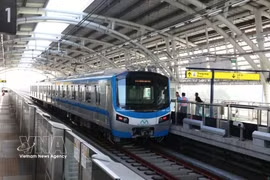
Nguyen Do Dung, CEO of international consultancy enCity, noted that the city’s development had been constrained by infrastructure connectivity. Investment in metro lines, ring roads and inter-regional corridors will therefore be key to expanding development space and reducing urban costs.
Experts described metro lines, ring roads, expressways, seaports and airports as the “circulatory system” of the mega-city. However, infrastructure alone is insufficient. Urban space must be organised around transport infrastructure, with transit-oriented development (TOD) potentially turning stations and transport hubs into centres for housing, commerce, services, jobs and public spaces.
Institutional breakthroughs, long-term vision
From a real estate perspective, “mega-opportunities” should not be understood as land fever or short-term speculation. Businesses and investors need to consider development space in relation to capital flows, knowledge, infrastructure, population, employment and economic hubs.
According to Thien, Politburo’s Resolution 31 sets a goal for Ho Chi Minh City to become Asia’s leading economic, financial and innovation centre with a high quality of life by 2045, and a global, smart and modern city by 2075.
To realise this vision, the National Assembly has adopted a new institutional framework, including the Urban Development Law, providing a legal foundation for the city to shift from administrative management to development governance and from growth based on land and low-cost labour to knowledge-, data- and technology-driven growth.
The adjusted Ho Chi Minh City master plan for 2021-2030, with a vision to 2050, outlines a multi-layered economic structure with defined functions for different growth hubs.
Under the plan, central Ho Chi Minh City will serve as a core hub for high-end services, including the International Financial Centre and a regional innovation centre. Binh Duong will develop as a high-tech industrial hub linked to research and innovation, while Ba Ria-Vung Tau will become a maritime and logistics centre, free trade zone, and international tourism hub associated with deep-water ports.
Thien identified three key tasks: developing a polycentric urban structure; promoting TOD around transport hubs, metro lines and ring roads; and adopting smart governance based on data and technology to improve resilience to climate change and supply-chain shifts.
Opportunities and challenges
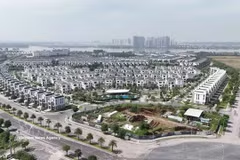
Duong Thuy Dung, CEO of CBRE Vietnam, said the city’s expansion had significantly changed the real estate market. Average primary apartment prices fell from 92 million VND (3,540 USD) to 76 million VND per square metre, creating more favourable conditions for homebuyers.
She urged businesses to shift from short-term “flipping” strategies towards long-term value investment.
Architect Vo Kim Cuong, former Deputy Director of the municipal Department of Planning and Architecture, stressed that urban planning must be implemented in a coordinated and feasible manner. He said implementation requires public consensus and strong determination from authorities.
As the urban population grows, greater attention will also be needed to social welfare, education, healthcare and other essential services.
Nguyen Thi Thanh Huong, Vice Chairwoman of the Vietnam Association of Realtors, said close coordination among authorities, businesses and residents is essential for Ho Chi Minh City to become an Asian-scale mega-city.
Only by developing new growth areas and creating a value ecosystem for real estate can the city fully tap its potential, she said./.