Hanoi to host international textile and garment industry exhibition

The annual exhibition comprises two main sections including HanoiTex, showcasing machinery, equipment and technologies for the textile and garment industry, and HanoiFabric, featuring fabrics and materials for textile, garment and embroidery production.

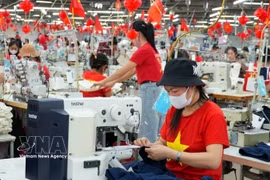
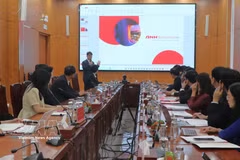
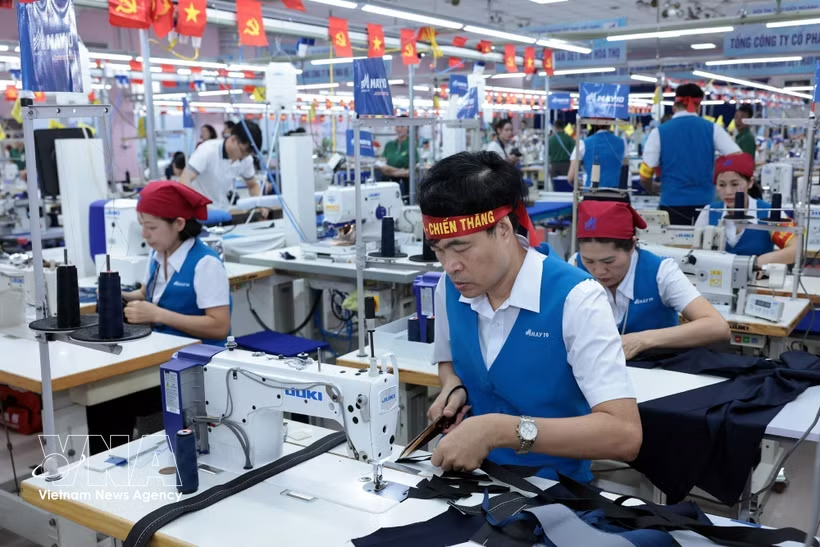
The Vietnam Textile and Garment Trade Union and the Vietnam National Textile and Garment Group organise the seventh Vietnam Textile and Garment Skilled Workers Competition 2026 in Hanoi on August 16, 2026. (Photo: VNA)

Hanoi (VNA) — The HanoiTex & HanoiFabric 2026 International Exhibition on Textile and Garment Industry, Equipment, Materials and Fabrics is scheduled to take place from October 21-23 at the International Exhibition Centre in Hanoi.

The annual exhibition comprises two main sections including HanoiTex, showcasing machinery, equipment and technologies for the textile and garment industry, and HanoiFabric, featuring fabrics and materials for textile, garment and embroidery production.

This year’s event is expected to bring together manufacturers, technology providers, material suppliers and partners across the domestic and international textile and garment supply chain.

The exhibition is held with the support of the Vietnam Chamber of Commerce and Industry (VCCI), Vietnam Textile and Apparel Association (VITAS), Vietnam National Textile and Garment Group (VINATEX) and the Ho Chi Minh City Association of Garment Textile Embroidery Knitting (AGTEX).

Exhibits will cover textile and garment machinery and equipment, yarns, fabrics and accessories, dyeing and finishing technologies, automation and solutions for greener, smarter and more sustainable production.

Technologies aimed at reducing water, chemical and energy consumption, enabling flexible production and cutting inventory costs will also be showcased.

A series of thematic seminars will be held throughout the three-day exhibition, providing opportunities for businesses, associations, experts and solution providers to exchange information and explore cooperation.

Topics will include trade defence, traceability, supply chain transparency, digital transformation and sustainable development, issues of growing importance to textile and garment businesses.

Truong Van Cam, Vice Chairman of VITAS, said HanoiTex & HanoiFabric 2026 will provide businesses with opportunities to access new machinery and production solutions, connect with suppliers of fabrics, yarns and materials, meet international partners and keep abreast of developments in technology, green production, automation and digital transformation. It will also provide opportunities to explore investment, trade and market expansion, he added.

Beyond technology and equipment, HanoiTex & HanoiFabric 2026 will highlight major trends shaping the industry, including digital transformation, automation, smart manufacturing, the circular economy and sustainable production.

The participation of international companies and brands is expected to strengthen business connectivity and create opportunities for companies to exchange experience, share solutions and explore new partnerships, contributing to the textile and garment sector’s competitiveness and international integration./.
VNA

See more

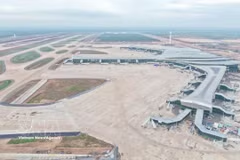
Phu Quoc speeds up multimodal infrastructure development ahead of APEC 2027 (Photo published by VNA)

Phu Quoc accelerates multimodal infrastructure ahead of APEC 2027

At the heart of this transformation is DT975, the corridor connecting Phu Quoc International Airport with the APEC Convention Centre. With a 62-metre cross-section featuring 10 motor vehicle lanes and an integrated light rail transit (LRT) line, the route is being developed as a key component of the island’s future transport network.

The agreement, which takes immediate effect, doubles the weekly passenger capacity limit to 16,800 seats from the current 8,000. (Illustrative photo: VNA)

Vietnam, India agree to expand air services

The new agreement between Vietnamese and Indian airlines, which takes immediate effect, doubles the weekly passenger capacity limit to 16,800 seats from the current 8,000. The expansion comes as airlines from both countries have used or are nearing full use of their existing traffic rights amid growing travel demand.

Deputy Prime Minister Nguyen Van Thang (right) receives Chairman and CEO of US-based R3 Lithium Linh Austin in Hanoi on September 21. (Photo published by VNA)

Deputy PM receives leader of US’s R3 Lithium

Welcoming US businesses to invest and operate in Vietnam, Deputy Prime Minister Nguyen Van Thang said the Southeast Asian country seeks not merely to attract more investment capital but to establish partnerships based on co-creation.

Delegates at the seminar "Canada- Vietnam: ICT and AI Cooperation" (Photo: published by VNA)

Experts suggest ways to connect Vietnam, Canada tech ecosystems

With joint funding mechanisms, clear coordination channels and market-driven projects, technology cooperation between Vietnam and Canada could move beyond the exchange of ideas, turning the two countries' complementary strengths into a shared innovation ecosystem and creating fresh momentum for bilateral economic ties.

Handling import-export cargo at MPC Hai Phong Port. (Photo: VNA)

Vietnam’s trade surpasses 825 billion USD

With growth approaching 30% year on year, Vietnam’s trade flows remain robust, driven by strong demand for consumer goods and production materials. Processing and manufacturing, particularly electronics, machinery and equipment, continued to drive export growth.

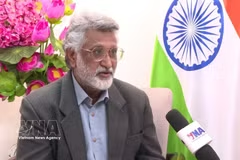
Harbinder Singh, Programme Director at India Exposition Mart Limited, grants an interview to Vietnam News Agency correspondents in India (Photo: VNA)

Vietnamese products see ample growth potential in Indian market

In addition to coffee, he said Vietnamese packaged food, beverages and fruit are competitive, with reasonable prices providing an advantage. Building sufficiently large-scale import chains between businesses of the two countries could help expand sales and lay the foundation for long-term commercial cooperation, he added.

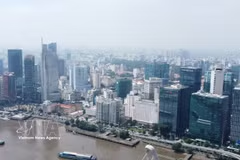
The Vietnam International Finance Centre in Ho Chi Minh City, with its many groundbreaking mechanisms, is attracting many international investors (Photo: VNA)

Ho Chi Minh City eyes infrastructure-led growth as mega-city

Mega-city cannot be created simply by combining three localities but must connect their resources into an integrated whole that generates value greater than the sum of its parts, said Prof. Dr. Nguyen Duc Thuan, Chairman of the Vietnam Association of Corporate Directors.

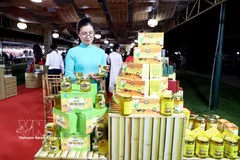
A booth introducing OCOP products at the festival (Photo: VNA)

Festival links farm produce, OCOP products, traditional crafts with tourism development

Held for the first time in Tuyen Quang, the festival runs from September 18 to 24 along Chien Thang Song Lo street in Minh Xuan ward, featuring 120 booths operated by businesses and cooperatives from 17 provinces and cities nationwide. It also includes six shared booths showcasing Tuyen Quang’s traditional crafts and 30 food stalls linked with the beer festival.

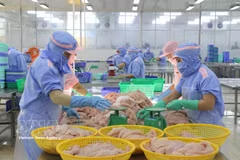
Workers process seafood for export. (Photo: VNA)

Vietnamese goods gain wider access to EU market

In the seventh year of implementing the EVFTA, the EU has completed its tariff liberalisation schedule, bringing import duties on approximately 99% of tariff lines for Vietnamese goods to zero. The development is expected to strengthen the competitiveness of Vietnamese businesses in the European market, but also requires them to improve their ability to meet increasingly strict market standards.

Long An International Port is one of the important gateways for Tay Ninh to connect its goods with the seaport system and international transport routes (Photo: VNA)

Logistics upgrade vital to 1-trillion-USD trade target: experts

As trade expands, systemic bottlenecks across transport networks, warehousing, ports, border gates, and industrial zones are becoming more apparent. Experts emphasise the need to shift from a fragmented, project-by-project approach toward strategic management structured around trade corridors and integrated supply chains.