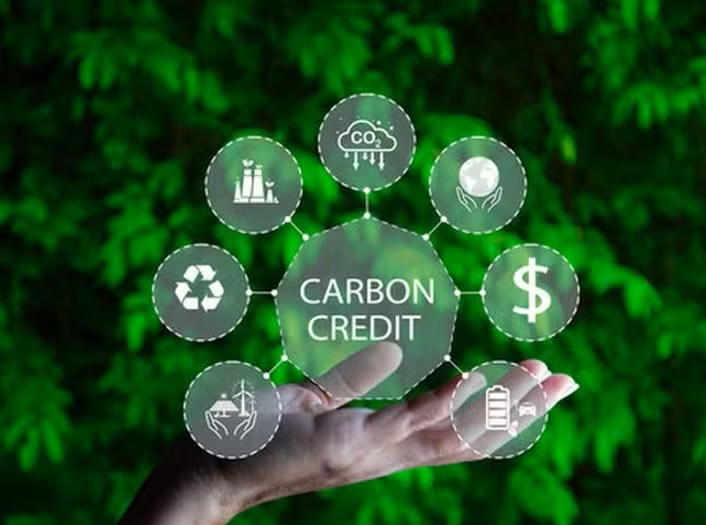
Hanoi (VNA) – Hanoi is establishing an inter-agency mechanism to coordinate greenhouse gas inventories, emissions reduction and participation in the carbon market, with departments assigned specific tasks in emissions data, carbon-credit projects, financial management, technology, and benefit-sharing mechanisms.
Under a decision of the municipal People’s Committee on establishing an inter-agency working group, departments and agencies are responsible for identifying facilities subject to greenhouse gas inventories, developing emissions-reduction plans and studying projects capable of generating carbon credits. These are considered key steps towards the city’s participation in the carbon market.
The Department of Agriculture and Environment is responsible for compiling greenhouse gas emissions inventory data in the city, serving the development of national climate change reports and implementation of the Nationally Determined Contributions (NDC) and Net Zero 2050 targets. It will also update the list of facilities subject to inventories and consolidate results of inventory inspections and emissions-reduction plans for 2026-2030.
The department will study and propose a list of emissions-reduction and potential carbon-credit projects in areas including waste treatment and methane recovery, wastewater, low-emission agriculture, forestry and urban greenery, wetlands and circular agricultural economy. This is a group of sectors capable of generating quantifiable emissions reductions, providing a basis for developing carbon credits.
From energy, industry to transport and construction
The municipal Department of Industry and Trade will manage data on energy consumption, production, energy efficiency and emissions intensity, and review facilities subject to inventories, allowance allocation and participation in the carbon market pilot.
It will also guide businesses in developing emissions baselines in energy saving, rooftop solar power, clean electricity, waste-heat recovery, fuel switching and technological innovation, while identifying potential carbon-credit projects.
Meanwhile, the municipal Department of Construction will manage emissions related to construction, buildings, urban infrastructure, housing and transport. It will develop emissions data on construction materials, buildings, lighting, air conditioning, water supply and drainage, demolition and construction waste, as well as vehicles, fuels and passenger and freight transport, and electric vehicles.
The department will quantify emissions reductions from switching buses and taxis to clean energy, developing urban railways, restricting high-emission vehicles and promoting public transport. It will also review potential carbon-credit sources from energy savings in buildings, replacement of cooling equipment, smart lighting, gas recovery at wastewater treatment facilities and the use of low-emission materials.
Finance and technology emerge as two critical links
The municipal Department of Finance is also tasked with handling financial issues related to allowances and carbon credits, including revenues from credit transfers and budgets for purchasing allowances and credits, and accounting for assets and property rights arising from carbon credits.
It will also study approval procedures for credit generating projects using public assets, the State budget and city resources, while clarifying credit ownership, partner selection and principles for sharing revenues and benefits from credits generated from public land, forests, greenery, water surfaces, public works, State data and infrastructure managed by State-owned enterprises or public service units.
Meanwhile, the municipal Department of Science and Technology will provide the technological foundation, covering standards, measurement, innovation, digital transformation, and data infrastructure. It will coordinate the development of digital platforms and online databases on greenhouse gases and carbon credits, while researching sensor-based emissions monitoring and advanced calculation technologies.
Notably, the healthcare sector has also been included in the emissions reduction and the carbon credit development mechanism. The municipal Department of Health will review hospitals, healthcare and pharmaceutical facilities with significant energy use, refrigerant consumption, waste, wastewater or greenhouse gas emissions, and develop emissions reduction plans while promoting energy efficiency, green procurement and green healthcare facilities.
It will also identify programmes and projects with carbon-credit potential, clarifying funding sources, assets used, ownership of emissions reduction results, credit rights and benefit-sharing mechanisms.
The division of responsibilities will establish links among emissions data, measurement, reporting and verification, finance, ownership and data infrastructure, laying the foundation for Hanoi to gradually develop its carbon market ecosystem./.