Buenos Aires (VNA) – The Argentine Chamber of Commerce for Asia and the Pacific (Cámara de Asia) held a seminar in Buenos Aires on September 24 to provide information, connect enterprises and discuss business opportunities in Japan, the Republic of Korea, Vietnam and Indonesia.
The event brought together representatives of diplomatic missions and trade promotion agencies of the four Asian countries, along with numerous Argentine businesses with experience in trade and investment in Asia and Southeast Asia. Professors, lecturers, and students of international economics, along with representatives of the Argentine business community, also attended.
In his opening remarks, Cámara de Asia Executive Director Martín Lo Coco said Asia is increasingly becoming a region of great potential for Argentine businesses thanks to its market size, economic growth and diverse import demand. As Argentina seeks to expand its external economic relations, stronger access to Asia-Pacific markets is considered an important avenue for diversifying export markets.
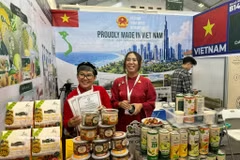
At the seminar, Vietnamese Trade Counsellor in Argentina Ngo Manh Khoi introduced key features of Vietnam’s economy and cooperation opportunities for Argentine businesses. According to official data, Vietnam’s GDP grew 8.02% in 2025, while total merchandise trade reached 930.05 billion USD, with exports exceeding 475 billion USD, up 17.0% from 2024, and imports at around 455 billion USD, up 19.4%. The economy was valued at approximately 514 billion USD.
He highlighted Vietnam’s stable economic and political environment, proactive international integration and participation in a broad network of new-generation free trade agreements, including the Comprehensive and Progressive Agreement for Trans-Pacific Partnership (CPTPP), the EU-Vietnam Free Trade Agreement (EVFTA) and the Regional Comprehensive Economic Partnership (RCEP). These provide a foundation for Vietnam to serve not only as a market of nearly 100 million people but also as a gateway for businesses to access supply chains and wider markets across the Asia-Pacific region.
Vietnam has set ambitious growth and development targets for the coming decades. During 2026–2030, the country aims to maintain average annual GDP growth of at least 10%, with a goal of becoming a “developing country with upper-middle income” by 2030 and a “developed, high-income country” by 2050. These goals are accompanied by efforts to accelerate industrialisation, innovation, digital transformation and international integration, opening up greater room for cooperation with foreign partners and businesses.
Vietnam and Argentina established diplomatic relations on October 25, 1973, and elevated them to a Comprehensive Partnership in 2010. The two economies are highly complementary, with Argentina strong in agricultural products, raw materials and food, while Vietnam has strengths in processed industrial goods, electronics, machinery, footwear and textiles.
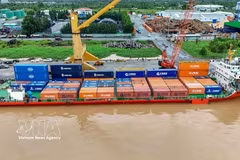
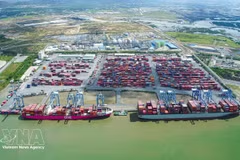
Bilateral trade has remained high in recent years, reaching approximately 4.27 billion USD in 2025. Vietnamese exports to Argentina surged 68.7% last year. Argentina is currently Vietnam’s third-largest trading partner in Latin America, while Vietnam is an important trading partner of Argentina.
Notably, the two sides are seeking to further expand trade through a Preferential Trade Agreement (PTA) between Vietnam and the Southern Common Market (MERCOSUR). The first round of negotiations took place in Buenos Aires in late August, focusing on issues including trade in goods, rules of origin, sanitary and phytosanitary measures, technical barriers, trade facilitation and economic cooperation.
Meanwhile, Argentina officially applied to join the CPTPP in June. As CPTPP Chair in 2026 and one of ASEAN’s dynamic economies, Vietnam supports Argentina’s accession to the agreement.
At the seminar, Argentine business representatives also shared practical experience in trade and investment activities in Japan, the Republic of Korea and Indonesia, reflecting growing interest among the country’s business community in Asian markets. Among the destinations discussed, Vietnam emerged as a market with significant potential thanks to its strong growth, extensive FTA network and increasingly important role in regional supply chains./.
VNA