ADB raises Vietnam's 2026 growth forecast to 7.8%

ADB has raised Vietnam’s growth forecast to 7.8% in 2026, from 7.2% in its July update, while raising its 2027 projection from 7.0% to 7.6%.

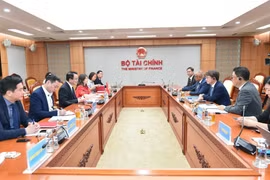
ADB's representatives at the press conference on September 23. (Photo: VNA)

​Hanoi (VNA) – The Asian Development Bank (ADB) has raised its 2026 growth forecast for Vietnam to 7.8% following stronger-than-expected economic performance in the first half of this year.

Speaking at the release of the Asian Development Outlook September 2026 on September 23, ADB Country Director for Vietnam Shantanu Chakraborty said the economy entered the year with strong momentum and continued to perform well despite greater uncertainty in the global environment.

​Vietnam’s gross domestic product (GDP) expanded by 8.2% in the first half, compared with 7.5% in the same period last year, supported by manufacturing, domestic consumption, foreign direct investment (FDI) and supportive policies.

Bui Minh Giap, ADB's principal economist in Vietnam, said a notable feature of Vietnam's recent economic performance was that growth had not been driven by a single sector but had spread across industry, construction, services, agriculture, consumption, investment and trade.

He highlighted investment and production as two important growth drivers. FDI remained a bright spot, with registered and disbursed capital increasing in the first six, seven and eight months of the year, demonstrating that Vietnam continues to be an important destination in regional production chains.

Meanwhile, the manufacturing purchasing managers' index (PMI) remained above the 50-point threshold for 14 consecutive months, indicating continued expansion in the manufacturing sector and supporting other areas of the economy.

Reflecting this stronger-than-expected performance, ADB has raised Vietnam’s growth forecast to 7.8% in 2026, from 7.2% in its July update, while raising its 2027 projection from 7.0% to 7.6%.

Inflation forecasts were also revised upwards to 4.3% this year and 4% in 2027 amid sustained demand pressures and higher energy and import costs.

Giap said the revisions showed that stronger growth was also accompanied by greater inflationary pressures. Vietnam's growth outlook had strengthened considerably, but risks remained, he noted.

Externally, weaker global demand and heightened external uncertainty could weigh on exports and investment, while higher energy prices and tighter global financial conditions could add to inflation and exchange-rate pressures, according to ADB.

Domestically, economic activity is increasingly being supported by investment and credit expansion, creating important policy trade-offs. Greater reliance on bank credit to finance large-scale investment could however increase risks of liquidity, maturity, and portfolio concentration if not prudently managed. This underscores the need to ensure that investment strengthens productive capacity, supports sound financial returns, and broadens private sector development.

Against this backdrop, Chakraborty said the key challenge behind the impressive growth figures was how Vietnam can sustain strong growth while improving its quality and resilience of that growth.

He stressed that safeguarding macroeconomic stability should remain a top priority. ADB recommended that Vietnam maintain prudent macroeconomic and financial policies, careful monitoring of credit quality, and continued efforts to contain inflation and exchange-rate pressures.

Public investment should continue to support the economy, with strong attention to efficiency, project readiness, and implementation quality. Well-targeted investment can help ease infrastructure bottlenecks, crowd in private investment, and strengthen the economy’s productive capacity, he said.

Chakraborty concluded that Vietnam's challenge is not only to sustain high growth but also to improve its quality and sustainability. Continued reforms will be key to raising productivity, strengthening domestic capacity and bringing Vietnam closer to its goal of becoming a high-income country./.


​

See more

A view at a CO.OPMART supermarket in Bac Ninh city (Photo: bacninh.gov.vn)

Bac Ninh’s CPI up 4.07% in nine months

The consumer price index (CPI) in Bac Ninh city rose 4.07% year-on-year in the first nine months of 2026, with housing and construction materials, education and transport recording the sharpest increases, according to the municipal Statistics Office.

Vietnam's textile - garment and footwear industries are aiming to shift from processing and assembly to stages with higher added value, increasing technology content and competitiveness. (Photo: VNA)

Vietnam’s supporting industries seek stronger domestic links

As global supply chains undergo major changes and environmental standards and digital technology requirements become more demanding, developing supporting industries has become essential to improving the competitiveness of the economy. This requires coordinated efforts by the Government, multinational corporations and domestic businesses.

Prime Minister Le Minh Hung speaks at the meeting (Photo: VNA)

PM orders power plan overhaul to meet double-digit growth

Securing adequate power supply is an urgent priority and a prerequisite to successfully achieve socio-economic development goals 2026, a foundational year for accelerating progress, with breakthroughs to follow in 2027 and the goals for the full term to be delivered, said Prime Minister Le Minh Hung.

General Secretary of the Communist Party of Vietnam Central Committee and President To Lam speaks at the meeting (Photo: VNA)

Top leader pledges support for firms, presses tech self-reliance

The country needs more firms that master technologies, build trusted brands and run production networks able to compete globally. Progress over the next five to 10 years must show up in productivity, job quality and market position, said top leader To Lam.

Then Prime Minister Pham Minh Chinh addresses the Autumn Economic Forum 2025 on November 26 last year. (Photo: VNA)

World Economic Forum to co-brand Autumn Economic Forum 2026 in Ho Chi Minh City

On October 27, the forum will host 16 thematic sessions across three parallel venues, focusing on AI – quantum, finance – digital economy – autonomy, and manufacturing – sustainability – next generation. Two sessions will be jointly organised with the WEF, addressing “Repositioning Vietnam and ASEAN in Global Value Chains” and “From AI Deployment to Future Manufacturing Workforce Readiness”.

Nguyen Dinh Kien, Secretary of the Sam Mun commune Party cell in Dien Bien province, builds wealth through spotted deer farming. (Photo: VNA)

📝OP-ED: Party Central Committee’s 4th plenum offers new thinking encouraging Party members to engage in business

Accordingly, the plenum reached a consensus on several key principles, including shifting from a mindset of “permission” to one of “encouragement and facilitation” for Party members engaging in the private sector; protecting their lawful economic activities; and maintaining strict oversight of those exercising control and benefiting from such activities.

AVAC ASF LIVE vaccine developed and manufactured by AVAC Vietnam Joint Stock Company. (Photo: avac.com.vn)

Vietnam ships first commercial ASF vaccine order to Philippines

Nguyen Van Diep, General Director of AVAC Vietnam, said this was the company’s first commercial export order following the Philippines’ approval of the vaccine for unrestricted circulation. The Philippine Department of Agriculture is expected to issue usage guidelines next week, paving the way for wider distribution and application.

Workers process octopus for export to the Japanese market at Huy Nam Company in An Giang province. (Photo: VNA)

Fisheries sector strives for 12 billion USD in exports amid rising costs

The 12-billion-USD export target remains achievable given solid output growth and generally favourable market conditions. However, any fourth-quarter slowdown would not necessarily reflect raw material shortages but also impacts on economic efficiency amid rising material and fuel costs.