Hanoi (VNA) – As Vietnam marks 40 years of “Doi moi” (Renewal), debates about the outcomes and limitations of the reform process continue to attract public attention. Views questioning the achievements of Doi moi often point to income gaps with developed economies, relatively low labour productivity, or the significant role of foreign direct investment (FDI) in exports.
Such assessments, however, need to be viewed in the context of Vietnam’s starting point in 1986 and the broader trajectory of its development. A country emerging from prolonged wars, facing severe socio-economic difficulties and economic embargo has undergone profound changes over the past four decades.
Before “Doi moi”, Vietnam was experiencing a serious socio-economic crisis, with annual inflation exceeding 700% at some points, millions of families facing food shortages, and weak infrastructure. Compared with the Vietnam of today, the transformation from such circumstances represents a fundamental and profound change.
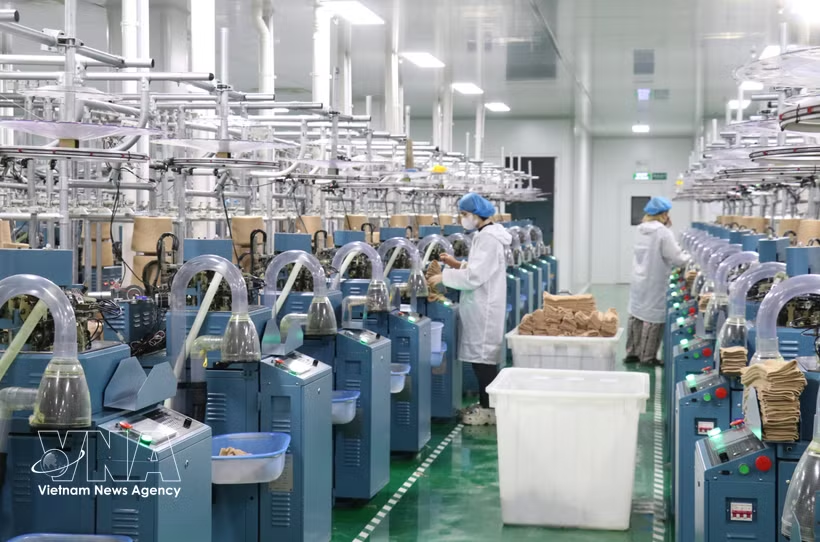
From a country once struggling to feed its people, Vietnam has emerged as a major agricultural exporter, and firmly safeguarded national food security. From a largely closed economy, Vietnam has become a party to 17 free trade agreements (FTAs), including new-generation FTAs. Therefore, using remaining shortcomings to deny the achievements of 40 years of Doi moi means overlooking the historical reality: Vietnam has travelled a long way from where it once stood.
According to the National Statistics Office, Vietnam’s multidimensional poverty rate fell to about 1.3% in 2025. The World Bank’s latest income classification provides another indicator of the country’s economic progress. Vietnam’s gross national income per capita rose to 4,970 USD in 2025, bring the country to the list of upper-middle-income economies.
Affirming the historical value and significance of this four-decade journey, General Secretary of the Communist Party of Vietnam Central Committee and President To Lam said at the fourth meeting of the steering committee for the review of 40 years of “Doi moi” that the great and historically significant achievements recorded over the past four decades provide an important foundation for affirming the Party’s renewal policy as entirely correct and creative, and serving as invaluable spiritual and material assets for the Vietnamese people to confidently enter a new stage of development.
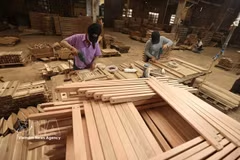
The achievements do not mean that Vietnam has no remaining development challenges. The FDI sector continues to account for a substantial share of exports, while linkages between foreign-invested and domestic enterprises remain an area requiring further improvement. Labour productivity also remains below that of more advanced economies.
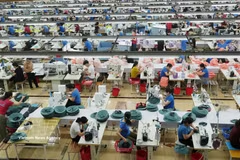
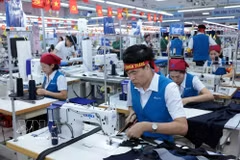
At the same time, the role of FDI can be viewed in the context of Vietnam’s development needs during the early stages of reform. Foreign investment provided capital, employment, technology, management expertise and access to global production networks. The current emphasis on attracting higher-quality FDI, promoting technology transfer and strengthening domestic enterprises reflects an evolution in policy rather than a rejection of the role FDI has played.
Another argument sometimes put forward is: “If “Doi moi” has been successful, why does Vietnam need to reform its growth model? Does this mean the previous model has failed?”
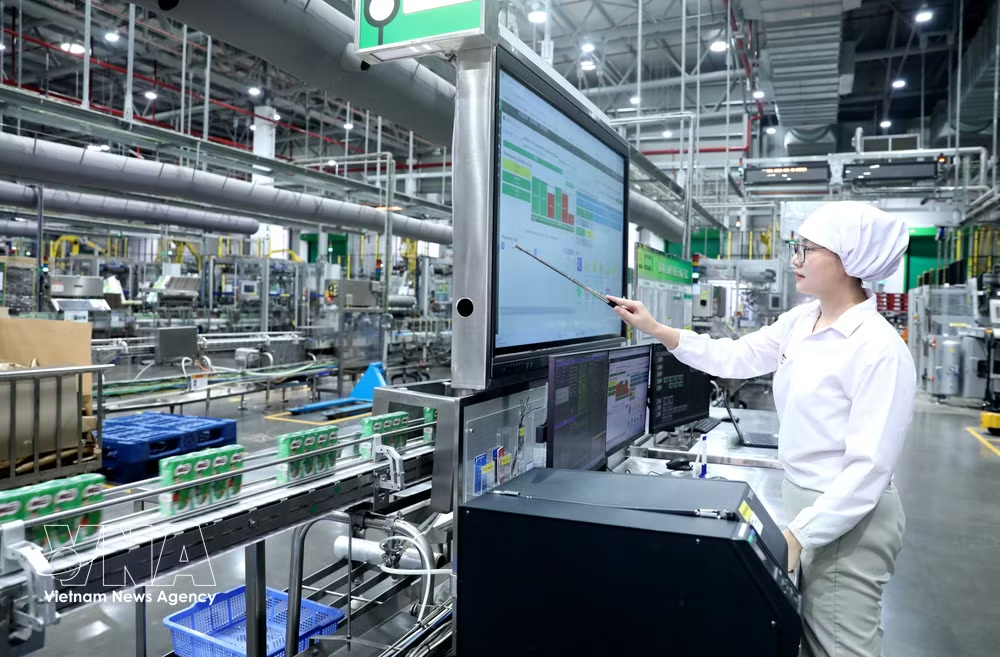
This reflects a misunderstanding of the nature of “Doi moi”. It is not a fixed formula to be implemented once and then brought to an end. Rather, its essence lies in responding to practical realities, continuously identifying new challenges and proactively making adjustments. From unleashing productive forces in 1986, to opening the door and integrating into the global economy, promoting industrialisation and modernisation, and now advancing digital transformation and knowledge- and technology-based development, “Doi moi” has evolved in line with the country’s changing development requirements.
The goal of turning Vietnam into a developed, high-income country is not merely a slogan, but is being translated into concrete policies through key Party resolutions. Acknowledging institutional and productivity shortcomings reflects a scientific approach to development and a commitment to avoiding complacency over achievements.
More importantly, 40 years of “Doi moi” have enabled Vietnam to accumulate invaluable forms of “development capital”. These include economic capital, reflected in the growing scale of the economy and increasingly modern and interconnected infrastructure; human capital, with a young, dynamic workforce capable of rapidly adapting to new technologies; institution capital, built on experience in operating a socialist-oriented market economy; integration capital, represented by an extensive network of strategic and comprehensive partners around the world; and, most importantly, the capital of public trust, reflected in people’s confidence in the Party’s development path and the nation’s aspiration to advance.
As Vietnam enters a new phase, continued reforms will focus on addressing remaining weaknesses while harnessing the country’s accumulated strengths to pursue faster, more sustainable and inclusive development. The achievements of the renewal process thus serve not as a reason for complacency, but as a foundation for Vietnam to continue moving forward with greater capacity and new development ambitions./.