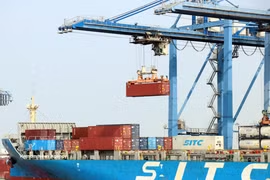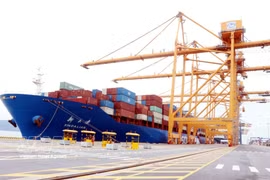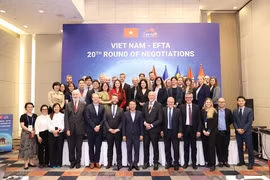
Ho Chi Minh City (VNA) – As Vietnam's growing network of free trade agreements (FTAs) is opening up more opportunities for exporters, in Ho Chi Minh City – the country's biggest hub of foreign trade, efforts are shifting from simply providing FTA information to helping businesses raise value added and engage more deeply in global supply chains.
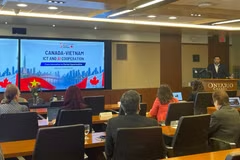
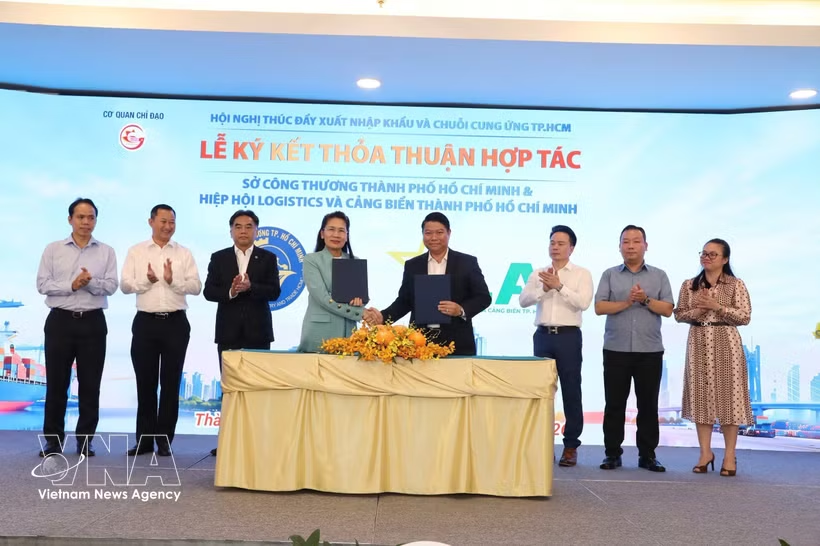
Speaking at a conference on promoting import – export activities and supply chains on September 21, Vice Chairman of the Ho Chi Minh City People's Committee Nguyen Loc Ha said FTAs create significant opportunities but also place greater requirements on business competitiveness amid rapid changes in global trade and supply chains.
The city has introduced a range of policies, including a strategy for goods import and export for 2025–2030, with a vision to 2050, aimed at boosting exports and developing markets.
The strategy targets average annual export growth of 10–11% during 2026–2030. Processed and manufactured goods are expected to account for more than 90% of exports by 2030, while medium- and high-tech products are hoped to make up around 70%, and FTA markets more than 75%.
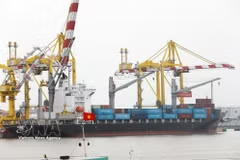
Ha stressed that policies must translate into practical support for businesses. The city will continue providing optimal conditions for businesses to expand market access, enhance their export capacity, and improve product quality to meet international standards. At the same time, it will push ahead with perfecting seaport, logistics and technology infrastructure to help firms expand exports and join global supply chains.
Le Van Danh, Deputy Director of the municipal Department of Industry and Trade, noted that the city's exports reached 65.83 billion USD in the first eight months of 2026, up 7.82% year-on-year, while imports rose 11.86% to 72.69 billion USD.
Danh said FTA utilisation should go beyond tariff preferences as export markets impose stricter requirements on quality, technical standards, environmental protection and sustainability. It must go hand in hand with improving product quality and meeting technical standards, green requirements and sustainable development criteria.
Ngo Chung Khanh, Deputy Director General of the Ministry of Industry and Trade's Department of Foreign Market Development and Multilateral Trade, said Vietnam has an extensive FTA network, but businesses' use of preferential tariffs remains modest under several new-generation FTAs.
In 2025, the utilisation rate was below 10% for the Comprehensive and Progressive Agreement for Trans-Pacific Partnership (CPTPP), around 34% for the EU–Vietnam Free Trade Agreement (EVFTA), and some 38% for the UK–Vietnam Free Trade Agreement (UKVFTA).
This shows that the potential lies not only in expanding the FTA network but also in turning trade commitments into actual orders and business opportunities, Khanh went on.
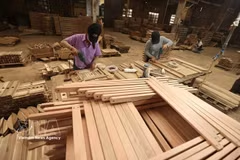
Ho Chi Minh City boasts strong potential in electronics and components, textiles and footwear, wood products, processed food, farm produce and aquatic products. However, FDI firms still account for a large share of exports while domestic businesses remain less represented.
Khanh said domestic firms need to move beyond simple supply roles and gradually develop capabilities in technology, design, components, branding and other higher-value activities.
Dr. Bui Ba Nghiem, a senior specialist at the Ministry of Industry and Trade's Agency of Foreign Trade, called for more targeted support based on the requirements of markets and lead buyers, particularly in electronics, mechanical engineering, wood, textiles and footwear.
He suggested supplier-development programmes focusing on productivity, quality control, testing, traceability and timely delivery. Success should be measured not only by the number of businesses supported but also by products approved and contracts fulfilled.
As businesses improve production and quality management, they will be better positioned to meet rules of origin and technical standards, enabling them to turn FTA tariff preferences into greater competitiveness in securing orders.
Danh said Ho Chi Minh City is implementing a plan to develop business linkages by clusters, value chains and supply chains through 2030. It will strengthen connections between lead firms, FDI enterprises and domestic companies while organising supplier-search programmes, supporting-industry exhibitions and business-matching events.
The city will also further diversify export markets, focusing on promising regions such as the Middle East, Southeast Asia and Latin America. Trade promotion will shift towards more targeted connections by industry, market and buyer group, he added.
Participants said businesses should consider FTAs from the product-development stage, design products to meet target-market standards, secure materials that satisfy rules of origin and maintain adequate documentation to prove origin.
With exports maintaining growth in the first eight months of 2026, better use of existing FTAs will help Ho Chi Minh City expand market access and shift export growth towards higher quality and value./
VNA