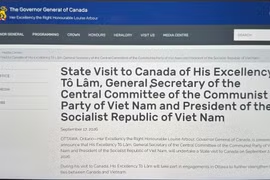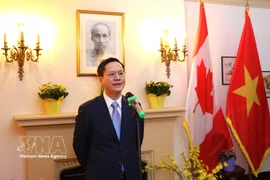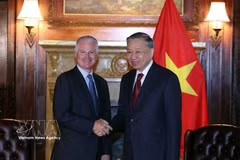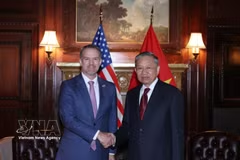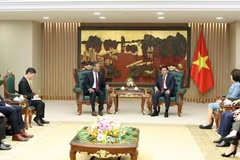
Ottawa (VNA) – The state visit to Canada by General Secretary of the Communist Party of Vietnam Central Committee and President To Lam is expected to provide fresh momentum for bilateral economic cooperation, as trade ties are shifting toward stronger production linkages, expanded supply chains and greater use of the complementary strengths of the two economies.
Speaking to Vietnam News Agency correspondents in Ottawa, Vietnamese Trade Counsellor in Canada Tran Thu Quynh said bilateral trade over the past two years has moved beyond conventional growth to become increasingly strategic for both sides.
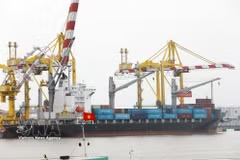
Vietnam Customs reported bilateral trade at 8.6 billion USD in 2025, up 18.8%, with exports reaching 7.5 billion USD for the first time and imports from Canada exceeding 1 billion USD. The growth continued in 2026, with Vietnam’s exports to Canada rising 25% in the first four months.
Vietnam is currently Canada’s largest merchandise trading partner in ASEAN and its sixth-largest import source worldwide. This performance came despite slower Canadian economic growth, the depreciation of the Canadian dollar against the US dollar and Vietnam’s loss of eligibility for Canada’s General Preferential Tariff programme from early 2025.
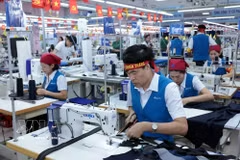
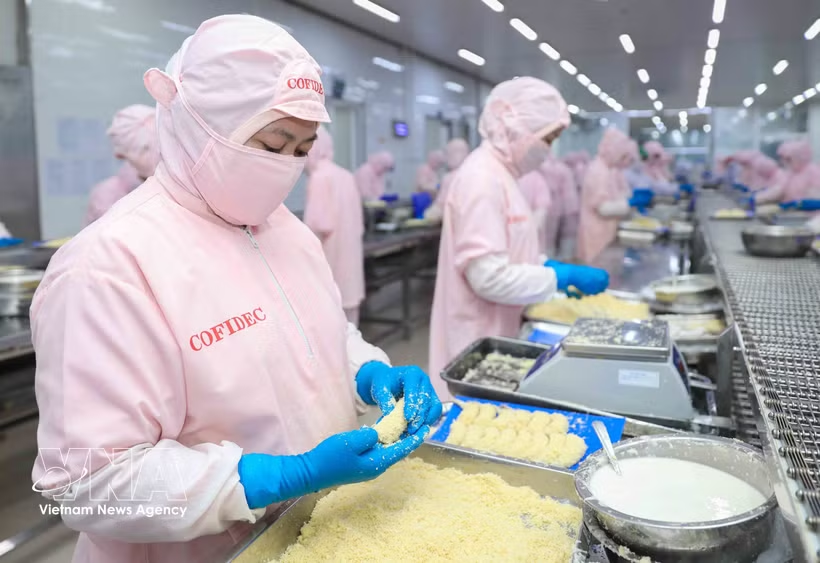
More importantly, the structure of trade is changing, with the two countries moving from exchanges of finished goods toward raw materials, supplies and intermediate products for production. Machinery and mechanical equipment, together with electronics and electrical equipment, account for about 53% of Vietnam’s exports to Canada. Machinery and mechanical equipment exceeded 3.5 billion USD, up 78.4%, while electronics and electrical equipment approached 3.7 billion USD. Vietnam has also increased imports of production inputs from Canada such as machinery, steel, fertilisers, pulp and minerals.
According to Quynh, this trend shows that businesses from both countries are gradually participating in the same production cycle, creating a foundation for deeper economic complementarity. As Canada diversifies markets and supply chains to reduce dependence on the US, Vietnam has greater opportunities to become a long-term supply and production partner.
However, significant potential remains untapped. Only 18.4% of eligible goods actually claimed preferential tariffs under the Comprehensive and Progressive Agreement for Trans-Pacific Partnership (CPTPP) in 2025. Excluding tariff lines already subject to zero tariffs, the rate stood at 49.8%. The Vietnamese Trade Office estimates that unused tariff preferences represent about 237-580 million USD in potential annual benefits.
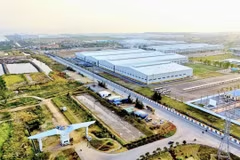
Investment also has substantial room for expansion. Canada is currently Vietnam’s 14th-largest foreign investor, with more than 4.9 billion USD, but most investment is concentrated in real estate, while manufacturing accounts for a relatively small share.
Improving the utilisation of CPTPP benefits, promoting industrial investment and expanding trade in services should become key priorities for cooperation in the coming period, said the official.
Vietnamese products also have opportunities to expand their market presence, supported by CPTPP preferences, established business relationships, international standards compliance and a Vietnamese community of nearly 300,000 in Canada.
The trade counsellor noted that businesses should gradually shift from contract manufacturing to building stable positions in retail systems and participating in private-label programmes operated by Canadian supermarket chains.
Beyond goods trade, Vietnam and Canada could also expand cooperation in energy; critical minerals and battery technologies; financial services; technical consulting and infrastructure project management; as well as the digital economy and professional services, Quynh stated.
Canada has strengths in natural resources, technology, finance and governance, while Vietnam has capabilities in processing, manufacturing, assembly and service provision. Linking these complementary strengths could create shared value chains, particularly in clean energy, mineral processing, software development and infrastructure.
The next phase of bilateral economic cooperation should focus not only on increasing trade turnover but also on expanding investment, technology transfer and production linkages, she added./.
VNA