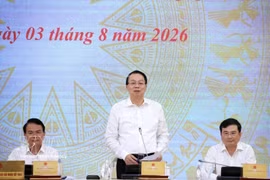
Hanoi (VNA) – Vietnam is turning to tax policy to help local companies seize investment, order and market opportunities unlocked by shifting global supply chains.
Tax policy as an upgrade lever
Those gains will only translate into lasting growth if Vietnamese firms climb into higher-value-added production, experts said at a forum held recently in Hanoi.
Foreign direct investment keeps flowing in and exports remain strong, but domestic firms are capturing a disproportionately small share of the value generated in global supply chains, the forum heard. Multinational corporations, meanwhile, are restructuring production chains and tightening requirements on technology, standards, traceability and green growth.
Tax policy should be used as a lever which channels investment toward technology, research and development, supporting industries and supply capacity, economists said.
Nguyen Anh Duong, Head of the General Research and Global Integration Division at the Institute for Policy and Strategy Studies under the Party Central Committee’s Commission for Policy and Strategy, said free trade agreements and diversification strategies such as "China +1," "Thailand +1" and "Vietnam +1" are giving Vietnam more room to attract investment and orders. Sustainability, green transition and digital capability are becoming competitive requirements in their own right.
The bigger prize isn't just more FDI projects, but a production ecosystem genuinely linked to domestic firms, Duong said. That means stronger ties between foreign investors and local companies, plus investment in supporting industries, logistics, digital infrastructure and energy. FDI policy should also prioritise hi-tech and innovation projects capable of generating spillover benefits.
Le Thi Duyen Hai, Vice Chairwoman and Secretary General of the Vietnam Tax Consultants’ Association, said tax policies introduced in recent years have effectively supported production and trade, investment and technological innovation.
Notably, the 2025 Law on Corporate Income Tax provides incentives for sci-tech, supporting industries, high technology, semiconductors, AI data centres, digital products and clean energy. The Decree 320/2025/ND-CP and Circular 20/2026/TT-BTC go further, letting companies deduct eligible R&D spending at up to 200% of actual cost. VAT deduction and refund mechanisms continue to free up resources for exporters.
To get more out of those incentives, Hai said they need to be designed around real gains in business capability. Location-based breaks risk simply relocating investment without lifting production capacity, while incentives tied to investment size don't necessarily reflect technological sophistication. Without a link to output, firms have little reason to spend more on R&D, productivity, exports or localisation.
Rewarding results, not scale
According to Hai, Vietnam now has more than 30,000 foreign-invested enterprises. They account for just 3% of all businesses in the country, yet generate more than 30% of state budget revenue from production and trade.
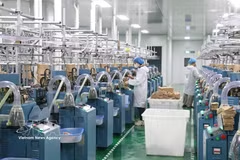
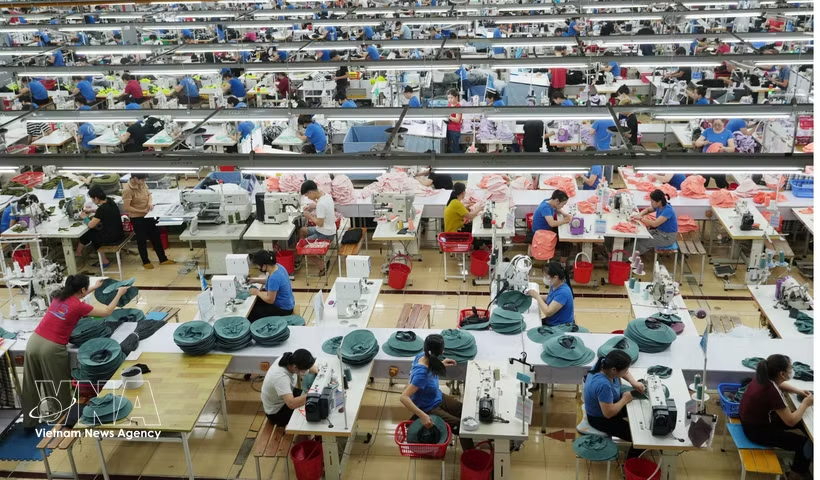
Vietnamese exporters, meanwhile, remain concentrated in relatively low-value-added sectors, while electronics and components, among the country's largest export categories, are dominated by foreign-invested firms. The task now isn't simply exporting more; it's moving domestic companies higher up the supply chain.
One proposal is a dedicated policy package for "Vietnamese firms in supply chains" with tax incentives tied to measurable outcomes such as revenue share from supplying multinationals, localisation rates, compliance with international quality standards, R&D investment and technology upgrades.
For companies landing new orders as supply chains shift toward Vietnam, proposed measures include support for machinery investment, accelerated depreciation and time-limited tax breaks on additional income. Eligibility should be tied to new orders, expanded production capacity, skilled labour, export turnover or revenue from supplying FDI enterprises.
At the same time, reforming VAT refunds around compliance and risk, rather than blanket rules, will also help exporters free up working capital faster. Officials should also weigh conditional exemptions or reductions on import duties for machinery, equipment and raw materials not yet produced domestically, when used in high-tech, automation, semiconductor, green production or export activities.
Dr. Do Dieu Huong, Deputy Director of the Centre for Strategy and Policy under the Institute of Vietnam and World Economy, said the rate of domestic firms integrated into global value chains fell from around 35% in 2009 to 18% in 2023. Supplier requirements, meanwhile, have expanded well beyond price, quality and delivery to include data, traceability, carbon emissions, environmental standards, labour practices and risk management.
That means support policies need to move beyond piecemeal schemes and address what supply chains actually require, including targeted help closing gaps in technology, quality, workforce, management and order-fulfillment capacity.
Tax policy alone won't be enough. It needs to sit within a broader ecosystem spanning technology, workforce training, logistics, digital transformation and sustainable development, with incentives that are time-bound, criteria-based and tied to measurable outcomes, economists said./.