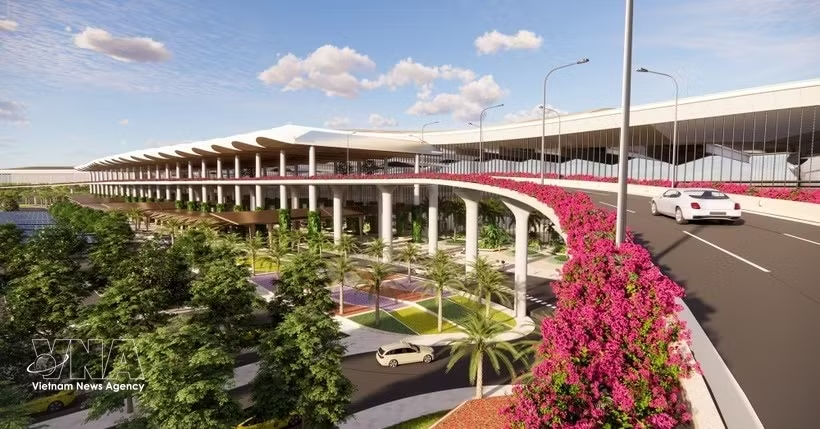
Hanoi (VNA) – The Civil Aviation Authority of Vietnam (CAAV) has proposed adjustments to the planning of several facilities at Phu Quoc International Airport in the Mekong Delta province of An Giang to serve the APEC Economic Leaders' Meeting 2027 (APEC 2027).
The proposal, submitted to the Ministry of Construction for appraisal and approval, covers the airport's master plan for 2021-2030, with a vision to 2050, including facilities to be developed immediately for the meeting.
For 2021-2030, the CAAV proposed bringing forward the investment in a parallel taxiway system and a connecting taxiway north of Runway No. 2, in order to connect with the aircraft maintenance and repair facility (hangar) planned for the northern area of the airport.
The plan also includes an apron in front of Terminal 2 and an expansion of the existing apron to provide about 42 aircraft positions. Another apron with about 45 positions would be built between the aprons serving Terminal 1 and the VIP/general aviation terminal, while the land west of the latter would be reserved for future expansion. To facilitate preparations for APEC 2027, several infrastructure components would be adjusted for immediate construction to ensure security, safety and smooth operations during the event.
Sections of service roads within the airfield would be realigned and extended to support patrols. The locations of some power supply and lighting substations would also be changed, with additional facilities to be installed as needed.
The internal road system would likewise be reconfigured, including the route from the main access road to Terminal 2. An elevated corridor linking Terminals 1 and 2 would be added to enable direct passenger transfers and improve operational efficiency.
The area west of the VIP/general aviation apron would also be reserved for a future cargo terminal, in line with the airport's long-term development plans.
Under the revised layout, the aviation catering facility would retain its planned scale and investment phasing through 2030, with a vision to 2050, but be relocated to an area of about 3ha east of Terminal 2.
The aviation fuel supply facility would similarly maintain its planned investment scale and phasing, while being moved to an area of more than 7ha in the northern part of the airport.
Repair and maintenance facilities for aviation vehicles and equipment would also retain their planned scales and investment schedules, but be relocated west of Terminal 1 to facilitate operations and preserve space for future apron expansion.
By 2050, the plan would allow the aircraft apron to be expanded on reserved land as demand increases.
The CAAV has asked the Ministry of Construction to approve the detailed Phu Quoc International Airport master plan adjustment for 2021-2030, with a vision to 2050.
It also recommended that An Giang province incorporate the revised airport master plan into its land-use and public transport plans, including routes connecting the airport with surrounding areas./.
Phu Quoc targets model security, civility status as APEC 2027 host
In particular, Phu Quoc's selection by the Party and State to host the 2027 APEC Economic Leaders’ Week marks a historic diplomatic milestone, offering the island a major opportunity to raise its global standing.