Vietnam seeks to raise value of agro-forestry exports by leveraging supply chains

Vietnam has developed a relatively comprehensive supply chain, covering forest plantations, raw materials, processing, design, manufacturing and logistics, creating jobs for about one million workers, Nguyen Quoc Khanh, Chairman of the Vietnam Timber and Forest Product Association (VIFOREST) and Chairman of the Board of Directors of AA Corporation, said.

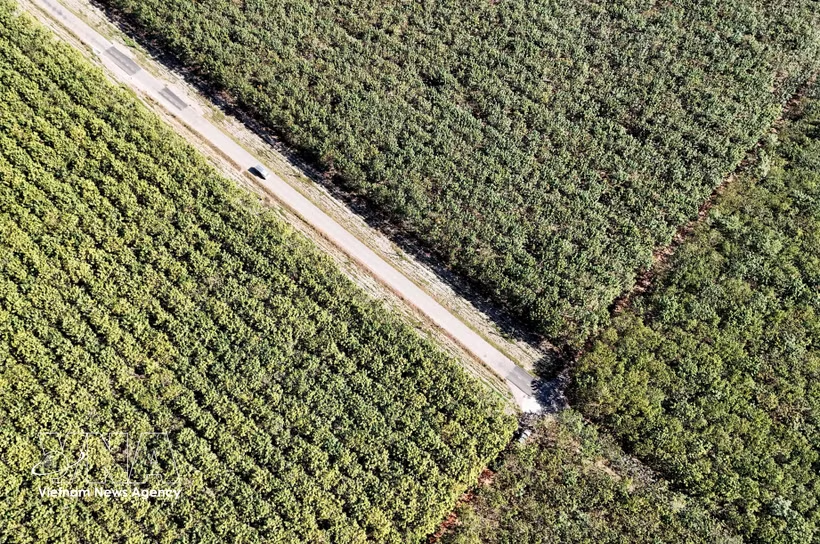
A rubber plantation of Dau Tieng Rubber One-Member Co., Ltd. in Thanh An commune, Ho Chi Minh City, enters the harvesting season. (Photo: VNA)

Hanoi (VNA) - Vietnam has established a significant position in global markets for wood, coffee and rubber. However, domestic businesses remain largely focused on production, processing and exports, with limited participation in higher-value-added stages of global supply chains.

The issue was discussed on September 22 at an online roundtable where experts said a large supply scale does not necessarily equate to a dominant position in the value chain.

A significant share of value added, technology, brands, standards, data, finance and decision-making remains outside Vietnam, they noted. Domestic businesses continue to focus mainly on production, processing and exports, while market standards, requirements and business models are often shaped externally.

Nguyen Quoc Khanh, Chairman of the Vietnam Timber and Forest Product Association (VIFOREST) and Chairman of the Board of Directors of AA Corporation, said Vietnam’s exports of wood, furniture and handicrafts rose from around 300 million USD two decades ago to 17.2 billion USD in 2025, generating a trade surplus of nearly 12 billion USD.

Vietnam has developed a relatively comprehensive supply chain, covering forest plantations, raw materials, processing, design, manufacturing and logistics, creating jobs for about one million workers. However, Khanh said production capacity has yet to be matched by the ability to influence markets, with Vietnam still primarily serving as a “manufacturing hub”.

Most businesses continue to manufacture according to designs and requirements under the original equipment manufacturing (OEM) model, while original design manufacturing (ODM) and original brand manufacturing (OBM), which allow deeper participation in product design, development and branding, remain limited.

According to him, the wood industry needs greater investment in design, branding, and traceability, and needs to shift from simply meeting requirements to anticipating market trends.

​For coffee, Thai Nhu Hiep, Vice Chairman of the Vietnam Coffee and Cocoa Association, said Vietnam has an advantage in output, particularly robusta coffee, but large volumes are insufficient without greater control over quality and data.

The rubber industry faces similar challenges. Nguyen Viet Tuong, former Vice Chairman of the Vietnam Rubber Association, said Vietnam ranks fourth globally in natural rubber production and third in exports, but most export value still comes from natural rubber and relatively low-level processed products.

To Xuan Phuc, Managing Director of Forest Trends, said Vietnam needs to move from being a production and supply base to becoming a reliable partner in global value chains. Traceability, standards and data should not merely serve buyers’ requirements, but also build trust and enable businesses to participate in higher-value segments.

Experts stressed that for export industries where Vietnam has already established a strong position, the goal should go beyond increasing export turnover to raising the share of value retained domestically and gaining greater control over high-value stages, while gradually contributing to the development of market standards, technologies and rules./.
​

VNA

See more

Students of Vietnam Maritime University in Hai Phong receive training that combines theory with practical experience. (Photo: VNA)

Hai Phong seeks to develop elite, skilled maritime workforce

Hai Phong is a key marine economic hub of Vietnam, thanks to its strong shipbuilding capacity and high-quality maritime training system. Alongside its capacity for new shipbuilding and ship repair, the city is also a leading provider of maritime workers for domestic and international businesses.

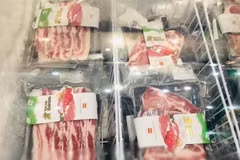
Imported pork on sale at a supermarket. (Photo VNA)

Meat import value surpasses 2 billion USD

The import value of meat and meat products hit 2.04 billion USD as of mid-September, of which pork products accounted for nearly 376 million USD, according to Vietnam Customs.

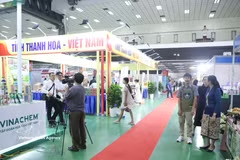
A Malaysian enterprise introduces Halal products to Vietnamese businesses at MIHAS 2026. (Photo: VNA)

Malaysia sees Vietnam as important springboard in Halal economy

Vietnam’s Halal certification authority has established direct cooperation with Malaysia’s Department of Islamic Development (JAKIM). The strategic cooperation is expected to be strengthened through government-to-government (G2G) cooperation as a foundation, before expanding into business-to-business (B2B) linkages, thereby helping Vietnamese businesses to participate more deeply in the international Halal ecosystem.

Representatives of the Permanent Mission of Vietnam in Geneva attend the seminar (Photo: VNA)

Vietnam promotes digitalisation, facilitates international trade

Under the theme “Enhancing international trade facilitation in practice: Digitalisation and the reduction of procedural trade barriers,” the seminar provided FTU lecturers and students with deeper insights into the WTO’s Trade Facilitation Agreement (TFA) and practical issues arising during its implementation.

Vietnamese delegation representatives speak at the forum, stressing the goal of turning dialogue opportunities into concrete cooperation projects between the two countries’ business communities. (Photo: VNA)

Vietnam-Tanzania Business Forum advances practical cooperation

Tanzania's trade surplus with Vietnam increased from 140.9 million USD in 2022 to 314.2 million USD in 2025. Vietnam is currently a key market for Tanzanian agricultural products, particularly cashew nuts. The International Trade Centre (ITC) has also identified Vietnam as one of Tanzania’s most promising export markets.

A luxury apartment complex on the banks of the Saigon River in Ho Chi Minh City (Photo: VNA)

Russian investors explore opportunities in Vietnam’s real estate market

Vietnam is seen as a potential market, with considerable room for growth in real estate, particularly commercial property, compared with some regional markets. Strong Vietnam-Russia ties and opportunities to establish foreign-invested enterprises are also considered favourable for Russian investors.

Representatives from PV GAS and ENEOS Xplora Inc. at their recent meeting (Photo: petrovietnam.petrotimes.vn)

PV GAS, ENEOS Xplora seek to expand cooperation in gas, LNG

Petrovietnam Gas Joint Stock Corporation (PV GAS), a member of Vietnam National Industry - Energy Group (Petrovietnam), and ENEOS Xplora Inc. are exploring broader cooperation in the gas and liquefied natural gas (LNG) value chain and energy projects.

A graphic image of Terminal 2 of Phu Quoc International Airport (Source: VietnamPlus)

Phu Quoc airport planning adjusted to serve APEC 2027

For 2021-2030, the Civil Aviation Authority of Vietnam proposed bringing forward the investment in a parallel taxiway system and a connecting taxiway north of Runway No. 2 at Phu Quoc International Airport, in order to connect with the aircraft maintenance and repair facility (hangar) planned for the northern area of ​​the airport.