First direct container ship from China's Nanning arrives in Can Tho

The Nanning-Can Tho service is expected to operate twice a month, with a transit time of about seven days.

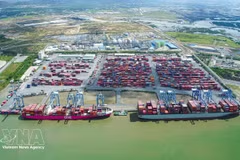
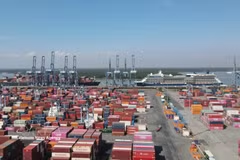
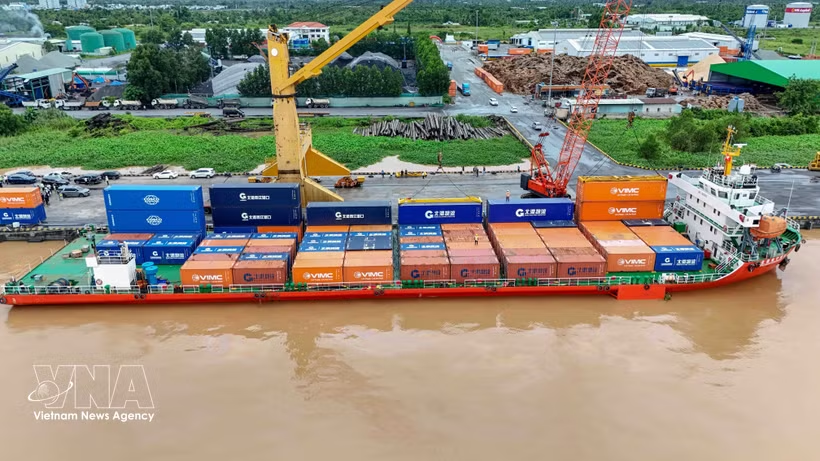
Imported containers from China are unloaded at Cai Cui Port in Can Tho city on September 24, 2026. (Photo: VNA)

Can Tho (VNA) – The first container ship to travel directly from China's Nanning to Can Tho via the Pinglu Canal arrived at Can Tho Port on September 24, opening a new waterway freight route between southwestern China and Vietnam’s Mekong Delta.

The vessel welcome ceremony was organised by Can Tho Port JSC in cooperation with Vietnam Maritime Corporation (VIMC) and China’s Beibu Gulf Port Group.

The Nanning-Can Tho service is expected to operate twice a month, with a transit time of about seven days. It will use river-sea container vessels of around 4,900 DWT, with a planned capacity of up to 500 TEUs per trip. About 25% of the containers are expected to be refrigerated and 75% dry containers. The first voyage was operated by the Panama-flagged BBG Nan Ning Bo Run. Built in 2021, the vessel is 100m long and 22m wide, with a deadweight capacity of 4,900 DWT.

Le Cong Ly, Standing Vice Chairman of the Can Tho People's Committee, said the arrival of the first vessel from Nanning via the Pinglu Canal at Can Tho Port was significant not only for establishing a new international shipping route, but, more importantly, for creating an additional freight connection between southwestern China and Can Tho and the wider Mekong Delta.

The city expects the route to strengthen Can Tho's role as a logistics hub for the Mekong Delta region, which boasts strengths in rice, seafood, fruit, agricultural products and processed goods.

Container handling at Can Tho Port has also grown strongly. In the first six months of 2026, the port handled 12,665 TEUs, up 162.49% year on year. The port has also developed container services connecting Can Tho with Ho Chi Minh City and Cai Mep-Thi Vai.

Le Quang Trung, Deputy General Director of VIMC, said the corporation would focus on three areas to ensure the new route operates effectively. They are connecting transport and logistics networks, developing cargo flows in both directions, and integrating services and data.

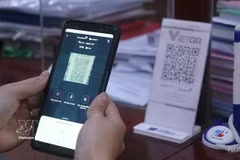
A balanced flow of goods in both directions is important for maintaining a stable schedule and competitive services, he said. VIMC also plans to promote digitalisation and data sharing to reduce waiting times and improve service efficiency.

A trial voyage on August 4 provided an initial assessment of the route's operations and market demand. The M/V Li Da Tong 2 Hao sailed from Qinzhou Port to Cai Cui Port carrying 66 containers of agricultural products from the Mekong Delta to Guangxi.

In 2025, two-way trade between Guangxi and Vietnam exceeded 300 billion CNY (about 44.7 billion USD) for the first time, with Vietnam remaining Guangxi's largest trading partner for 27 consecutive years.

According to Beibu Gulf Port Group, using the Pinglu Canal shortens the inland waterway journey by more than 560 km compared with the route via the Pearl River, reduces transit times by seven to 10 days, and could cut overall logistics costs by 18–30%.

The new Nanning-Can Tho service is expected to give businesses an additional direct logistics option and expand Can Tho Port's container network from domestic services to international connections./.

VNA
See more

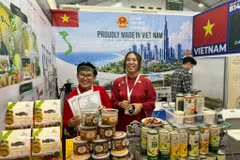
Danny Green JSC showcases unique products made from high-quality Vietnamese agricultural ingredients. (Photo: VNA)

Vietnam showcases diverse halal products at Indonesia trade fair

As Indonesia continues to expand and develop its halal industry ecosystem, Halal Indo 2026 provides Vietnamese businesses with an opportunity to promote their products, seek partners and better prepare to enter one of the world’s major halal markets

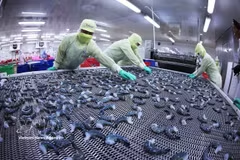
Shrimp products are frozen using IQF technology at the Minh Phu Seafood Group factory in Ly Van Lam ward, Ca Mau province. (Photo: VNA)

Shrimp exports reach 3.3 billion USD in eight months

According to data from the Vietnam Customs cited by the Vietnam Association of Seafood Exporters and Producers (VASEP), shrimp exports reached 478.5 million USD in August, up 4.2% from the same month last year. The eight-month total stood at 3.3 billion USD, representing a year-on-year increase of 12%.

A rubber plantation of Dau Tieng Rubber One-Member Co., Ltd. in Thanh An commune, Ho Chi Minh City, enters the harvesting season. (Photo: VNA)

Vietnam seeks to raise value of agro-forestry exports by leveraging supply chains

Vietnam has developed a relatively comprehensive supply chain, covering forest plantations, raw materials, processing, design, manufacturing and logistics, creating jobs for about one million workers, Nguyen Quoc Khanh, Chairman of the Vietnam Timber and Forest Product Association (VIFOREST) and Chairman of the Board of Directors of AA Corporation, said.

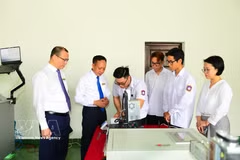
Students of Vietnam Maritime University in Hai Phong receive training that combines theory with practical experience. (Photo: VNA)

Hai Phong seeks to develop elite, skilled maritime workforce

Hai Phong is a key marine economic hub of Vietnam, thanks to its strong shipbuilding capacity and high-quality maritime training system. Alongside its capacity for new shipbuilding and ship repair, the city is also a leading provider of maritime workers for domestic and international businesses.

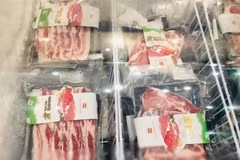
Imported pork on sale at a supermarket. (Photo VNA)

Meat import value surpasses 2 billion USD

The import value of meat and meat products hit 2.04 billion USD as of mid-September, of which pork products accounted for nearly 376 million USD, according to Vietnam Customs.

A Malaysian enterprise introduces Halal products to Vietnamese businesses at MIHAS 2026. (Photo: VNA)

Malaysia sees Vietnam as important springboard in Halal economy

Vietnam’s Halal certification authority has established direct cooperation with Malaysia’s Department of Islamic Development (JAKIM). The strategic cooperation is expected to be strengthened through government-to-government (G2G) cooperation as a foundation, before expanding into business-to-business (B2B) linkages, thereby helping Vietnamese businesses to participate more deeply in the international Halal ecosystem.

Representatives of the Permanent Mission of Vietnam in Geneva attend the seminar (Photo: VNA)

Vietnam promotes digitalisation, facilitates international trade

Under the theme “Enhancing international trade facilitation in practice: Digitalisation and the reduction of procedural trade barriers,” the seminar provided FTU lecturers and students with deeper insights into the WTO’s Trade Facilitation Agreement (TFA) and practical issues arising during its implementation.