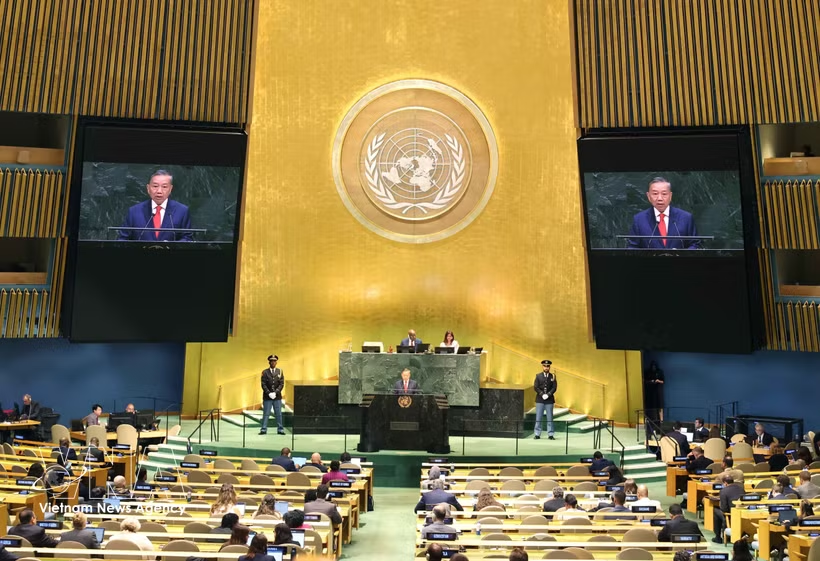
Top leader’s UN speech reaffirms Vietnam’s consistent choice of peace, cooperation, development

The speech carries one consistent message: humanity shouldn't treat confrontation as inevitable in a fast-changing world. Instead, it should proactively manage change through trust, international law, dialogue, cooperation and shared responsibility.

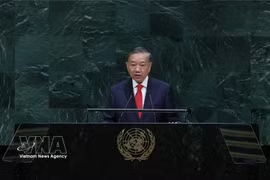
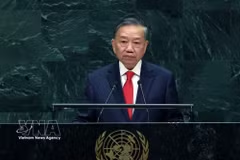
General Secretary of the Communist Party of Vietnam Central Committee and President To Lam addresses the high-level General Debate of the UN General Assembly’s 81st session in New York on September 22, 2026. (Photo: VNA)

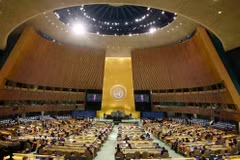
New York (VNA) – General Secretary of the Communist Party of Vietnam Central Committee and President To Lam used his address at the high-level General Debate of the United Nations (UN) General Assembly’s 81st session in New York on September 22 (local time) to reaffirm Vietnam’s consistent commitment to peace, cooperation and development, said Assoc. Prof. Dr Bui Hoan Son, Vice Chairman of the Party Central Committee’s Commission for Publicity.

In an interview recently granted to the Vietnam News Agency, Son said the speech carries one consistent message: humanity shouldn't treat confrontation as inevitable in a fast-changing world. Instead, it should proactively manage change through trust, international law, dialogue, cooperation and shared responsibility.

According to him, the speech didn't dodge the world's harder realities today, including conflict risk, an arms race, economic fragmentation, supply chain disruptions, climate change, pandemics, inequality and the risks emerging from new technology. Its takeaway wasn't pessimism, though, but a call for responsibility and action.

One line crystallises that spirit: "Change is inevitable, but conflict and confrontation are not". The framing pairs a clear-eyed view of competition with a case for keeping room open for dialogue and cooperation. It concedes that power balances are shifting, interests are diverging and competition is intensifying, but insists governments and people still have the ability to choose how they respond. Rebuilding trust, in this reading, is what keeps competition from tipping into confrontation, differences from hardening into conflict, and technology from cutting new divides.

Through the message, Vietnam reaffirmed its consistent commitment to peace, cooperation and development, as well as its continued emphasis on the UN Charter, international law and multilateralism, not just a statement of foreign policy, but a reflection of a country shaped by war that has learned to value independence, peace and reconciliation.

Vietnam's contribution to the global debate is direct: a durable international order can't rest on the balance of power alone. It needs rules, trust, responsibility and benefits people can actually feel, the official said.

What stands out most to Son is that the speech keeps people at its centre. Restoring trust, reforming global institutional mechanisms, pursuing sustainable development and governing technology all come back to one question: are people safer, freer and better off? That, he said, gives Vietnam's message a clear cultural and humanitarian edge on the world political stage.

The Vice Chairman flagged three points worth particular attention. The first is the idea of restoring trust and managing differences responsibly. The world isn't short of forums or commitments, but it's short of trust. Without it, differences turn into confrontation, competition slips out of control, and international law gets applied inconsistently. Therefore, maintaining dialogue, honouring commitments, respecting sovereignty and settling disputes through peaceful means are practical necessities.

The second is the concept of equitable, humane, inclusive and sustainable development. That tracks with Vietnam's own development thinking: growth rate alone doesn't measure progress; quality of life, development opportunity, social equity, environment and the ability to ensure that no one is left behind do too.

The speech's emphasis on respecting each country's history, culture and development stage rules out a one-size-fits-all model. Nations should choose their own path while holding to shared standards of peace, cooperation and responsibility, he noted.

The third is the linkage between Vietnam's strategic autonomy and a new growth model built on productivity, quality, added value, science –technology, innovation and digital transformation tied to cultural development, social progress, equity and environmental protection.

The point, domestically and globally, is that Vietnam doesn't equate autonomy with isolation. It's the capacity to stand on its own strengths and engage the world on more equal, proactive terms. A country with strong internal capacity, a distinct cultural identity, scientific and technological depth, and broad social consensus adapts to external shocks more easily, Son said.

Overall, he perceived that the four orientations in the speech, including trust and international law, inclusive development, technology governance, and stronger multilateralism, share a single philosophy: managing change so that development serves people, peace and shared interests. That is how Vietnam positions itself as an active member, a reliable partner a responsible player globally.
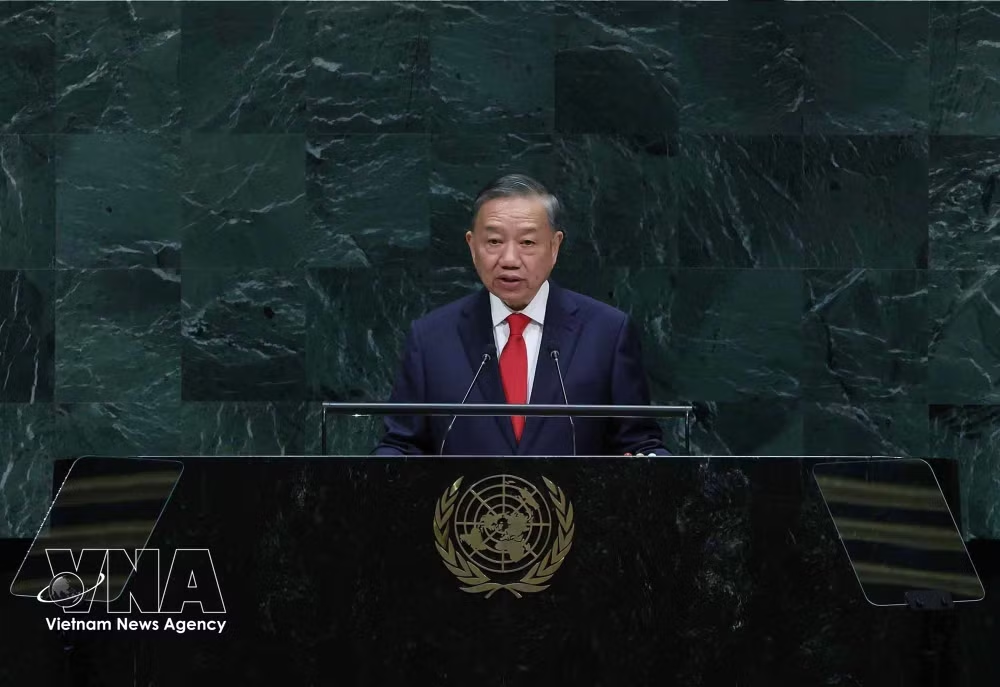
vnanet-u.jpg
General Secretary of the Communist Party of Vietnam Central Committee and President To Lam addresses the high-level General Debate of the UN General Assembly's 81st session in New York on September 22, 2026. (Photo: VNA)

In his view, the speech's approach to technology is about proactively shaping technology governance rather than merely passively adapting. What matters isn't just which technologies Vietnam has, but the values behind how they're designed, used and regulated. Governance frameworks need to be inclusive, safe, transparent and responsible, while respecting national and digital sovereignty and each country’s right to pursue its own development path.

This is particularly important with regard to artificial intelligence as algorithms embed themselves deeper in production, education, culture, communications, public services and even how societies form perceptions, Son went on.

The speech also calls on developing countries to have a real say in rule-making, plus support for infrastructure, digital capacity and access to scientific – technological gains. The risk otherwise: if one part of the world controls data, computing infrastructure, platforms and standard-setting while the rest are just users, the digital divide hardens into a new development gap.

Global technology governance, Son said, has to be tied to fair access to opportunity, knowledge and resources.

For Vietnam, he said that's both an integration requirement and a domestic task. The country needs to push innovation, digital infrastructure and a digital workforce, while building matching governance capacity, including timely legislation, digital ethics, data security, protection of children and vulnerable groups, broader digital literacy and a healthier cyberspace culture. The more powerful the technology, the greater the responsibility it demands culturally, socially and humanly.

Vietnam's hosting of the UN Convention against Cybercrime signing in Hanoi in 2025, cited in the speech, backs that up, Son said, adding that it is the evidence the country wants to help set common norms for cyberspace, not just benefit from technological progress.

The goal, he added, is a safer, fairer, more humane digital order where technology serves people and shared development./
VNA

See more

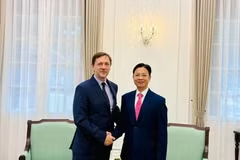
Deputy Minister of Foreign Affairs Ngo Le Van (R) receives Hungarian Ambassador to Vietnam Baloghdi Tibor in Hanoi on September 24 (Photo: Ministry of Foreign Affairs)

Vietnam, Hungary seek to deepen bilateral ties

Hungary is one of Vietnam’s leading important partners in Central and Eastern Europe. Vietnam attaches importance to and wishes to continuously strengthen multifaceted ties with the country.

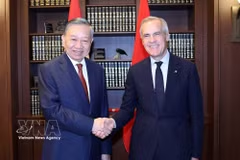
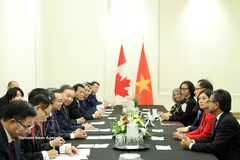
General Secretary of the Communist Party of Vietnam Central Committee and President To Lam (L) meets with Canadian Prime Minister Mark Carney in Ottawa on September 24, 2026. (Photo: VNA)

Vietnam, Canada issue joint statement on Strategic Partnership

The two leaders elevated Vietnam - Canada relations to a Strategic Partnership anchored in eight pillars. Collectively, these pillars position Vietnam and Canada to address shared challenges, seize emerging opportunities, and contribute to a more secure, prosperous, and dynamic Indo-Pacific region.

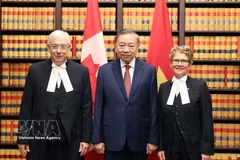
General Secretary of the Communist Party of Vietnam Central Committee and President To Lam meets with Speaker of the Senate Raymonde Gagné and Speaker of the House of Commons Francis Scarpaleggia on September 24 (local time). Photo: VNA

Top leader meets with Speakers of Canada’s Senate and House of Commons

Building on more than 50 years of friendship and the newly established Strategic Partnership framework, Vietnam–Canada relations as a whole, as well as cooperation between the two countries’ legislative bodies in particular, would continue to develop in an increasingly substantive and effective manner, for the benefit of the people of both countries and for peace, cooperation, and development in the region and the world.

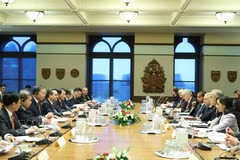
General Secretary of the Communist Party of Vietnam Central Committee and President To Lam receives representatives from the Canada–Vietnam Parliamentary Friendship Group at the Parliament of Canada on September 24 (local time). (Photo: VNA)

Party General Secretary and President receives Canada-Vietnam Parliamentary Friendship Group

The parliamentary friendship groups of Vietnam and Canada should increase delegation exchanges and contacts among parliamentarians, specialised committees, women parliamentarians, and young parliamentarians; promote joint activities and the sharing of experience in legislation and oversight; and further play their role in building broad consensus within the Canadian Parliament and society on strengthening relations with Vietnam.

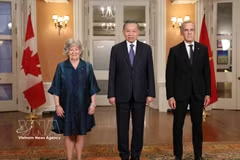
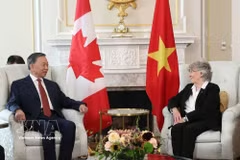
General Secretary of the Communist Party of Vietnam Central Committee and President To Lam meets with Governor General of Canada Louise Arbour at Rideau Hall in Ottawa on September 24 morning (local time). Photo: VNA

Top leader meets with Governor General of Canada

Vietnam consistently attaches importance to its relations with Canada, and highly valued the important progress in bilateral relations after nearly a decade of implementing the Comprehensive Partnership framework, said General Secretary of the Communist Party of Vietnam Central Committee and President To Lam.

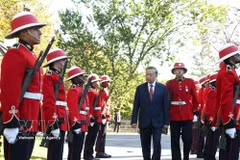
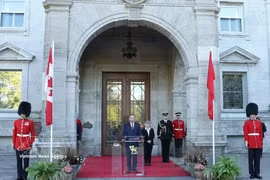
General Secretary of the Communist Party of Vietnam Central Committee and President To Lam reviews the guard of honour at the official welcome ceremony in Ottawa on the morning of September 24, 2026 (local time). (Photo: VNA)

Governor General of Canada hosts welcome ceremony for Vietnam’s top leader

General Secretary and President To Lam voiced his hope that the visit will open a new chapter in Vietnam–Canada relations, reflecting a new level of political trust, increasingly close alignment of interests and visions, as well as the determination of both countries to build a long-term, stable and substantive relationship and make it a model of cooperation between two countries on opposite sides of the Pacific Ocean.

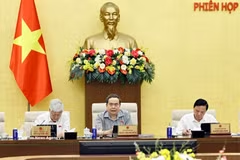
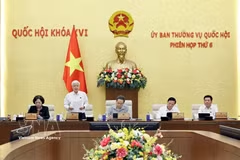
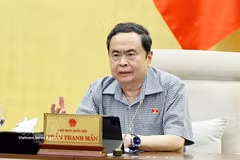
NA President Tran Thanh Man speaks at the NA Standing Committee's sixth session in Hanoi on September 24. (Photo: VNA)

Legislators move to overhaul food safety law with single focal point

The top legislator warned that food safety shouldn't be used to bring back a "request-and-grant" mechanism, and administrative reform shouldn't be an excuse to lower safety standards. Any policy that directly affects products or public health must rest on scientific evidence.

Deputy Foreign Minister pledges support for Fulbright University Vietnam

Deputy Foreign Minister pledges support for Fulbright University Vietnam

With the two countries actively and effectively delivering on their Comprehensive Strategic Partnership, and Vietnam entering a new growth phase that demands a more skilled workforce, Deputy Minister of Foreign Affairs Nguyen Minh Hang expressed her hope that the university will keep innovating, broaden its fields of study, and further sharpen training quality to support Vietnam's workforce development and bilateral educational ties.

Vietnamese Ambassador to the UK Do Minh Hung speaks at the ceremony in London on September 23. (Photo: VNA)

Vietnam, UK strengthen friendship and people-to-people ties

Vietnamese Ambassador to the UK Do Minh Hung said people are the foundation of the bilateral ties, stressing the role of Vietnamese students, intellectuals and the Vietnamese community in promoting mutual understanding and connecting the two countries.

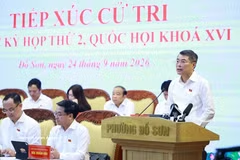
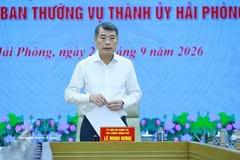
Prime Minister Le Minh Hung speaks at the meeting with voters in Hai Phong city on September 24 ahead of the second session of the legislature. (Photo: VNA)

PM Le Minh Hung meets with Hai Phong voters ahead of 16th NA’s second session

PM Hung asked Hai Phong city to work harder to achieve its targets for economic growth, budget collection, investment attraction and public investment disbursement, while addressing bottlenecks and promoting industry, electronics, trade, tourism and support for businesses, particularly small and medium-sized enterprises.

NA Vice President Do Van Chien speaks at the sixth session of the NA Standing Committee on September 24. (Photo: VNA)

Lawmakers weigh draft law to grant cultural industries formal legal status

The bill aims to complete the legal framework, clear institutional bottlenecks, pool resources and unlock creative potential, while boosting the cultural content of products and services. It's also meant to shield the domestic market and turn cultural industries into a breakthrough growth driver.

NA President Tran Thanh Man addresses the discussion (Photo: VNA)

Lawmakers discuss facilitating intellectual property registration

Presenting the draft law, Deputy Minister of Science and Technology Hoang Minh said the draft law centres on two major policy areas: further simplifying procedures and reducing business conditions, and transferring the management of rights to plant varieties from the Ministry of Agriculture and Environment to the Ministry of Science and Technology.

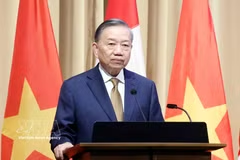
General Secretary of the Communist Party of Vietnam Central Committee and President To Lam speaks at the High-Level General Debate of the 81st United Nations General Assembly (UNGA 81) on September 22 (Photo: VNA)

Vietnam affirms proactive, responsible diplomacy at UNGA 81

This marked General Secretary and President Lam’s first working trip to the UN and the US since Vietnam successfully held the 14th National Party Congress and the election of deputies to the 16th National Assembly and People’s Councils at all levels for the 2026-2031 term. It reaffirmed Vietnam’s consistent foreign policy of independence, self-reliance, multilateralisation and diversification, along with proactive and active international integration in a comprehensive and extensive manner.

Prime Minister Le Minh Hung speaks at the conference to approve a draft report on the results of the third round of inspection and supervision of the Standing Board of the Hai Phong municipal Party Committee. (Photo: VNA)

PM urges Hai Phong to build strategic leadership capacity, drive growth

Prime Minister Le Minh Hung asked Hai Phong to review bottlenecks and shortcomings in its cadre contingent, taking into account population, geographical area, workload, the characteristics of urban, rural and island areas, as well as the development requirements and objectives of each locality.