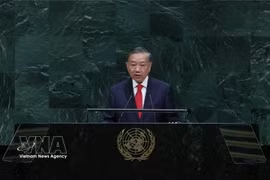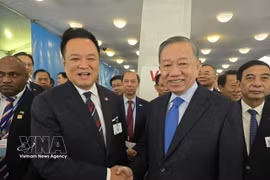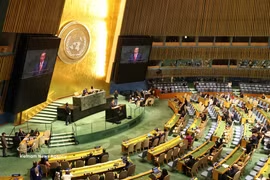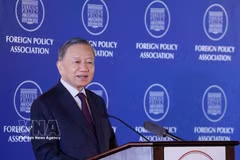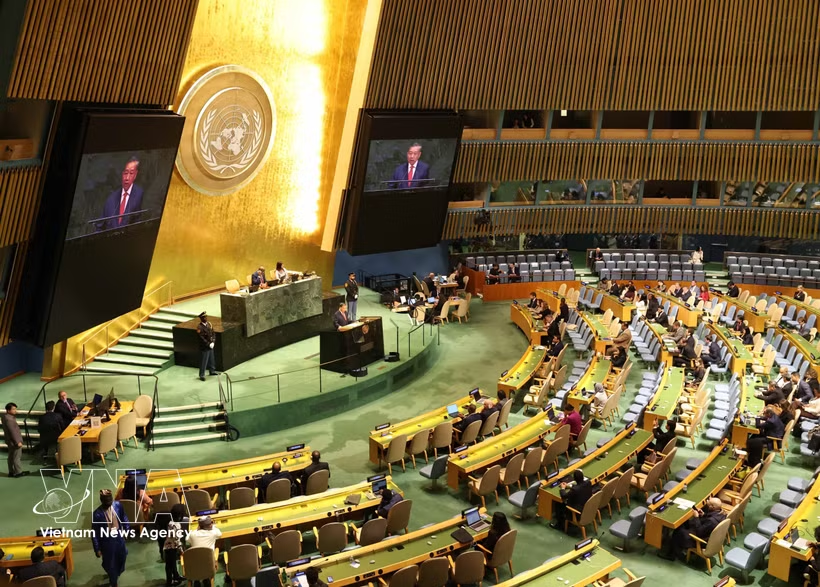
New York (VNA) - General Secretary of the Communist Party of Vietnam Central Committee and President To Lam delivered an important address at the high-level general debate of the 81st session of the United Nations General Assembly (UNGA) at the UN headquarters in New York on September 22 (local time).
The Vietnam News Agency respectfully presents a translation of his address.
Excellencies, ladies and gentlemen,
The world is undergoing profound shifts in the international order, accompanied by risks and uncertainties. The trend of using or threatening to use force, the arms race, particularly the modernisation of nuclear weapons and the development of new types of advanced weapons, is increasing the risk of confrontation, miscalculation, and conflict, even large-scale war.
Meanwhile, the global economy is becoming increasingly fragmented, with growing barriers to trade, investment, and technology. Disruptions to supply chains and economic instability are narrowing development opportunities for many countries. Climate change, natural disasters, pandemics, and new risks arising from technology continue to pose direct threats to people’s lives and livelihoods, as well as to the development and stability of many countries.
Shifts in the balance of power and development inequalities are placing growing strains on international relations. Instability is further exacerbated when competition goes unchecked, commitments are left unfulfilled and international law is applied selectively. An erosion of trust further hampers cooperation efforts.
What should concern us is not only how the international order is changing, but also where such changes will take the world. Change is inevitable, as it is an objective movement of history. But conflict and confrontation are not inevitable. From its own history, Vietnam deeply understands the price of war, the value of independence, and the power of reconciliation and cooperation.
Therefore, I believe that the theme of this session - “Restoring trust, managing transformation: A United Nations that delivers for all”- aptly reflects the urgent demands of our time.
Ladies and gentlemen,
From losses caused by the Second World War, humanity built the United Nations with the aspiration to prevent war, safeguard peace, promote cooperation, and place relations among nations on the foundation of common principles. Over more than eight decades, despite its limitations, the United Nations has contributed to maintaining dialogue, advancing decolonisation, protecting the right of peoples to self-determination, and supporting development.
These achievements must be preserved and further promoted. Institutions need to be renewed to keep pace with the times; the fundamental principles of the United Nations Charter must be respected and strengthened. What we seek is a fairer, more democratic, and more inclusive international order, in which every country has a voice and every people has an opportunity to develop.
The mission of our generation is to jointly shape and manage change so that competition does not turn into confrontation, differences do not lead to conflict, and scientific and technological progress does not create new divisions.
In this spirit, I would like to share four major orientations as follows:
First, we must restore trust among nations on the basis of respect for the UN Charter and international law.
The United Nations Charter and international law constitute the foundation of the world order and must be fully, consistently, and without selectivity respected. All countries must respect one another’s independence, sovereignty, territorial integrity, and right to choose their own development paths; refrain from interfering in each other’s internal affairs; and refrain from threatening or using force in violation of the United Nations Charter.
Restoring trust does not require countries to eliminate their differences, but to responsibly manage those differences together. Crises must be prevented. Competition must be managed. Dialogue must be maintained. Commitments must be respected and fully implemented. Major powers need to take the lead in respecting international law, exercising restraint, and responsibly addressing common challenges. The United Nations must play a central role in these efforts.
In every conflict, civilians must be protected, international humanitarian law must be respected, and access to humanitarian assistance must be ensured. Vietnam supports the right of the Palestinian people to self-determination and the two-state solution, with an independent State of Palestine living peacefully alongside the State of Israel, in accordance with international law and relevant United Nations resolutions.
In the Asia-Pacific region, nearly six decades of development by the Association of Southeast Asian Nations (ASEAN) have demonstrated that countries can turn suspicion into trust, confrontation into dialogue, division into cooperation, and individual strength into collective strength.
In this spirit, Vietnam consistently pursues the settlement of disputes, including those in the East Sea, by peaceful means and in accordance with international law, particularly the 1982 United Nations Convention on the Law of the Sea (UNCLOS). Vietnam resolutely protects its sovereignty, sovereign rights, and jurisdiction. The seas and oceans must be spaces for peace, cooperation, connectivity, and sustainable development.
In the spirit of promoting peace and the right to development of all peoples, Vietnam has always stood in solidarity with the State and people of Cuba. It calls on the United States to end unilateral embargo and blockade measures, including the energy blockade against Cuba, and to remove Cuba from the list of state sponsors of terrorism. Vietnam also calls on the international community to support Cuba in overcoming the crisis caused by the embargo.
Second, we should promote fair, humane, inclusive, and sustainable development.
International commitments must be translated into action and bring about a life of peace, security, civilisation and happiness to the people. Therefore, the Pact for the Future and the 2030 Agenda – our promise to current and future generations – must be fully and earnestly implemented.
Commitments on development financing, including the Sevilla Commitment, must be translated into concrete solutions, including expanding access to long-term capital at affordable costs, supporting countries facing heavy debt burdens, and strengthening the voice of developing countries in international financial and monetary institutions. The multilateral trading system must be strengthened in an open, fair and transparent manner, ensuring development opportunities for all countries.
The response to climate change must be given an appropriate place in development cooperation, particularly financing for adaptation, technology transfer and a just energy transition. Development must put people at the centre and leave no one behind. Growth must go hand in hand with social progress and equity, environmental protection and the livelihoods of people, particularly in vulnerable countries and communities. Global progress must uphold a spirit of humanity in relations among countries, while ensuring legitimate interests and respecting differences in the history, culture and development conditions of each country.
Third, it is necessary to proactively shape technology governance so that progress serves people and common development.
Science, technology, digital transformation and artificial intelligence are opening up unprecedented opportunities, but also posing new challenges. The future of technology does not automatically guarantee fairness. Technological progress must help narrow gaps and expand development opportunities, rather than create new forms of dependence or sources of conflict.
We need to establish inclusive, safe, transparent and responsible governance principles and frameworks to ensure that technology serves people, respects national sovereignty, digital sovereignty and the right to development autonomy. Developing countries must have substantive participation in the process of developing rules, receive support in infrastructure and digital capacity, and have equitable access to the benefits of scientific and technological progress.
The organisation of the signing ceremony for the United Nations Convention against Cybercrime in Hanoi in 2025 demonstrated Vietnam’s desire to make practical contributions to global digital cooperation. Vietnam stands ready to work with its partners to promote cooperation and strengthen capacity in preventing and combating cybercrime, enabling people to live safely and benefit from technological advances.
Vietnam is also willing to support international initiatives on green transition and digital transformation and the development of effective governance frameworks, so that science and technology can truly become a driving force for common development.
Fourth, attention should be paid to strengthening multilateralism and the central and indispensable role of the United Nations.
The strength of the United Nations does not lie in its ability to assume the responsibilities of individual countries, but in its credibility and capacity to build consensus, establish norms and develop rules, and mobilise global efforts to address common challenges.
To enable the United Nations to adapt to the transformations of the times, Vietnam supports efforts to reform the United Nations, particularly its General Assembly, Security Council and Secretariat, with a view to enhancing their effectiveness, prioritising structural reform, streamlining the organisational apparatus, and promoting the organisation’s strengths in implementing global agendas and ensuring the interests of developing countries.
Ladies and gentlemen,
What I have just shared also draws on the experience of the Vietnamese nation itself.
Vietnam’s nearly half-century journey alongside the United Nations reflects the transformation of our own country. From being primarily a recipient of valuable support during the years of post-war reconstruction and “Doi moi” (Renewal), Vietnam today is increasingly taking a proactive role in contributing to common affairs, bringing Vietnam - United Nations relations to greater depth and substance. Vietnamese military and police personnel have participated and continue to participate in UN peacekeeping operations, carrying the Vietnamese people’s aspiration for peace to places around the world where peace remains fragile.
The tradition of independence and self-reliance provides the foundation for Vietnam to strengthen its strategic autonomy and proactively pursue international integration. With the goal of becoming a developing country with modern industry and upper-middle income by 2030 and a developed, high-income country by 2045, Vietnam is shaping a new development model based on productivity, quality and added value; making science, technology, innovation and digital transformation key drivers; and linking economic growth with cultural development, social progress and equity, and environmental protection.
Self-reliance also means proactively adapting to and engaging in equal cooperation with the world. Therefore, Vietnam consistently pursues a foreign policy of independence, self-reliance, self-strengthening, peace, friendship, cooperation and development, and diversification and multilateralisation of external relations. Vietnam will remain steadfast in upholding the United Nations Charter and international law, promoting dialogue and the peaceful settlement of disputes, and participating more extensively in peacekeeping operations. Vietnam is working with other ASEAN members to build a united, resilient and strong ASEAN, while actively preparing to host the Asia-Pacific Economic Cooperation (APEC) forum in 2027 and contributing to peace, cooperation and development in the region and the world.
As a member of the United Nations Human Rights Council, Vietnam places emphasis on dialogue and cooperation to promote and protect human rights and ensure that all people benefit from the fruits of development. Vietnam stands ready to share its experience in poverty reduction, agricultural development and climate change adaptation, and work with partners to expand collaboration for mutual benefit.
Ladies and gentlemen,
The world will continue to change. The direction of that change will depend on the choices we make and the responsibilities we assume today.
Vietnam chooses peace, cooperation and development, and remains committed to working with other countries to strengthen the United Nations, uphold international law and translate common commitments into tangible benefits for the people.
Vietnam believes that with a strong United Nations, we can work together to build a more peaceful, fair, inclusive and better world for all. On this journey, Vietnam will continue to be an active member, a reliable partner and a responsible country, ready to contribute to the common efforts of the international community.
Thank you very much./.