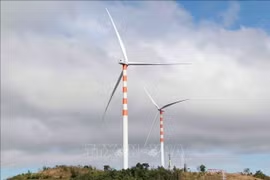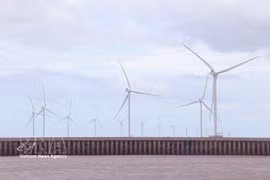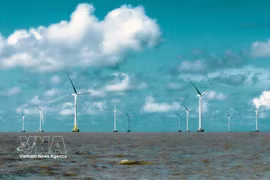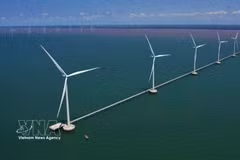
Hanoi (VNA) – With one of the world’s largest offshore wind resources, Vietnam has an opportunity to build a new green marine industry in line with the Politburo’s Resolution No. 20-NQ/TW.
On July 28, 2026, Party General Secretary and President To Lam signed Resolution No. 20-NQ/TW of the third plenum of the 14th Party Central Committee, setting a course to build Vietnam into a strong maritime nation. The resolution calls for strong development of renewable energy and new marine industries, prioritising sustainable energy transition in coastal areas and rapidly expanding renewables.
VietnamPlus spoke with Dr Du Van Toan from the Institute of Meteorology, Hydrology, Environment and Marine Sciences under the Ministry of Agriculture and Environment about Vietnam’s offshore wind potential, its advantages, and how to tap what he calls an “offshore gold mine” to support the maritime-nation goal.
Vietnam has “enormous” offshore wind potential
- As a senior researcher specialising in the marine economy, renewable energy and climate change, could you give more details about Vietnam’s current offshore wind potential and advantages?
Dr Du Van Toan: Vietnam boasts one of the world’s largest offshore wind resources. A coastline of more than 3,260 km, an exclusive economic zone of nearly 1 million sq. km, and stable wind regimes give the country “giant” wind energy resources.
About five years ago, the World Bank (WB) estimated Vietnam’s technical offshore wind potential at about 600 GW, among the highest in Asia-Pacific. An updated study by the Vietnam Meteorological and Hydrological Administration under the Ministry of Agriculture and Environment, together with UNDP, raises that to about 1,068 GW. Even after excluding shipping lanes, maritime transport routes, and marine protected areas, Vietnam still has more than 900 GW of technically exploitable potential.
Vietnam is considered to have the best wind resources in Southeast Asia. Globally, it ranks among the top five or six countries for wind conditions, among the top 10 for offshore wind potential, and among the top 20 for overall wind power development potential.
- You’ve described Vietnam’s offshore wind potential as enormous and among the world’s best. How has this “treasure” been tapped so far to support energy security and national competitiveness amid the global energy transition?
Dr Du Van Toan: Vietnam drew foreign investor interest relatively early. Right from 2017, many foreign companies, including UK investors, came to explore offshore wind power opportunities. In 2021, the WB revealed a study which found that Vietnam could develop 35–70 GW of offshore wind power by 2030, depending on policy and scenario. Those assessments attracted strong interest from energy groups from Denmark, Japan, Australia, the US and elsewhere.
Domestically, Vietnam rolled out the FIT2 feed-in tariff for onshore and coastal wind power, triggering an unprecedented investment wave of nearly 100 projects nationwide during 2018–2020. Some projects stalled on incomplete legal procedures or unsigned power purchase agreements, and the market subsequently stagnated after FIT2.
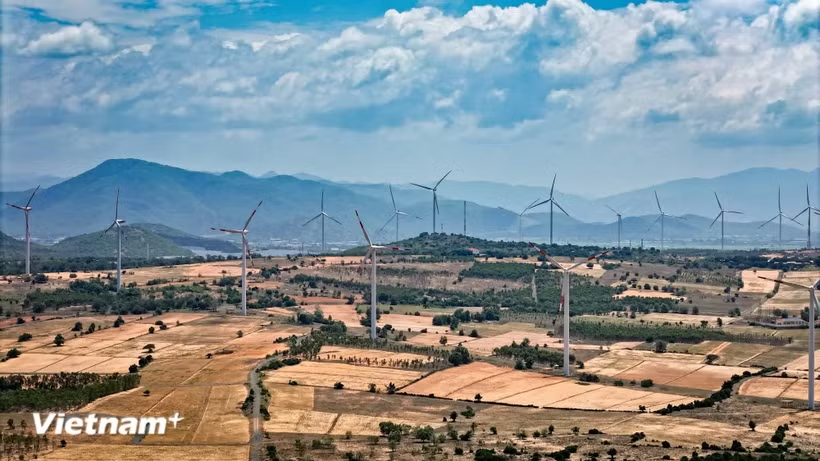
In 2022–2023, a surge in survey registrations by companies in southern coastal localities resulted in large sea areas almost “fully reserved”, underscoring the Vietnamese market’s great appeal. More recently, wind power projects have continued to be scaled up and connected to the grid, adding more than 1,000 MW to lift total connected wind power capacity past 6,000 MW, making this one of Vietnam’s fastest-growing renewable sources.
But most projects remain onshore or nearshore. Offshore wind, the segment with the greatest potential, is still largely untapped.
Offshore wind power development still faces major obstacles
- Despite the enormous potential and investor interest, Vietnam’s offshore wind power is still facing many difficulties and obstacles. What are the biggest bottlenecks holding back the sector, and what should be prioritised for removal?
Dr Du Van Toan: Vietnam only formally recognised offshore wind power in the Electricity Law of 2024. Projects beyond six nautical miles from the lowest average sea-water edge are classified as offshore ones. Those within that boundary are nearshore and fall under local authorities’ management. That legal definition is viewed as a key step, creating a basis for management and investment attraction mechanisms in a relatively new sector in the country.
The eighth Power Development Plan and its 2025 revision set ambitious targets: about 20 GW of onshore and nearshore wind power and 6 GW of offshore wind power by 2030. By 2050, onshore capacity is projected at 80–90 GW and offshore at nearly 140 GW, making offshore wind a core energy source of the national electricity system.
Yet marine energy development, particularly offshore wind power, still faces nuermous legal and implementation hurdles. The first is overlapping laws, including the Electricity Law, Investment Law, Law of the Sea of Vietnam, Law on Marine and Insular Resources and Environment, and Law on Planning, which drag out project procedures.
Vietnam also lacks a clear process for allocating marine areas to private and foreign investors for surveys. Standards and technical regulations for inspection, certification and survey equipment covering offshore wind, hydrodynamics, geophysics, geology, the marine environment and ecosystems have not been issued. Long-term pricing and bidding mechanisms remain unclear, raising financial risk and making banks and investors cautious. There is no coordinated investment mechanism for transmission from offshore sites to the mainland, fuelling concerns about power evacuation once projects are completed.
Moreover, the supporting industry ecosystem remains underdeveloped, from surveying, manufacturing and installation to a highly skilled workforce. Vietnam also lacks a national-level training and research centre dedicated to offshore wind power.
Investors also have no ready-to-use offshore wind data system, forcing them to fund their own surveys. Operating a single offshore wind measurement station costs about 2 million USD a year. Even after those outlays, there is no legal guarantee of businesses’ priority rights over the marine areas they surveyed, keeping many investors cautious.
Developing 1 GW of offshore wind power requires an average 3–4 billion USD. Even the first few gigawatts will need tens of billions of US dollars. Without a comprehensive legal framework, investment consortia and international banks will struggle to make financing decisions.
Vietnam could develop a new green marine industry
- If institutional and marine spatial planning issues, marine-area allocation, survey licensing and investor selection are resolved soon, what breakthrough could Vietnam achieve, for example, a modern marine economic value chain spanning logistics, shipbuilding, high-tech aquaculture and green hydrogen?
Dr Du Van Toan: If bottlenecks in planning, marine-area allocation, survey licensing and investor selection are cleared in 2026–2027, Vietnam could not only see its first offshore turbines installed by the end of this decade but also build a new green marine industry able to compete in the global renewable energy value chain.
If the related legal framework, from the Electricity Law, the Law on Marine and Insular Resources and Environment to the Land Law and rules on marine spatial planning, area allocation and grid connections, is completed in 2026, I believe Vietnam could see its first offshore wind turbines in 2028–2029.
The outlook is encouraging. Recently, international conflicts, supply chain disruptions, and volatile oil and gas prices have pushed many countries to accelerate the shift to clean energy to secure supply and cut reliance on imported fuels.
Vietnam is no exception. Rapid electric vehicle adoption and the net-zero commitment for 2050 are driving demand for green electricity.
One positive sign is that the green electricity market is beginning to take shape. A direct power purchase mechanism has emerged, with the first deals in which some major FDI companies bought renewable power for production through the national grid. If that model scales up, it could become an important driver of clean energy investment. In that landscape, offshore wind power will have one of the strongest competitive positions.
To Vietnam, beyond clean power, offshore facilities can be integrated with other marine activities. Surrounding areas of turbine foundations could host artificial reefs and new ecosystems to restore aquatic resources. Floating solar panels or high-tech aquaculture could be placed between turbine clusters, creating multi-purpose use rather than dedicating marine space to a single activity.
Particularly, when wind power output exceeds grid absorption, the power could be used to electrolyze seawater into green hydrogen for export or for hard-to-abate industries. This is considered a strategic direction many countries are pursuing to raise the value of renewable energy.
Offshore wind could also spawn an entirely new industry with a value chain spanning mechanical manufacturing, shipbuilding, offshore construction, logistics, operations and maintenance, and environmental monitoring. From a marine-governance perspective, large wind farms hundreds of kilometres offshore could improve the monitoring of remote waters through radar, observation networks and modern infrastructure. Wind turbines would not just generate electricity. They will serve as “green landmarks” affirming Vietnam’s presence and capacity to manage and sustainably develop its maritime space.
- What recommendations do you have for the Government, ministries, sectors, localities and the business community to realise the goal of making Vietnam a strong and prosperous maritime nation as directed by Party General Secretary and President To Lam, and to effectively tap offshore wind power potential as a new driver of green growth and sustainable marine economy development in the decades ahead?
Dr Du Van Toan: In my view, sustainable offshore wind power development requires a multidimensional approach combining scientific planning, a robust legal framework and meaningful local community participation. Projects should be planned farther offshore to avoid traditional fishing grounds, coral reefs, seagrass beds and marine protected areas. Especially, development within the nearshore zone of less than six nautical miles, where fishing is concentrated, should be limited. Environmental and social impact assessments must be rigorous and transparent from the start.
The amended Law on Marine and Insular Resources and Environment should include more strongly the rules on national marine spatial planning, especially for areas designated for offshore wind power, submarine power cables, and supporting infrastructure.
At the same time, Vietnam should also create special incentives for marine renewable energy projects, such as exemptions or reductions in marine-area use fees in early years, carbon credit support, and access to domestic and international carbon markets. That would underpin a blue economy while helping Vietnam meet its 2050 net-zero commitment.
Thank you very much!