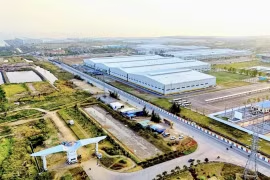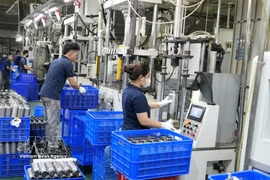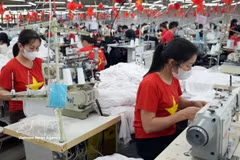
Hanoi (VNA) – Of around 45,000 foreign direct investment (FDI) projects in Vietnam, about 1,500 are subject to the global minimum tax (GMT), while fewer than 200 have actually incurred tax liabilities under the mechanism.
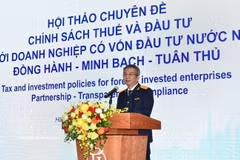
The figures were revealed by Deputy Director of the Department of Taxation under the Ministry of Finance (MOF) Dang Ngoc Minh at a September 28 seminar on tax and investment policies for FDI enterprises.
He said the common GMT rate of 15% applies to enterprises that previously benefited from preferential tax rates of 5% or 10%, as well as other tax incentives.
Vietnam collected around 16.5 trillion VND (635.4 million USD) in GMT revenue in 2025, contributing to socio-economic development while recovering part of the tax incentives previously granted.
FDI attraction shifts towards quality
Director of the department Mai Xuan Thanh said that after nearly four decades of attracting foreign investment, the FDI sector has become an important part of Vietnam’s economy, contributing to economic growth, exports, employment and technology transfer.
However, investment policy has shifted from focusing on the volume of capital attracted to investment quality, value creation and contributions to sustainable development, he said, stressing the need to adapt policies and management practices to changing investment priorities.
Nguyen Anh Tuan, Deputy Director of the MOF's Foreign Investment Agency, said Vietnam needs to improve productivity, growth quality, competitiveness and economic self-reliance.
Continued FDI attraction remains necessary, but the goal is no longer simply to increase capital inflows or the number of projects. Greater emphasis should be placed on the quality, efficiency and sustainability of investment, while strengthening links between the FDI sector and domestic capabilities and long-term development goals, he added.
Incentives shift to cost-based support
Minh said foreign investors’ decisions to choose Vietnam are no longer as heavily dependent on tax incentives as before, with the country’s strategic position in global production chains, infrastructure, trade relations and workforce providing favourable conditions for deeper participation in production networks.
Accordingly, income-based incentives will no longer be appropriate, and FDI attraction policies will shift towards cost-based support, including assistance for technology, technology transfer and human resource training in industrial and high-tech sectors.
The Government will also invest in industrial infrastructure to help enterprises develop ecosystems and encourage Vietnamese firms to join supply chains through training, business establishment support and ecosystem development.
Future incentives will be linked to enterprises’ performance, particularly technology transfer and human resource training, and must be clearly specified from the outset in investment licences.
Minh said tax authorities would conduct pre-supervision of enterprises’ implementation of their commitments. A shared database platform should be developed to enable tax authorities to exchange enterprise and population data with agencies under the Ministry of Finance and other Government bodies.
The aim is to allow enterprises to declare relevant information and commitments only once, while tax authorities conduct indirect monitoring and subsequent inspections based on performance assessments./
See more
Vietnamese goods account for only around 1% of CPTPP market share
To support businesses, the MoIT is developing an FTA implementation management system built on three pillars. These include providing information through the Government’s FTA portal, assessing FTA implementation results in localities, and building an FTA utilisation ecosystem connecting management agencies, localities, associations, businesses, logistics and financial service providers, and other stakeholders across production and export chains.
Vietnam approves outlet development plan through 2030, with vision to 2045
Under the plan, Vietnam aims to establish at least one outlet model by 2030, gradually complete the relevant legal framework and integrate outlet development into the master plans and development schemes of localities with potential.
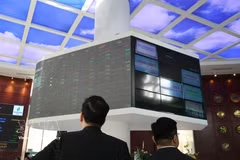
Vietnam’s stock market offers new platform, new connections
In the first seven months of 2026, capital raised through share offerings totalled 113.92 trillion VND, up 43.41%, while funds raised through public offerings of bonds, international bonds and convertible bonds reached 52.15 trillion VND, up 160.64%.
Vietnam’s manufacturing, labour market show positive signs
HR Asia cited “The Great Restructuring: ASEAN Consumer and Business Trends Survey 2026”, conducted by recruitment and human resources consultancy Reeracoen Group and market research firm Rakuten Insight, as showing that Vietnam is leading ASEAN in economic growth momentum, improved business revenue and increased recruitment demand amid supply-chain restructuring.
UNDP representative highlights priorities for Vietnam to become strong maritime nation
Vietnam needs flexible incentives and specialised green financial instruments, stronger inter-sectoral coordination, improved local governance capacity and a more complete MRV data system, said Ramla Khalidi, Resident Representative of the United Nations Development Programme (UNDP) in Vietnam.
Why does Travel + Leisure call Phu Quoc Asia’s next MICE hotspot?
According to the magazine, Phu Quoc was once known primarily for its beaches and relaxed holiday atmosphere. Over the past two years, alongside that appeal, the island has gradually developed its capacity to serve the MICE market, with international resorts, event venues, world-class shows and an expanding flight network.
Agricultural sector targets 18 billion USD in Q4 exports
Agro-forestry-fishery exports reached some 56.3 billion USD in the first nine months of 2026, up 7.8% year on year. To exceed 74 billion USD for the full year, monthly revenue must average 5.97 billion USD over the next three months.
Vietnam unlocks new development space from sea
As the country enters a new development phase with greater demands for stronger marine-economy growth, institutional bottlenecks have emerged and need to be addressed.
Reference exchange rate edges down 2 VND on September 29
With the current trading band of +/- 5%, the ceiling rate applicable for commercial banks during the day is 26,912 VND/USD, and the floor rate 24,349 VND/USD.
Tilapia exports to Brazil surge 222 times in eight months
This dramatic spike primarily reflected a massive expansion in export volume from a very low baseline in the same period last year.
CPTPP offers opportunities for supply-chain diversification amid global trade shifts
The CPTPP is emerging as more than an export market, offering Vietnam opportunities to diversify suppliers, production networks and export destinations amid global trade restructuring.
QR payments make Vietnam more convenient for international visitors
International visitors no longer need to rely solely on cash or cards in Vietnam. Singaporean tourists can use LiquidPay, Aleta Planet and DCS DeCard, while Chinese visitors can scan VietQRGlobal codes with WeChat and WeChat Pay.
Ho Chi Minh City sets October 30 deadline for fishing boat tracking system
Ho Chi Minh City has ordered relevant agencies and coastal localities to accelerate installation of the electronic catch documentation and traceability system (eCDT) on fishing boats, with the work to be completed by October 30, 2026.
Vietnam sees high growth prospects
Experts from the Institute of Vietnam and World Economy under the Vietnam Academy of Social Sciences noted the quality of recent growth as the high growth rate has been recorded against an increasingly higher comparative base.
Hanoi steps up targeted investment promotion to deepen global value chain engagement
Hanoi is moving from broad-based investment promotion towards targeted efforts focusing on projects and corporations with strong leadership capacity and potential to create spillover effects. For 2026-2030, it aims to attract 10 multinational corporations to establish executive offices, research and development (R&D) centres, innovation centres or regional service centres, helping build an technology and innovation ecosystem with international competitiveness.
Vietnamese exports face tougher challenges in EU market
Despite the challenges, the EU remains a major market for Vietnamese goods. Two-way trade reached 52.6 billion EUR in the first seven months, up 23.2% year on year. Vietnam's exports rose 26% to 45.6 billion EUR , while imports increased 6% to 7 billion EUR.
Tax policies, investment environment updated for FDI enterprises
Politburo Resolution No. 10 calls for a strong shift from focusing on scale and quantity towards quality, efficiency and added value. It gives priority to projects featuring advanced technologies, modern management, innovation capacity and the ability to participate more deeply in global value chains.
Over 5 billion USD in foreign capital and new challenge for Vietnam’s property market
According to Su Ngoc Khuong, Senior Director of Investment at Savills Vietnam, infrastructure will become one of the key drivers shaping a new development cycle for the property market. Major transport projects are improving inter-regional connectivity and creating new growth poles along economic corridors.
Da Nang steps up efforts to tap Russia, CIS markets
Da Nang welcomed more than 411,000 visitors from Russia and other CIS countries in the first eight months of 2026, up 94.2% year-on-year and accounting for about 5.8% of total international arrivals.
Reference exchange rate down 9 VND at week’s beginning
With the current trading band of +/- 5%, the ceiling rate applicable for commercial banks during the day is 26,914 VND/USD, and the floor rate 24,350 VND/USD.