Hanoi (VNA) – Hanoi is shifting towards targeted investment promotion to attract multinational corporations capable of leading high-tech supply chains, while accelerating institutional reform, infrastructure development and human resources training to deepen its participation in global value chains.
The capital city is moving from broad-based investment promotion towards targeted efforts focusing on projects and corporations with strong leadership capacity and potential to create spillover effects. For 2026-2030, Hanoi aims to attract 10 multinational corporations to establish executive offices, research and development (R&D) centres, innovation centres or regional service centres, helping build an technology and innovation ecosystem with international competitiveness.
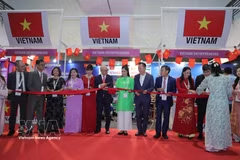
At a June conference to announce the capital city's master plan with a 100-year vision, and promote investment in 2026, 50 memoranda of understanding (MoUs) were signed. On August 5, the municipal People’s Committee issued Plan No. 304/KH-UBND to implement the signed MOUs and cooperation agreements.
The master plan specifies the lead and coordinating agencies, tasks, expected outputs and deadlines for each MoU, providing a mechanism to monitor and urge implementation and ensure that the agreements are translated into concrete socio-economic development and investment attraction outcomes.
Hanoi is also pursuing “targeted” investment promotion for potential investors, enabling the city to proactively approach the right partners, understand their specific needs and develop appropriate support instead of waiting for investors.
Alongside investment promotion, the city has issued resolutions of the municipal People’s Council to implement the 2026 Capital Law, with a focus on greater decentralisation and delegation of powers, mechanisms to attract strategic investors, special investment procedures, investment incentives and access to land.
Hanoi is also studying the establishment of a free trade zone and free economic zone under Resolution No. 02-NQ/TW of the Political Bureau on building and developing Hanoi in the new era, while contributing to the improvement of investment legislation to implement Politburo Resolution No. 10-NQ/TW on developing foreign-invested economy.
Completing high-tech infrastructure
To accommodate major technology corporations, the city is working to remove land-related bottlenecks, accelerate site clearance and develop infrastructure, said Le Trung Hieu, Deputy Director of the municipal Department of Finance.
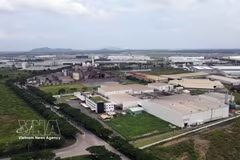
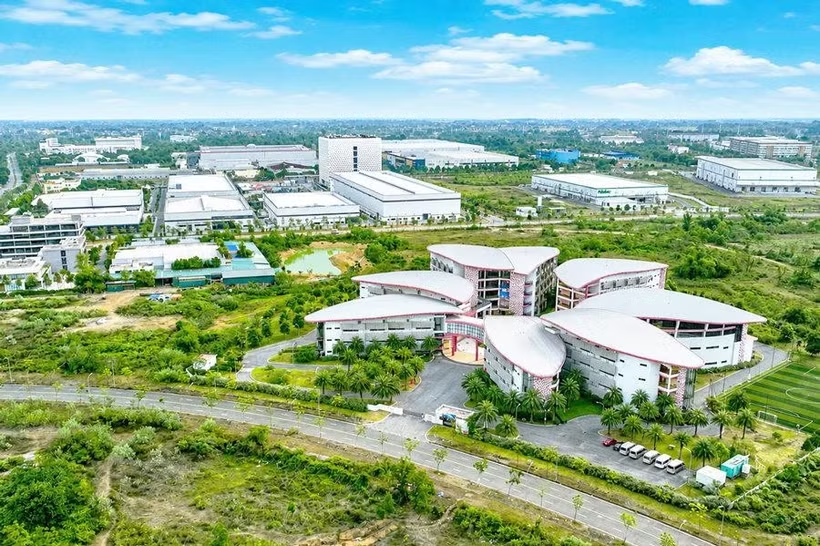
Hoa Lac Hi-Tech Park is expected to have about 800ha of cleared land by the end of 2026, while the biotechnology hi-tech park covers about 199ha. Seven industrial parks with a combined area of about 1,800ha have been approved, with others undergoing expansion or receiving in-principle investment approval.
Notably, Hanoi issued Decision No. 80/2026/QD-UBND, promoting ecological, green and circular industrial park models in line with sustainable investment trends. The city is also upgrading digital infrastructure, including 5G networks, piloting Smart Poles and Internet of Things (IoT) infrastructure, launching the HITC Hub innovation space, and implementing its semiconductor industry development plan through 2030.
Hieu said Hanoi is gradually putting in place the conditions needed to attract a new generation of foreign direct investment (FDI), aiming not only to increase investment projects but also to develop R&D, innovation and regional service centres that would enable local businesses to participate more deeply in global supply and value chains.
Former Director of the Price and Market Research Institute at the Ministry of Finance Assoc. Prof. Dr. Ngo Tri Long said Hanoi should shift firmly towards targeted investment promotion, identify priority projects and strategic corporations in knowledge-intensive sectors, and link investment incentives with commitments on technology, R&D, human resources training, localisation, environmental standards, social responsibility and linkages with domestic businesses.
He also stressed the importance of developing high-quality human resources as key “soft infrastructure”, managing FDI through data, and prioritising projects capable of bringing entire business ecosystems and supply chains rather than simply those with large capital./.