Vietnamese exports face tougher challenges in EU market

Despite the challenges, the EU remains a major market for Vietnamese goods. Two-way trade reached 52.6 billion EUR in the first seven months, up 23.2% year on year. Vietnam's exports rose 26% to 45.6 billion EUR , while imports increased 6% to 7 billion EUR.

Promoting Vietnamese products at a trade fair. (Illustrative photo: VNA)

Hanoi (VNA) – Vietnam-EU trade continued to grow strongly in the first seven months of 2026 despite sluggish European economic growth, but Vietnamese exporters are facing tougher requirements on the environment, quality, packaging, e-commerce and product traceability.

The Vietnamese Trade Office in Belgium and the EU has urged businesses to proactively adapt to stricter EU regulations, particularly in steel, agricultural and food products, and e-commerce.

For steel, the EU has imposed a duty-free quota of 18.3 million tonnes covering 26 product categories since July 1, with a 50% tariff on imports outside the quota. As a partner with a free trade agreement with the EU, Vietnam benefits from part of the quota reserved for countries with such agreements. However, the Trade Office expects Vietnamese steel exports to remain under pressure and has called for further negotiations on quotas.

E-commerce is also facing new cost pressures. Since July 1, the EU has ended duty exemptions for parcels worth less than 150 EUR (about 171 USD), replacing them with a temporary 3 EUR charge per item. From November, each product category in a small parcel will also incur a 2 EUR handling fee, potentially affecting the competitiveness of Vietnamese goods sold directly to EU consumers.

Food and agricultural exports face tighter safety and quality controls. The EU's Rapid Alert System for Food and Feed (RASFF) issued 10 alerts involving Vietnamese food products in July and August, including lychee, tuna, cinnamon, black pepper, pangasius, shrimp, rambutan and green tea. Some cases were considered serious and rejected at the border.

Vietnamese businesses also need to prepare for new EU rules, including the EU Deforestation Regulation (EUDR), expected to take effect in late December, new packaging and packaging-waste rules that entered into force on August 12, and measures banning products made with forced labour.

The Trade Office has called for stronger early-warning mechanisms to keep businesses informed of policy and technical changes, as well as tighter quality controls of agricultural and food products from the production stage.

Despite the challenges, the EU remains a major market for Vietnamese goods. Two-way trade reached 52.6 billion EUR in the first seven months, up 23.2% year on year. Vietnam's exports rose 26% to 45.6 billion EUR , while imports increased 6% to 7 billion EUR.

Manufactured goods were the main growth driver, with machinery, mechanical equipment and electrical machinery accounting for nearly 60% of exports. Textiles and garments, wood and wooden products, toys and sporting goods also recorded strong growth. By contrast, exports of iron and steel, footwear, coffee, seafood and furniture declined.

Trade between Vietnam and Belgium hit around 2.59 billion EUR, including 2.15 billion EUR in Vietnamese exports and 443.5 million EUR in imports.

The growth came despite sluggish EU economic performance, with the bloc's GDP rising 0.7% year on year in the second quarter. Belgium's central bank forecasts GDP growth of around 0.6% for 2026.

Beyond traditional export sectors, the Trade Office has proposed expanding Vietnam-Belgium cooperation in logistics, seaports, renewable energy, hydrogen, green technology and the circular economy, in line with Belgium's development priorities./.
​

VNA

See more

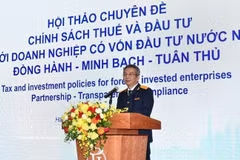
Mai Xuan Thanh, Director of the Tax Department speaks at the event (Photo: VNA)

Tax policies, investment environment updated for FDI enterprises

Politburo Resolution No. 10 calls for a strong shift from focusing on scale and quantity towards quality, efficiency and added value. It gives priority to projects featuring advanced technologies, modern management, innovation capacity and the ability to participate more deeply in global value chains.

In the first eight months of 2026, Da Nang welcomed more than 411,000 visitors from Russia and other CIS countries, up 94.2% year on year and accounting for around 5.8% of the city's total international arrivals. Russian arrivals alone reached nearly 300,000, up 151.4%, making Russia the city's seventh-largest international tourism market. Da Nang's tourism sector is stepping up efforts to tap the Russia and CIS markets, focusing on long-stay and high-spending visitors while expanding air connectivity, digital promotion and tourism products tailored to market demand. (Photo: VNA)

Da Nang steps up efforts to tap Russia, CIS markets

Da Nang welcomed more than 411,000 visitors from Russia and other CIS countries in the first eight months of 2026, up 94.2% year-on-year and accounting for about 5.8% of total international arrivals.

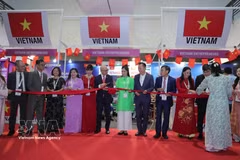
Delegates visit the booth of Hanoi Xanh Cooperative (Vietnam) at Halal Expo 2025 in Türkiye, November 2025. (Photo: VNA)

Vietnam seeks bigger share of global Halal market

Vietnam's Halal exports remain modest at around 900 million USD a year, accounting for less than 1% of the global market. Most exports are still raw agricultural and seafood products. Only around 1,000–1,300 Vietnamese businesses obtained or maintained Halal certification during 2024–2026.

Illustrative image (Photo: kinhtexaydung.petrotimes.vn)

Hanoi sets up inter-agency mechanism to operate carbon market

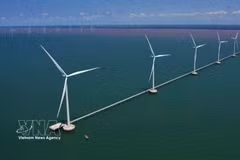
Under a decision of the municipal People’s Committee on establishing an inter-agency working group, departments and agencies are responsible for identifying facilities subject to greenhouse gas inventories, developing emissions-reduction plans and studying projects capable of generating carbon credits.

The exhibition drew more than 18,000 online registrations, with about 75% of visitors being professional buyers from factories, manufacturers, distributors and procurement departments of brands operating in Vietnam. (Photo: VNA)

Vietnam draws new supply-chain links from OCTF 2026

Against the backdrop of changing global and regional supply chains, stronger connections between Vietnamese businesses and foreign suppliers could help diversify sourcing, improve production efficiency and expand domestic firms' participation in value chains.

Malaysian customers sample Vietnamese coffee. (Photo: VNA)

Vietnam-Malaysia trade eyes 20 billion USD milestone

Malaysia remains one of Vietnam’s key trading partners in ASEAN and globally. However, Vietnam’s exports have lagged behind imports, resulting in a trade deficit of 5.67 billion USD with Malaysia in 2025 and nearly 4 billion USD in the first six months of 2026.

Farmers in Ca Mau apply mechanisation in harvesting the summer-autumn rice crop. (Illustrative photo published by VNA)

Deputy PM calls for shift from output-driven to quality-based growth

The development of the agriculture, forestry and fisheries sectors should not focus solely on increasing export value, but must be linked to comprehensive restructuring of agriculture towards modern, ecological, high-value-added and sustainable development, said Standing Deputy Prime Minister Pham Gia Tuc.