Vietnam sees high growth prospects

Experts from the Institute of Vietnam and World Economy under the Vietnam Academy of Social Sciences noted the quality of recent growth as the high growth rate has been recorded against an increasingly higher comparative base.

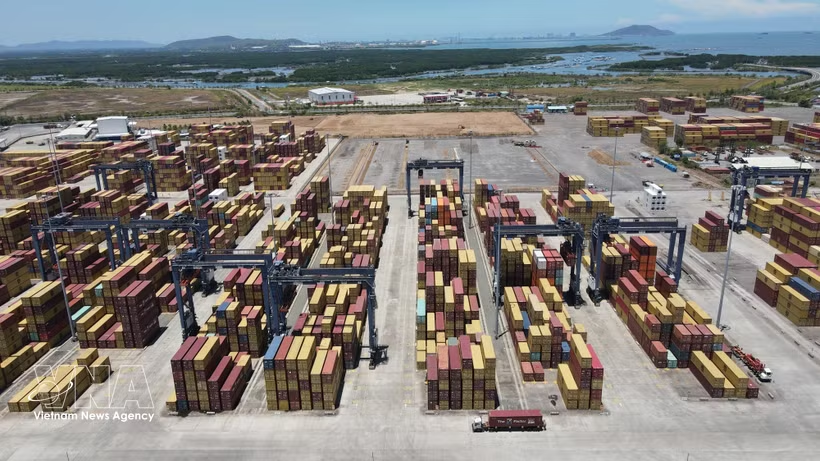
A view of SSIT deep-water port in Ho Chi Minh City, which can accommodate large-tonnage vessel. (Photo: VNA)

Hanoi (VNA) - Vietnam’s economy is entering the final months of 2026 with a solid growth foundation, supported by strong production, consumption, exports and investment. While the country has considerable room to sustain high growth, experts warn that both external uncertainties and domestic risks will need to be addressed.

Growth momentum strengthened

Vietnam’s GDP expanded 8.18% year-on-year in the first half of 2026, with growth drivers relatively broad-based across economic sectors.

In the first eight months, industrial production rose 11.9%, with manufacturing and processing up 12.9%. Retail sales of goods and consumer services increased 13.3%. Disbursed foreign direct investment (FDI) reached 17.25 billion USD, up 12%, while exports rose 22.4% to 374.84 billion USD and imports increased 35.3% to 395.3 billion USD. By September 3, public investment disbursement had reached 513.3 trillion VND (19.7 billion USD), equivalent to 50.2% of the target assigned by the Prime Minister.

Experts from the Institute of Vietnam and World Economy under the Vietnam Academy of Social Sciences noted the quality of recent growth as the high growth rate has been recorded against an increasingly higher comparative base. Vietnam’s GDP grew 8.02% in 2025, the highest rate in Southeast Asia. According to a joint report by Bain & Company, DBS and Vriens & Partners, the six largest Southeast Asian economies, namely Indonesia, Malaysia, the Philippines, Thailand, Singapore and Vietnam, averaged 5.1% growth in 2024-2025. Vietnam, however, recorded average growth of 7.5%, compared with 2.7% for Thailand.

On September 23, the Asian Development Bank (ADB) raised its forecast for Vietnam’s 2026 GDP growth to 7.8%, from 7.2%, and revised its 2027 forecast upward from 7% to 7.6%.

Bain & Company, DBS and Vriens & Partners project that the six major Southeast Asian economies will grow by an average 4.8% annually in 2026-2035, with Vietnam continuing to be a leading growth driver.

At a recent workshop, experts from the Institute of Vietnam and World Economy forecast Vietnam’s 2026 growth at around 8.5%, significantly above the latest ADB forecast.

Growth drivers and risks

Despite differences in forecasts, analysts point to similar growth drivers, including manufacturing and processing, domestic consumption, FDI and supportive policies. Domestic experts also highlight the role of public investment, tourism and transport recovery, additional FDI capital for industry, and improved corporate cash flows.

However, the outlook is not without risks. ADB warns that rising global uncertainty could put pressure on exports, investment, inflation and exchange rates. Greater reliance on investment and credit could also increase risks to liquidity and financial stability, while weaker global demand would directly affect Vietnam’s highly trade-dependent economy.
vnanet-growth2.jpg
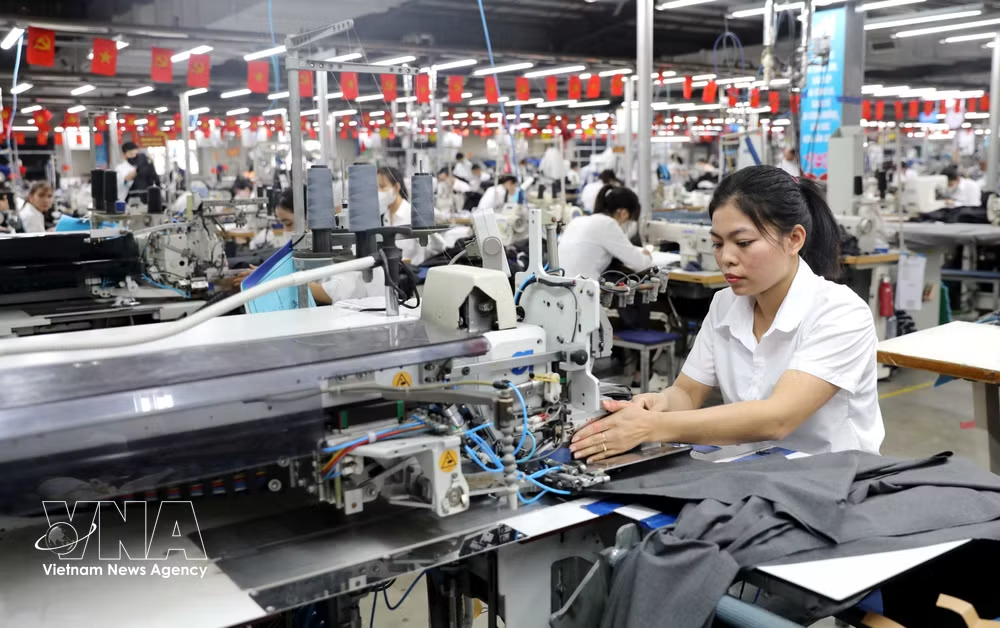
Digital transformation is becoming a dominant trend at factories and enterprises, contributing to a modern, transparent and efficient economy. (Photo: VNA)

Domestic experts point to slower growth in real purchasing power, high capital costs, rapidly rising imports and fluctuations in energy prices. Additional tariff measures in major export markets could also heighten trade risks.

They therefore recommend accelerating public investment, shortening tax-refund and payment procedures, improving businesses’ access to credit, preparing energy scenarios and helping firms meet market-specific standards and rules of origin.

ADB likewise calls for prudent macroeconomic management, inflation control, financial stability and structural reforms, with investment directed toward areas capable of improving productivity.

Overall, Vietnam has a solid basis for maintaining high growth in 2026. The key challenge is to turn existing momentum into stronger productivity, investment efficiency and economic resilience, thereby creating a sustainable foundation for growth in the years ahead./.


VNA

See more

Hoa Lac Hi-Tech Park is expected to have about 800ha of cleared land by the end of 2026. (Illustrative image: Photo: cafef.vn)

Hanoi steps up targeted investment promotion to deepen global value chain engagement

Hanoi is moving from broad-based investment promotion towards targeted efforts focusing on projects and corporations with strong leadership capacity and potential to create spillover effects. For 2026-2030, it aims to attract 10 multinational corporations to establish executive offices, research and development (R&D) centres, innovation centres or regional service centres, helping build an technology and innovation ecosystem with international competitiveness.

Promoting Vietnamese products at a trade fair. (Illustrative photo: VNA)

Vietnamese exports face tougher challenges in EU market

Despite the challenges, the EU remains a major market for Vietnamese goods. Two-way trade reached 52.6 billion EUR in the first seven months, up 23.2% year on year. Vietnam's exports rose 26% to 45.6 billion EUR , while imports increased 6% to 7 billion EUR.

Mai Xuan Thanh, Director of the Tax Department speaks at the event (Photo: VNA)

Tax policies, investment environment updated for FDI enterprises

Politburo Resolution No. 10 calls for a strong shift from focusing on scale and quantity towards quality, efficiency and added value. It gives priority to projects featuring advanced technologies, modern management, innovation capacity and the ability to participate more deeply in global value chains.

In the first eight months of 2026, Da Nang welcomed more than 411,000 visitors from Russia and other CIS countries, up 94.2% year on year and accounting for around 5.8% of the city's total international arrivals. Russian arrivals alone reached nearly 300,000, up 151.4%, making Russia the city's seventh-largest international tourism market. Da Nang's tourism sector is stepping up efforts to tap the Russia and CIS markets, focusing on long-stay and high-spending visitors while expanding air connectivity, digital promotion and tourism products tailored to market demand. (Photo: VNA)

Da Nang steps up efforts to tap Russia, CIS markets

Da Nang welcomed more than 411,000 visitors from Russia and other CIS countries in the first eight months of 2026, up 94.2% year-on-year and accounting for about 5.8% of total international arrivals.

Delegates visit the booth of Hanoi Xanh Cooperative (Vietnam) at Halal Expo 2025 in Türkiye, November 2025. (Photo: VNA)

Vietnam seeks bigger share of global Halal market

Vietnam's Halal exports remain modest at around 900 million USD a year, accounting for less than 1% of the global market. Most exports are still raw agricultural and seafood products. Only around 1,000–1,300 Vietnamese businesses obtained or maintained Halal certification during 2024–2026.

Illustrative image (Photo: kinhtexaydung.petrotimes.vn)

Hanoi sets up inter-agency mechanism to operate carbon market

Under a decision of the municipal People’s Committee on establishing an inter-agency working group, departments and agencies are responsible for identifying facilities subject to greenhouse gas inventories, developing emissions-reduction plans and studying projects capable of generating carbon credits.

The exhibition drew more than 18,000 online registrations, with about 75% of visitors being professional buyers from factories, manufacturers, distributors and procurement departments of brands operating in Vietnam. (Photo: VNA)

Vietnam draws new supply-chain links from OCTF 2026

Against the backdrop of changing global and regional supply chains, stronger connections between Vietnamese businesses and foreign suppliers could help diversify sourcing, improve production efficiency and expand domestic firms' participation in value chains.

Malaysian customers sample Vietnamese coffee. (Photo: VNA)

Vietnam-Malaysia trade eyes 20 billion USD milestone

Malaysia remains one of Vietnam’s key trading partners in ASEAN and globally. However, Vietnam’s exports have lagged behind imports, resulting in a trade deficit of 5.67 billion USD with Malaysia in 2025 and nearly 4 billion USD in the first six months of 2026.