Vietnam approves outlet development plan through 2030, with vision to 2045

Under the plan, Vietnam aims to establish at least one outlet model by 2030, gradually complete the relevant legal framework and integrate outlet development into the master plans and development schemes of localities with potential.

Hanoi (VNA) – The Ministry of Industry and Trade (MOIT) has approved a plan to develop outlet models in Vietnam through 2030, with a vision to 2045, aiming to create shopping, tourism and experience destinations, stimulate consumption, develop trade and services, and enhance the competitiveness of the domestic retail market.

An outlet is a concentrated retail model featuring multiple brands, where manufacturers or distributors sell directly to consumers at prices suited to the model. Goods may include inventory, slightly defective products and products made specifically for outlet sales.

Under the plan, Vietnam aims to establish at least one outlet model by 2030, gradually complete the relevant legal framework and integrate outlet development into the master plans and development schemes of localities with potential.

During 2030–2045, outlet models are expected to be developed across the northern, central and southern regions, with at least one model in each region. By 2030, at least 5,000 officials, civil servants and businesses involved in outlet management, operation and development are expected to receive capacity-building training.

The plan asks for outlet development to be modern, transparent and well-regulated in line with international practices, while ensuring effective State management of trade and preventing smuggling, trade fraud and counterfeits.

Vietnamese goods are expected to account for at least 30–40% of products at pilot outlets. By 2030, at least 10 groups of “national gift” products are expected to be created for sale at outlets, with priority given to national-brand products, five-star One Commune One Product (OCOP) products, outstanding rural industrial products and pioneering Vietnamese products.

The plan identifies three main models: premium outlet villages with 30,000–50,000 sq.m of leasable space; urban/suburban outlet centres with 5,000–25,000 sq.m; and integrated outlets with 15,000–50,000 sq.m incorporated into multifunctional complexes.

These models target areas with advantages in purchasing power, tourism and transport connectivity. Potential locations include major expressway corridors and areas near airports in Hanoi and Ho Chi Minh City, the coastal route between Da Nang and Hoi An, and tourism centres such as Cam Ranh in Khanh Hoa province and Phu Quoc in An Giang province.

Hanoi, Ho Chi Minh City, Da Nang, Quang Ninh and An Giang (Phu Quoc) are encouraged to consider and attract investment to pilot outlet models. Localities are expected to assess potential locations, arrange land and determine appropriate investment methods in line with master plans, market demand, transport connectivity and tourism potential.

The plan said investor selection should prioritise financial capacity, retail chain management experience, brand attraction and commitments to selling Vietnamese goods at outlets. Local authorities are also responsible for organising trade, tourism and cultural activities at outlets to attract customers and promote their localities.

It also requires stronger market surveillance at outlet models, focusing on goods, prices and price listing, as well as measures against smuggling, trade fraud, counterfeit and substandard goods.

The MOIT’s Agency for Domestic Market Surveillance and Development will serve as the focal point for advising ministry leaders and coordinating implementation. Units under the ministry shall coordinate with the agency to fine-tune regulations related to goods, pricing, consumer protection, corporate responsibilities, investment policies, market development, e-commerce, digital transformation, products, brands and shopping tourism.

Meanwhile, local authorities will select appropriate models, attract investment and oversee their implementation./.​

VNA

See more

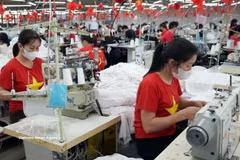
The Ministry of Industry and Trade has issued a circular amending and supplementing certain regulations on textile and garment exports to Mexico under the CPTPP. (Photo: VNA)

Vietnamese goods account for only around 1% of CPTPP market share

To support businesses, the MoIT is developing an FTA implementation management system built on three pillars. These include providing information through the Government’s FTA portal, assessing FTA implementation results in localities, and building an FTA utilisation ecosystem connecting management agencies, localities, associations, businesses, logistics and financial service providers, and other stakeholders across production and export chains.

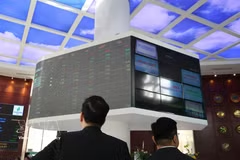
Investors monitor stock movements on Ho Chi Minh City Stock Exchange. (Photo: VNA)

Vietnam’s stock market offers new platform, new connections

In the first seven months of 2026, capital raised through share offerings totalled 113.92 trillion VND, up 43.41%, while funds raised through public offerings of bonds, international bonds and convertible bonds reached 52.15 trillion VND, up 160.64%.

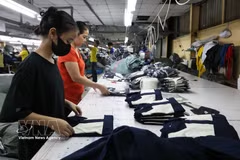
Workers at a garment factory in Vinh Loc commune, Ho Chi Minh City. (Photo: VNA)

Vietnam’s manufacturing, labour market show positive signs

HR Asia cited “The Great Restructuring: ASEAN Consumer and Business Trends Survey 2026”, conducted by recruitment and human resources consultancy Reeracoen Group and market research firm Rakuten Insight, as showing that Vietnam is leading ASEAN in economic growth momentum, improved business revenue and increased recruitment demand amid supply-chain restructuring.

Phu Quoc is building its capacity to host MICE tourism, with international resorts, event venues, world-class shows and an expanding flight network. (Photo: Sunset Town)

Why does Travel + Leisure call Phu Quoc Asia’s next MICE hotspot?

According to the magazine, Phu Quoc was once known primarily for its beaches and relaxed holiday atmosphere. Over the past two years, alongside that appeal, the island has gradually developed its capacity to serve the MICE market, with international resorts, event venues, world-class shows and an expanding flight network.

Agricultural sector targets 18 billion USD in Q4 exports

Agricultural sector targets 18 billion USD in Q4 exports

Agro-forestry-fishery exports reached some 56.3 billion USD in the first nine months of 2026, up 7.8% year on year. To exceed 74 billion USD for the full year, monthly revenue must average 5.97 billion USD over the next three months.

A view of SSIT deep-water port in Ho Chi Minh City, which can accommodate large-tonnage vessel. (Photo: VNA)

Vietnam sees high growth prospects

Experts from the Institute of Vietnam and World Economy under the Vietnam Academy of Social Sciences noted the quality of recent growth as the high growth rate has been recorded against an increasingly higher comparative base.

Hoa Lac Hi-Tech Park is expected to have about 800ha of cleared land by the end of 2026. (Illustrative image: Photo: cafef.vn)

Hanoi steps up targeted investment promotion to deepen global value chain engagement

Hanoi is moving from broad-based investment promotion towards targeted efforts focusing on projects and corporations with strong leadership capacity and potential to create spillover effects. For 2026-2030, it aims to attract 10 multinational corporations to establish executive offices, research and development (R&D) centres, innovation centres or regional service centres, helping build an technology and innovation ecosystem with international competitiveness.

Promoting Vietnamese products at a trade fair. (Illustrative photo: VNA)

Vietnamese exports face tougher challenges in EU market

Despite the challenges, the EU remains a major market for Vietnamese goods. Two-way trade reached 52.6 billion EUR in the first seven months, up 23.2% year on year. Vietnam's exports rose 26% to 45.6 billion EUR , while imports increased 6% to 7 billion EUR.

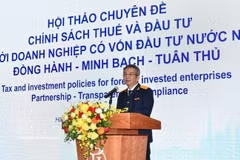
Mai Xuan Thanh, Director of the Tax Department speaks at the event (Photo: VNA)

Tax policies, investment environment updated for FDI enterprises

Politburo Resolution No. 10 calls for a strong shift from focusing on scale and quantity towards quality, efficiency and added value. It gives priority to projects featuring advanced technologies, modern management, innovation capacity and the ability to participate more deeply in global value chains.

In the first eight months of 2026, Da Nang welcomed more than 411,000 visitors from Russia and other CIS countries, up 94.2% year on year and accounting for around 5.8% of the city's total international arrivals. Russian arrivals alone reached nearly 300,000, up 151.4%, making Russia the city's seventh-largest international tourism market. Da Nang's tourism sector is stepping up efforts to tap the Russia and CIS markets, focusing on long-stay and high-spending visitors while expanding air connectivity, digital promotion and tourism products tailored to market demand. (Photo: VNA)

Da Nang steps up efforts to tap Russia, CIS markets

Da Nang welcomed more than 411,000 visitors from Russia and other CIS countries in the first eight months of 2026, up 94.2% year-on-year and accounting for about 5.8% of total international arrivals.