Hanoi (VNA) – Implementing Resolution No. 20-NQ/TW, dated July 28, 2026, of the Party Central Committee on building and developing Vietnam into a strong maritime-based nation and promoting high-tech marine aquaculture, Vietnam has a major opportunity to unlock the potential of the sea, generate prosperity from marine resources and enhance its competitiveness regionally and globally.
To turn offshore and deep-sea areas into new development space and a long-term growth driver, marine aquaculture will depend not only on natural advantages, but increasingly on institutional capacity, governance quality, mastery of science and technology, and business participation.
Awakening sea with high technology
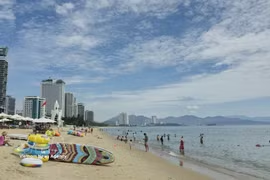
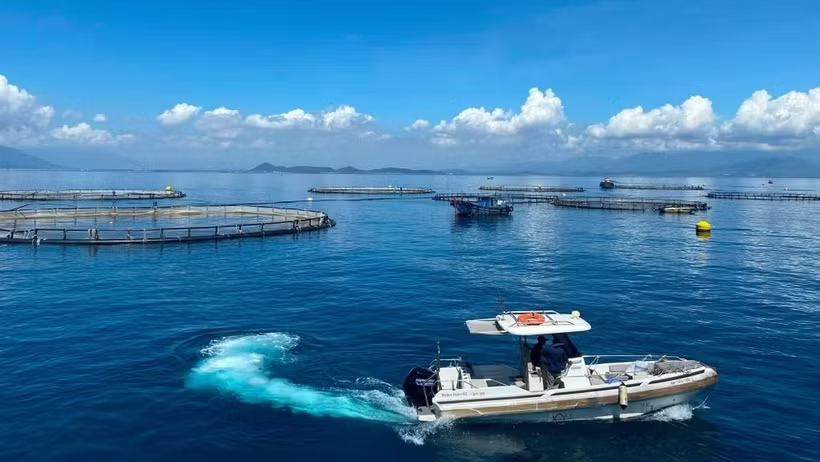
Following the administrative reorganisation, the central province of Khanh Hoa has a vast marine area, with nearly 500km of coastline and bays such as Nha Trang, Cam Ranh and Van Phong, offering major advantages in tourism, fisheries, seaports and marine science and technology.
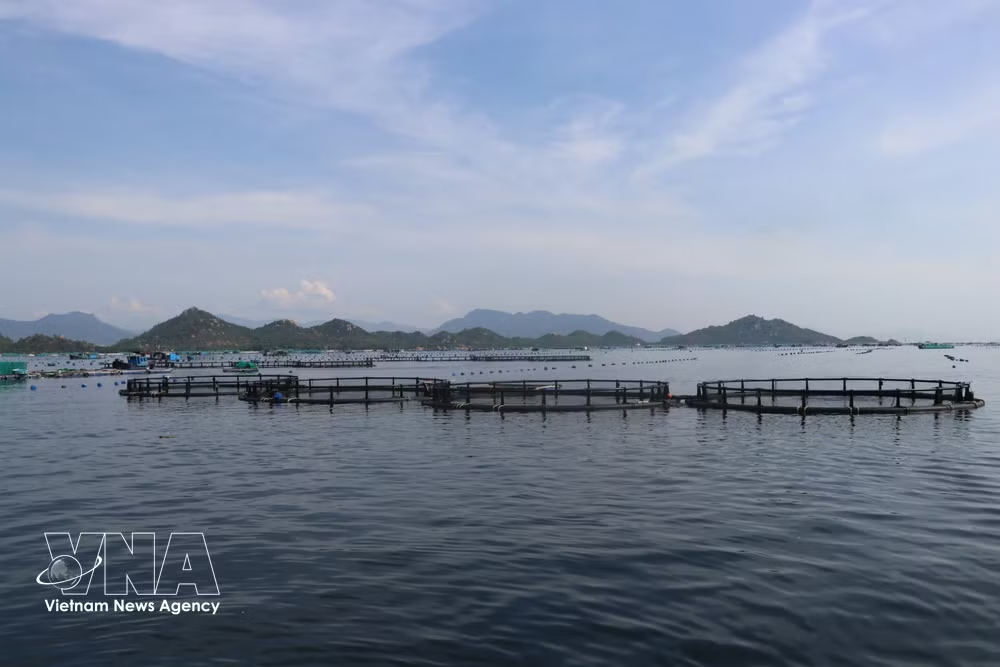
To promote modern marine aquaculture and a strong marine economy, the Khanh Hoa provincial People’s Council recently approved nearly 60 billion VND (2.31 million USD) in support to help local residents replace outdated marine farming cages with high-tech systems.
As a pioneer in AI-powered automation for aquaculture, including automated feeding systems and net-washing robots, STP Group has worked with Phat Co Fisheries Cooperative to develop an aquaculture farm combined with experiential tourism in Quang Ninh city.
Nguyen Thi Hai Binh, General Director of STP Group, said the company is researching and applying science and technology solutions to develop sustainable marine aquaculture while protecting the environment.
Marine aquaculture should be developed within a “multi-layered” marine space and closely linked with science and technology, she said. This approach creates multiple layers of value within the same marine space, from aquaculture and ecotourism to scientific research, environmental education and sustainable livelihoods.
When properly planned and organised, a marine area can generate multiple layers of value within the same space.
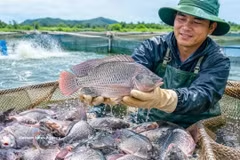
The success of modern barramundi farming systems in Van Phong or the aquaculture and tourism farm on Phat Co Island could serve as models for the future development of Vietnam’s marine aquaculture sector.
Unlocking institutional resources
A review of the implementation of the 2015 Law on Marine and Island Resources and Environment showed that many provisions have proved effective in integrated management of marine and island resources and environmental protection. However, as the country enters a new development phase with greater demands for stronger marine-economy growth, institutional bottlenecks have emerged and need to be addressed.
On August 7, 2026, the Government issued Resolution No. 218/NQ-CP on the action programme to implement Resolution No. 20-NQ/TW on building and developing Vietnam into a strong maritime nation. The programme identifies nine breakthrough groups of tasks for 2026-2030, with a vision to 2045, providing a basis for ministries, sectors and localities to formulate implementation plans.
Associate Professor and Dr Nguyen Huu Dung, Chairman of the Vietnam Marine Aquaculture Association, said that as room for land-based aquaculture continues to shrink, the ocean is the “last field” available to create new growth momentum.
However, Vietnam’s marine aquaculture potential has yet to be fully harnessed, he said. Bottlenecks lie not only in cage technology but also in production organisation. Policies on allocation of marine areas need to become clearer and more stable.
Residents, cooperatives and businesses need a solid, long-term legal basis to invest in modern farming cages, monitoring systems, seed, feed and logistics services. As offshore aquaculture requires substantial investment and faces considerable risks from natural disasters, long-term credit and marine aquaculture insurance are particularly important.
Resolution No. 218/NQ-CP identifies nine breakthrough groups of tasks for 2026-2030, with a vision to 2045. Among them, institutional improvement and reform of national marine spatial planning are identified as foundations for breakthroughs in developing Vietnam into a strong maritime nation.
The Vietnam Agency of Seas and Islands is currently tasked with leading the drafting of amendments to the Law on Marine and Island Resources and Environment, with the aim of institutionalising the major orientations set out in Resolution No. 20-NQ/TW.
Nguyen Quoc Toan, Director of the agency, said the sea is not merely a place for resource exploitation but also a strategic development space for the nation and therefore needs to be managed in a unified, modern and sustainable manner.
New policies will have positive impacts on most marine economic sectors, particularly those requiring stable, long-term access to marine space and involving large-scale investment, such as industrial marine aquaculture./.