Hanoi (VNS/VNA) - The Comprehensive and Progressive Agreement for Trans-Pacific Partnership (CPTPP) is increasingly becoming not simply as a market for selling goods, but as a platform to diversify suppliers, production networks and export destinations amid a restructuring of global trade.
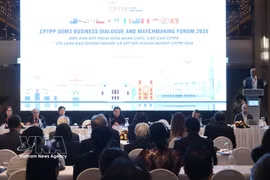
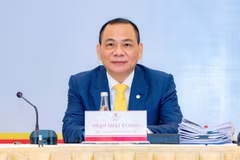
Speaking at a seminar organised by Cong Thuong (Industry and Trade) Magazine on September 28, Ngo Chung Khanh, deputy director of the Multilateral Trade Policy Department under the Ministry of Industry and Trade, said changing trade policies are prompting countries and companies to reassess established supply chains.
“Relationships that were once considered very stable are becoming less so,” Khanh said, adding that differences in policies and trade positions were encouraging countries to seek alternative sources of supply.
Vietnam, with its position as a manufacturing hub in the region, could benefit from this shift as international companies look to diversify suppliers, he said.
The CPTPP, which currently comprises 12 economies, provides Vietnamese businesses with a broader framework for participating in those supply chains, Khanh said. The bloc is also expanding its reach, with countries Costa Rica and Uruguay seeking for membership, while other have expressed interest in joining.
Vietnam’s trade with CPTPP members still accounts for a modest share of their overall import demand, indicating significant room for expansion, Khanh said.
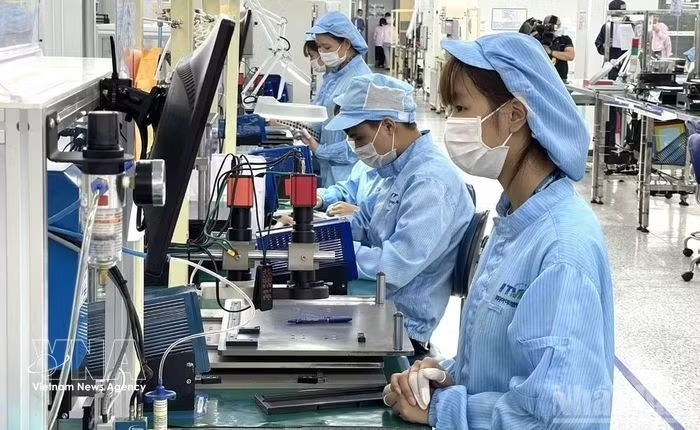
The opportunity extends beyond exports, he said. Companies can use CPTPP markets to source inputs, diversify suppliers and reorganise production networks to reduce dependence on a single source.
“CPTPP is not simply a consumer market. It is also a supply chain,” he said.
Market diversification is not simply shifting from one market to another but requires market research, relationship building and adaptation to individual markets’ standards and regulations, he said.
He urged businesses to strengthen their capacity to comply with rules of origin, labour and environmental requirements in order to qualify for preferential treatment, he said.
At the same time, diversification should not mean abandoning traditional markets, Khánh stressed, urging companies to pursue a balanced strategy with a clear roadmap for developing new markets while maintaining existing ones.
The government is also working to strengthen the implementation of free trade agreements, Khanh said, describing FTAs as an asset for the economy. The focus is on providing information, assessing implementation results and building an ecosystem that connects resources to help businesses make better use of FTAs, he said.
Khanh hoped Vietnam could raise its share of the CPTPP market from currently 1% to around 4-5%.
Nguyen Thi Trang, trade counsellor at the Vietnam Trade Office in Mexico, described market diversification as a long-term strategy, while stressing the importance of businesses developing their own capacity to research and build markets.
Do Thi Thuy Huong, deputy chairwoman the Vietnam Electronic Industries Association, pointed out major challenges includes access to market information, technical standards and the ability to build resilient supply chains.
Huong urged firms to adopt a more proactive approach with focus not only on responding to market demand but on actively developing markets, seeking customers and strengthening production capacity.
Such an approach would help companies turn CPTPP opportunities into sustainable export growth while building the capacity needed to participate more deeply in regional and global supply chains, she said./.
See more
QR payments make Vietnam more convenient for international visitors
International visitors no longer need to rely solely on cash or cards in Vietnam. Singaporean tourists can use LiquidPay, Aleta Planet and DCS DeCard, while Chinese visitors can scan VietQRGlobal codes with WeChat and WeChat Pay.
Ho Chi Minh City sets October 30 deadline for fishing boat tracking system
Ho Chi Minh City has ordered relevant agencies and coastal localities to accelerate installation of the electronic catch documentation and traceability system (eCDT) on fishing boats, with the work to be completed by October 30, 2026.
Vietnam sees high growth prospects
Experts from the Institute of Vietnam and World Economy under the Vietnam Academy of Social Sciences noted the quality of recent growth as the high growth rate has been recorded against an increasingly higher comparative base.
Hanoi steps up targeted investment promotion to deepen global value chain engagement
Hanoi is moving from broad-based investment promotion towards targeted efforts focusing on projects and corporations with strong leadership capacity and potential to create spillover effects. For 2026-2030, it aims to attract 10 multinational corporations to establish executive offices, research and development (R&D) centres, innovation centres or regional service centres, helping build an technology and innovation ecosystem with international competitiveness.
Vietnamese exports face tougher challenges in EU market
Despite the challenges, the EU remains a major market for Vietnamese goods. Two-way trade reached 52.6 billion EUR in the first seven months, up 23.2% year on year. Vietnam's exports rose 26% to 45.6 billion EUR , while imports increased 6% to 7 billion EUR.
Tax policies, investment environment updated for FDI enterprises
Politburo Resolution No. 10 calls for a strong shift from focusing on scale and quantity towards quality, efficiency and added value. It gives priority to projects featuring advanced technologies, modern management, innovation capacity and the ability to participate more deeply in global value chains.
Over 5 billion USD in foreign capital and new challenge for Vietnam’s property market
According to Su Ngoc Khuong, Senior Director of Investment at Savills Vietnam, infrastructure will become one of the key drivers shaping a new development cycle for the property market. Major transport projects are improving inter-regional connectivity and creating new growth poles along economic corridors.
Da Nang steps up efforts to tap Russia, CIS markets
Da Nang welcomed more than 411,000 visitors from Russia and other CIS countries in the first eight months of 2026, up 94.2% year-on-year and accounting for about 5.8% of total international arrivals.
Reference exchange rate down 9 VND at week’s beginning
With the current trading band of +/- 5%, the ceiling rate applicable for commercial banks during the day is 26,914 VND/USD, and the floor rate 24,350 VND/USD.
Vietnam seeks bigger share of global Halal market
Vietnam's Halal exports remain modest at around 900 million USD a year, accounting for less than 1% of the global market. Most exports are still raw agricultural and seafood products. Only around 1,000–1,300 Vietnamese businesses obtained or maintained Halal certification during 2024–2026.
Vingroup sets up new firm, expands into oil and gas sector
Vin Oil&Gas Global operates in the investment and trading of petroleum and oil and gas products.
HanoiTex – HanoiFabric 2026 to take place in October
It will bring together domestic and international textile and garment companies to showcase new solutions in automation, digital transformation and green production.
Cross-border QR payments shift from connectivity to economic value
In the first eight months of 2026, cashless payment transactions rose 34.56% in volume and 13.26% in value year-on-year.
An Giang races to complete infrastructure on Phu Quoc island to serve APEC 2027
Among the key transport and conference projects, the runway expansion at Phu Quoc International Airport has been completed, while the VIP terminal is 96% complete and Terminal 2 is 72% complete.
Removing bottlenecks crucial to offshore wind power development: insiders
Vietnam needs a comprehensive policy framework to remove legal and procedural bottlenecks and create conditions for offshore wind power projects to access long-term investment capital, helping to unlock the country’s substantial offshore wind potential, said insiders.
Vietnam pushes trade as partner country at India's UPITS Show
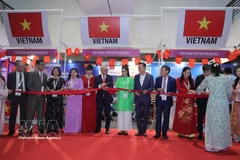
The roughly 100 sq.m Vietnam Pavilion is divided into four sections: fruit, agricultural goods and processed food; industrial and consumer products, leather, footwear and apparel; tourism, aviation and cuisine; and others.
Vietnam among 10 largest non-high-income T&T economies in WEF index
Vietnam, China, India, Indonesia, Malaysia, Thailand, the Philippines, Türkiye, Mexico and Brazil are among the 10 largest non-high-income T&T economies by direct T&T GDP.
Vietnam, US step up investment, financial cooperation
Vietnam hopes US companies, including Coca-Cola, will continue expanding their long-term investment while promoting innovation, supply chains, green transition and greater value creation in Vietnam.
Da Nang international financial centre joins sustainable finance network
Joining FC4S from the early stage of VIFC-DN’s development is expected to help the centre access international experience, standards and best practices in green and sustainable finance, while expanding links with financial centres, institutions and international investors.
Hanoi sets up inter-agency mechanism to operate carbon market
Under a decision of the municipal People’s Committee on establishing an inter-agency working group, departments and agencies are responsible for identifying facilities subject to greenhouse gas inventories, developing emissions-reduction plans and studying projects capable of generating carbon credits.